
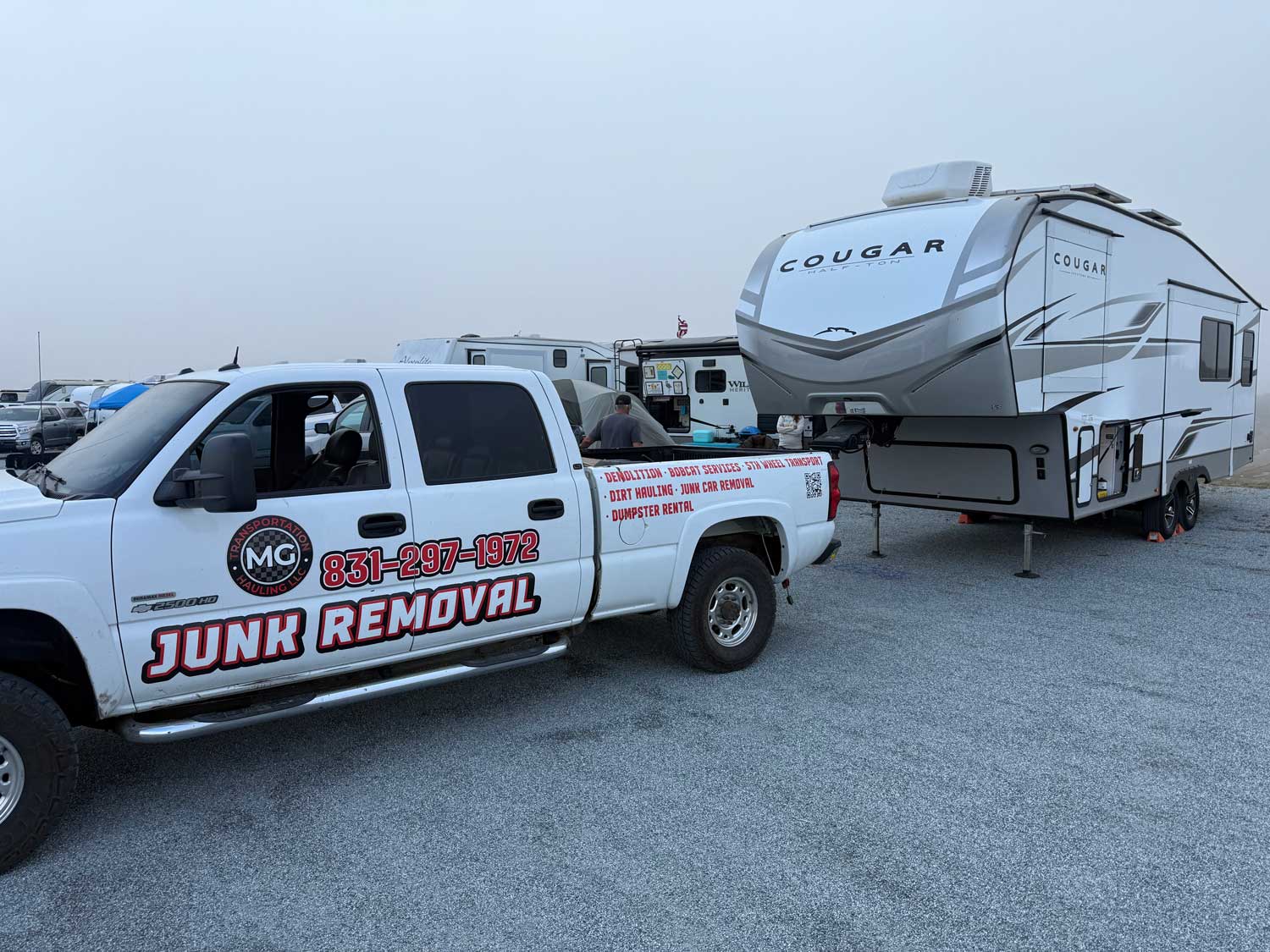
Direct Answer: A low advertised hauling rate usually covers one item or a small slice of a truck bed. Volume, weight, access, and disposal category set the real number.
Most people who call me have already seen a number somewhere. A small advertised rate next to a photo of a clean truck, and a pile in the garage that has been growing since last spring.
The quiet fear is always the same. You book it, a crew shows up, they look at the pile, and the number triples before anyone lifts anything. I hear that worry from Hollister and Gilroy homeowners almost every week.
So let me decode the ad for you. I’ll explain what a low advertised price usually buys, the four things that actually set a price on a local job, and a short list of questions you can run on any hauler, including me.
What’s Included in a Cheap Junk Removal Price
Almost every low teaser rate you see in this industry is priced around one item or a small fraction of a truck bed. It is a starting point, not a job price.
The honest way to read any hauling ad is to ask one question: what size load does that number buy? If the answer is a single mattress or an eighth of a truck, the ad is accurate. It just isn’t describing your garage.
Here is what a low advertised rate typically does include:
- One item, or a small slice of the truck bed
- The crew loading that item for you
- Standard disposal for ordinary household material
- Travel inside the core service area
And here is what gets added once a real pile is in front of the crew:
- Additional volume past that first small slice
- Heavy material billed against weight at the disposal end
- Difficult access like stairs, long carries, or a narrow side yard
- Items with their own handling rules, like refrigerators and freezers
None of that is a trick. It is just the difference between a headline and a job. There’s also a floor on any truck roll, which I get into in why small pickups still have a minimum charge.
The Four Things That Actually Set the Number
When I price a job over the phone or in a driveway, I am running the same four checks every time.
Volume. What fraction of the truck bed does the pile fill? A quarter load and a full load are different jobs, and most people underestimate by about half because clutter is stacked and shaped oddly.
Weight. Household clutter rides light. Concrete, dirt, tile, roofing, and soaked furniture do not, and that changes the math completely.
Access. A pile sitting in an open driveway is faster than the same pile behind a locked gate, up a flight of stairs, or at the back of a long side yard. Labor time is real cost.
Disposal category. Clean wood, mixed debris, metal, mattresses, and appliances with refrigerant each go to different places under different rules. One pile can split into three destinations.
Two jobs with identical piles can land far apart once those four factors land differently. I walked through that in more detail in why two hauling jobs in Hollister can cost completely different amounts.
Weight Is Where a Cheap Price Breaks Down
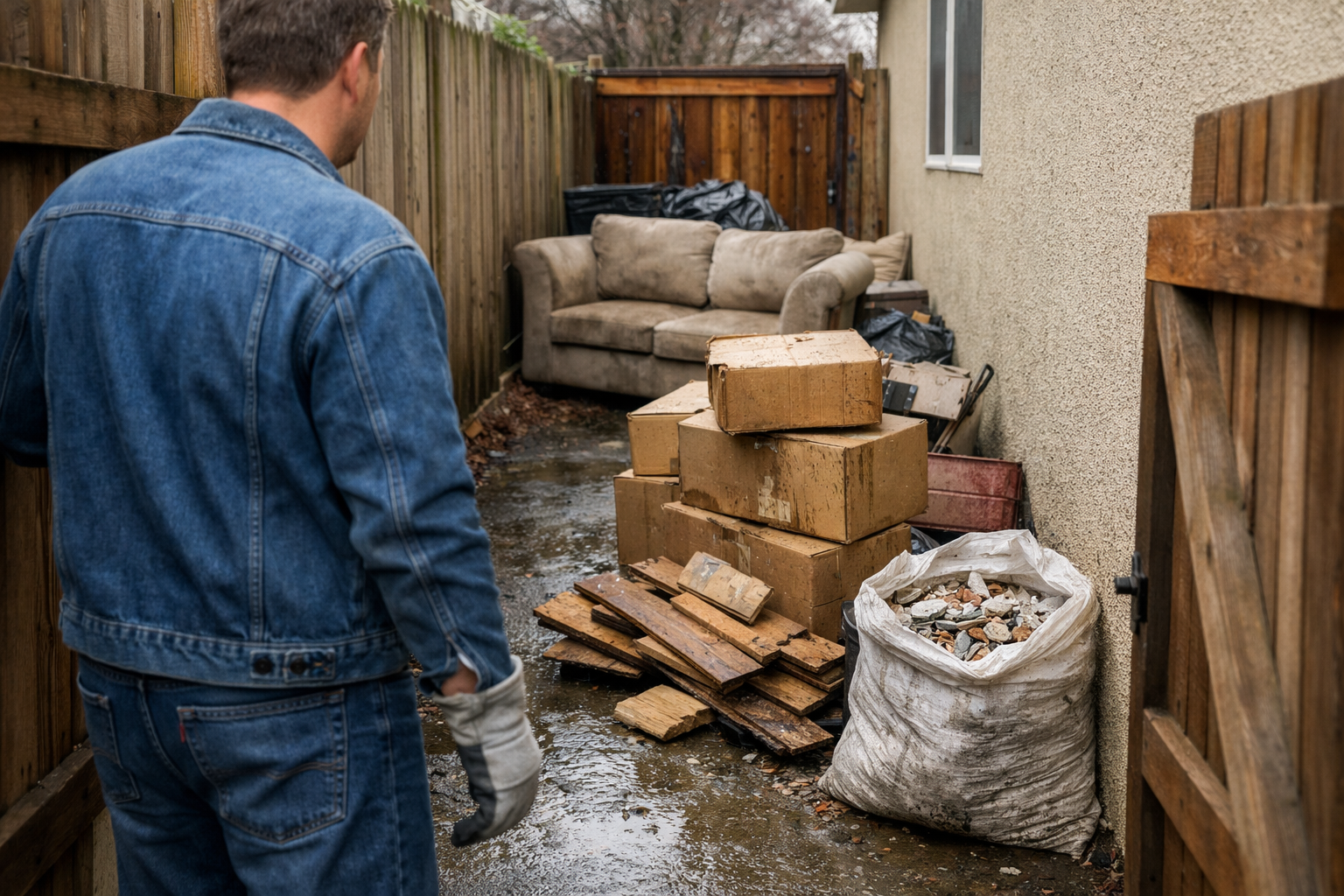
Weight is the factor homeowners never think about, and it is the one that most often separates an ad price from a real one.
Volume pricing assumes household clutter. It stops working the moment the pile includes concrete, dirt, tile, roofing, or waterlogged furniture, because those loads get charged against tonnage at the disposal end. The John Smith Road Landfill east of Hollister prices construction and demolition material by the ton for account customers rather than by the pickup load.
There is a seasonal piece to this that catches people in San Benito County every year. Hollister gets roughly 15 inches of rain annually, and nearly all of it falls between December and February.
That matters for a pile that has been sitting outside:
- Cardboard soaks up water and can double in weight
- Mattresses and upholstered furniture hold rain for weeks
- Untreated lumber swells and gets heavier
- Dirt and sand turn from a volume problem into a weight problem
The same side yard cleanout can price two different ways depending on what’s in it and how wet it is. Moving a job ahead of the December rain is a real cost decision, not a sales line.
I’d also avoid quoting yourself gate fees from memory. Local disposal rates were adjusted in 2026 and they move, so either confirm current rates before you self haul or get a quote that already has disposal built in. The weight question comes up constantly with soil, and I broke that down in clean fill, mixed loads, and why weight sets the price.
How Different Loads Tend to Price
This is a general guide to how material type changes the pricing logic, not a rate sheet. Your own number depends on the actual pile.
| Load Type | How It Usually Prices | What to Ask the Hauler |
|---|---|---|
| Household clutter, boxes, small furniture | By volume, as a fraction of the truck | How much truck space does my estimate cover? |
| Concrete, dirt, tile, roofing | By weight at the disposal facility | Is disposal tonnage included or billed separately? |
| Mattresses and upholstered furniture | By item, with separate handling rules | Is there a per item charge on these? |
| Refrigerators, freezers, window AC units | By item, with refrigerant handling steps | Do you handle appliance disposal in house? |
| Mixed construction debris | Volume plus weight, often sorted | Does the price change if the load is mixed? |
| Full property or estate cleanout | Crew hours plus volume plus disposal | Is this a firm number or an estimate pending a look? |
The Five Question Phone Script
Run these five questions on every hauler you call and two unlike quotes turn into a fair comparison.
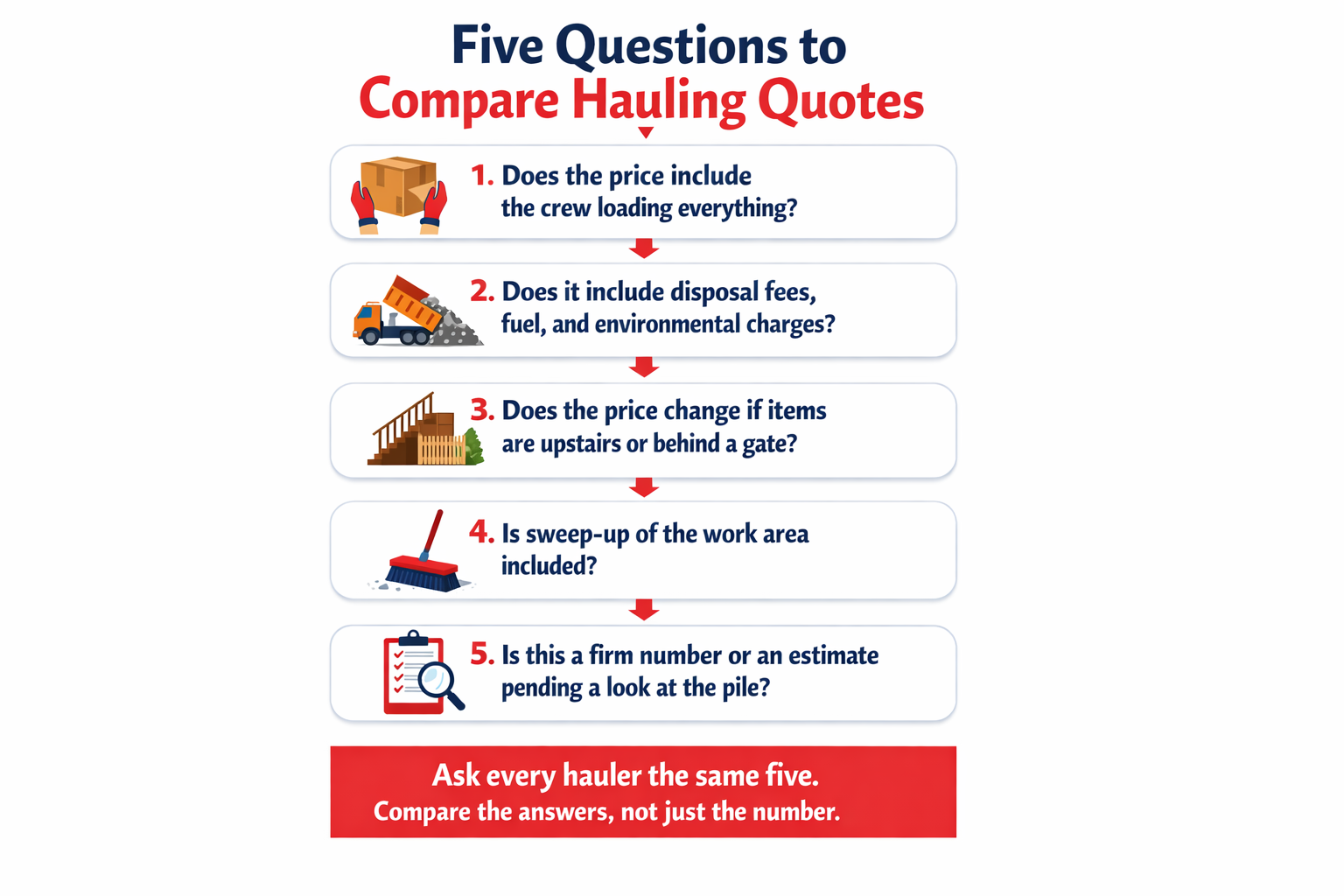
Five Questions That Make Two Quotes Comparable
Most comparison shoppers I talk to have two or three numbers written on a notepad and no idea why they’re so far apart. Usually it’s because the quotes cover different work.
Ask all five of these, in the same order, to everyone you call:
- Does the price include the crew loading everything, or am I expected to have it at the curb?
- Does it include disposal fees and any fuel or environmental charges?
- Does the price change if items are upstairs or behind a gate?
- Is sweeping the work area afterward included?
- Is this a firm number or an estimate pending a look at the pile?
That last one is the most useful. An honest estimate over the phone is still an estimate, and a hauler who says so is telling you how they work.
The loading and the clean up are the two things a cheap ad most often leaves out, and they’re the two things customers notice. One reviewer put it simply: “They disclosed all information upfront and there were no hidden fees.” (Jennifer L.) Another had already shopped the job around before booking: “The price was very reasonable compared to 4 others I checked on.” (Doris R.)
If you want the full breakdown of what that labor actually covers, I wrote it up in what full service actually covers in a junk removal job.
When a Price Is Too Low to Be Real
There’s a flip side to all of this. A quote that lands far below every other number you got usually means one of two things.
Either something is excluded that the other quotes included, or the load isn’t going to a permitted facility. The second one is the problem, because in San Benito County the property owner can get pulled into it.
San Benito County’s waste materials document that illegal dumping on public or private property carries a fine of up to $10,000, and that under California Health and Safety Code section 117555 a person who dumps illegally can face up to six months in jail. You can read the county’s own guidance on the San Benito County Integrated Waste Management resources page.
I’m not naming anyone or accusing anybody. The physics just don’t bend. A load has to end up somewhere legal, and somebody pays the gate fee.
So ask where your load is going. A legitimate answer sounds specific:
- Names the facility or transfer station by name
- Explains how the load gets separated, like metal and green waste versus mixed debris
- Mentions a disposal ticket or receipt
- Doesn’t get vague or annoyed when you ask
That paperwork trail is part of what a fair price pays for. Construction material has its own tightened rules now, which I covered in hauling concrete or drywall to the wrong spot.
If You’re Researching Now and Hauling Later
Most people price this out months before they actually book. Searches for hauling cost across the Monterey and Salinas area sit low through the fall and then jump sharply in January, while the hire-someone-right-now phrasing goes the other direction. January searchers are investigating, not booking.
If that’s you, here’s the order I’d work in:
- Photograph the pile from two angles, with something in frame for scale
- Pull out the heavy material and note it separately: concrete, dirt, tile, roofing
- Note the access path, stairs, gates, and how far the carry is
- Get a look-first estimate instead of a number guessed from a description
One more thing worth knowing. San Benito County residents have access to free bulky item programs and monthly household hazardous waste drop-off days at the landfill, and Recology South Valley runs bulky item pickups on the Gilroy side.
For a few small items, those programs may be all you need. Hiring a crew is a decision about volume, weight, and labor, not the only path available.
Frequently Asked Questions About Cheap Junk Removal Pricing
What’s actually included in a $99 junk removal service?
Typically one item or a very small portion of a truck bed, plus loading and standard disposal. It is a starting rate, not a full-load price. Ask what size load the number covers before you assume your garage fits inside it.
What’s the cheapest way to get rid of junk around Hollister or Gilroy?
For a handful of items, the county bulky item programs and the monthly household hazardous waste drop-off days are hard to beat on cost. Once you’re past a pickup truck load, or the material is heavy, the math usually flips toward renting a dumpster or hiring a crew, mostly because of disposal fees and your own time.
Why does weight change the price if you’re charging by volume?
Because the disposal facility charges by the ton on construction and demolition material. A truck half full of concrete or wet dirt can cost more at the gate than a truck packed full of boxes, so the pricing has to follow the real cost.
Should I wait until spring to do my cleanout?
If the pile is sitting outside and uncovered, waiting usually costs you. Cardboard, mattresses, upholstered furniture and bare lumber soak up winter rain and get measurably heavier. Moving a job ahead of December is a straightforward way to keep the load light.
How do I know a hauler is disposing of my stuff legally?
Ask where the load goes and listen for specifics. A real answer names the facility, explains how the load gets sorted, and mentions a disposal receipt. Vague answers are worth paying attention to, because the penalties for illegal dumping can land on the property owner.
Can anyone take an oversized item other haulers turned down?
Sometimes, yes. We’ve taken on removals that other outfits passed on, including large vehicles and equipment from estate properties. Those jobs come down to equipment, access, and logistics, so photos and measurements up front make a real difference to the answer you get.
Ready to put a real number on your own pile?
We’re a locally run Hollister operation, not a franchise working off a national price sheet, and that’s why the answers you get here are about your actual pile instead of a headline rate. Estimates are free, the crew loads and cleans up as part of the job, and Marcus usually answers the phone and walks through the options himself. If you want your own number for a cleanout anywhere from San Benito County through Gilroy and down into Monterey County, the line is (831) 297-1972 and the quote form is at mgtransportationhauling.com whenever you’re ready.
