
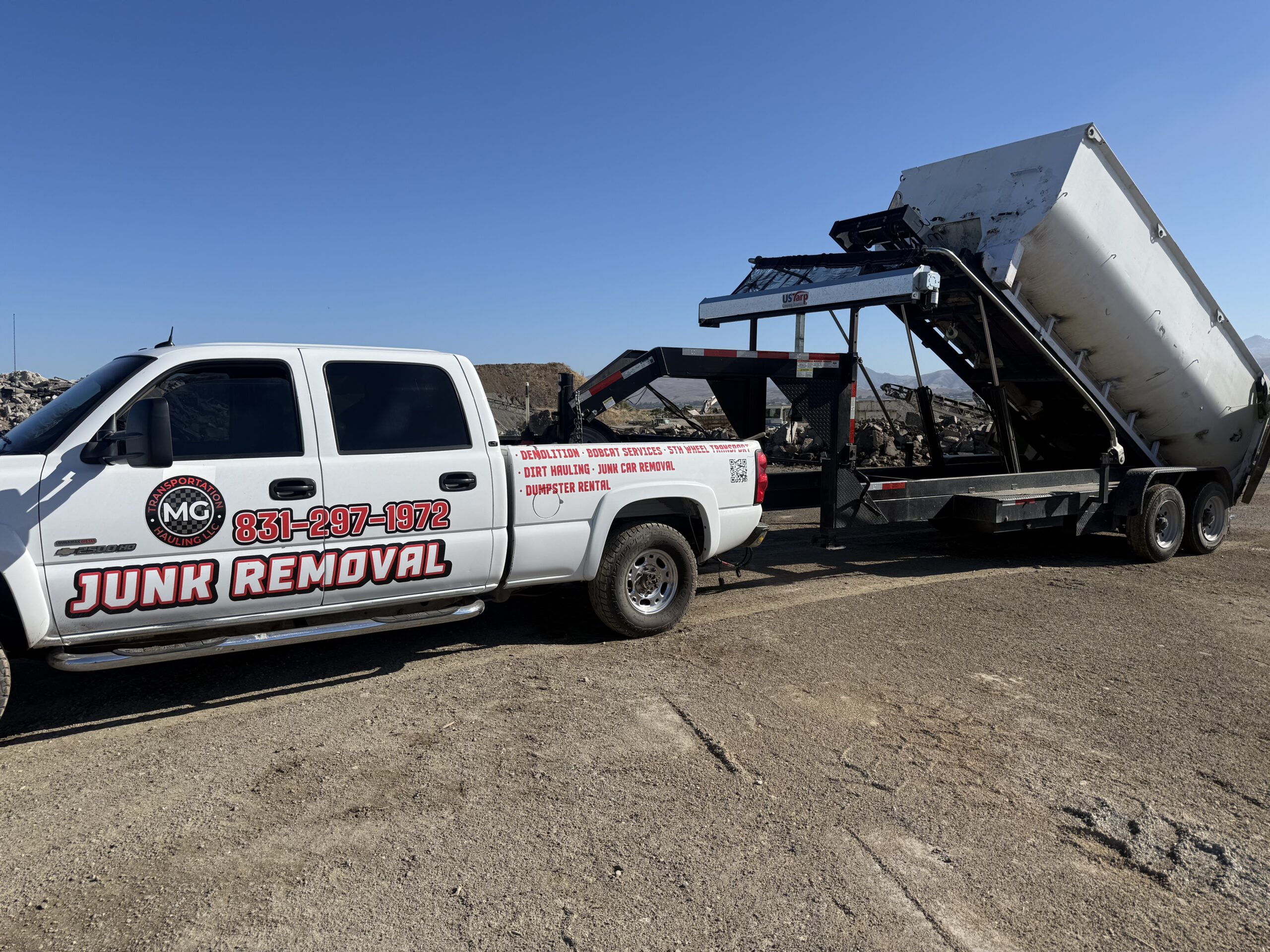
Direct Answer: Full service means the crew does the work. They come inside, load everything that’s going, haul it off, and sweep the area. You don’t lift or move anything.
Almost every hauler in San Benito and Monterey County advertises “full service.” The problem is that customers picture different things when they read it. Some expect a crew that walks into the back bedroom and carries out a broken dresser. Others assume they still have to drag everything to the curb first.
I get this question on the phone constantly, usually from someone in Hollister or Gilroy staring at a packed garage and trying to figure out what they’re actually paying for. It’s a fair question, and a vague answer is how people end up frustrated on job day.
So here’s a straight breakdown of what full service covers, what it doesn’t, and the two or three things worth asking about before you book anything.
So what does full service junk removal actually mean?
The short version: you don’t move anything.
A full service crew shows up, walks the job with you, loads what’s going, and hauls it off. That includes items inside the house, in a back bedroom, up a flight of stairs, behind a shed, or buried at the back of a garage. If it’s on the list and we can safely carry it, we carry it.
That’s the real dividing line between service types:
- Full service haul: crew loads, hauls, and cleans up. Labor is included in the price.
- Curbside-only hauling: you drag everything to the street yourself, and the crew just picks it up.
- Dumpster rental: the container gets dropped, and every bit of the lifting is on you.
All three are legitimate options. They just cost different amounts and demand different amounts of your time. If you’re weighing them against each other, this comparison of dumpster rental versus a full service crew lays out when each one makes sense.
One homeowner told me she’d assumed she had to empty the garage herself before we arrived. She’d already spent a weekend on it. She didn’t have to.
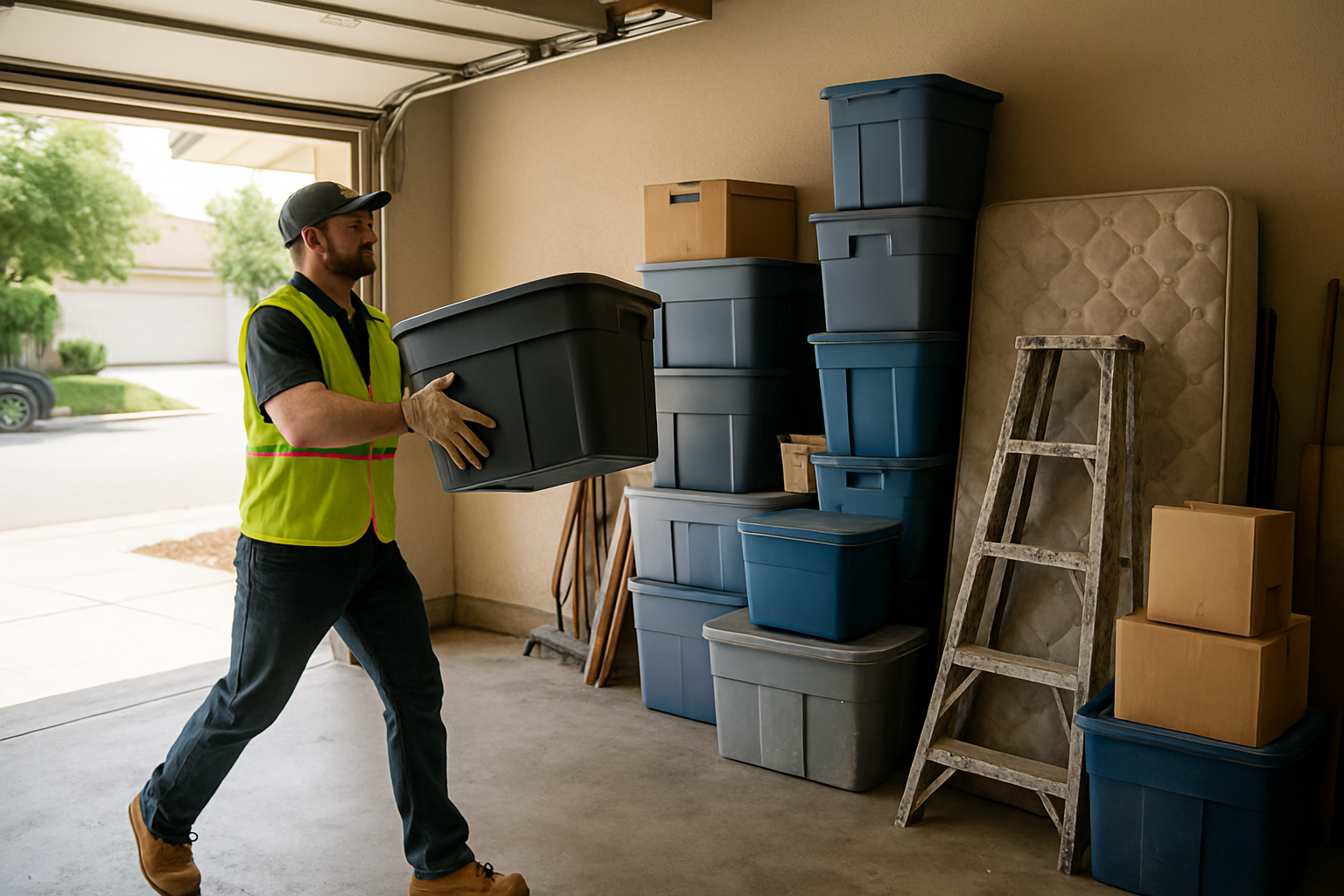
Does the crew clean up after they load?
Yes, and this is the part people are most surprised by.
When you pull twenty years of stuff out of a garage, you’re left with dust, loose screws, cardboard scraps, and whatever was living under the pile. A post-load sweep is part of the job, not a favor. The area should look better than a bare floor covered in debris.
Reviewers bring this up more than almost anything else. One customer in the area wrote that we “went above and beyond to get the job done in a timely” way, and that was a job that ran past dark. Another Hollister homeowner said simply, “Great end result; friendly people, hard workers.”
A few things worth knowing about cleanup:
- Sweeping and debris pickup are standard on residential cleanouts.
- Deep cleaning, carpet shampooing, or sanitizing are not hauling services. Those are separate trades.
- On hoarder or estate jobs, expect the cleanup step to take longer, because the floor underneath usually hasn’t been seen in a while.
If you need the space move-in ready for a tenant, tell the crew that up front. It changes how much time gets budgeted.
What can’t a full service crew take?
This is the conversation nobody wants to have mid-job, so let’s have it now.
Haulers can’t take hazardous household materials. That’s not a preference, it’s how disposal facilities are regulated. Items that need to be routed separately usually include:
- Paint, stains, solvents, and thinners
- Pesticides, pool chemicals, and cleaners
- Motor oil, antifreeze, and car batteries
- Propane tanks and other pressurized cylinders
- Fluorescent tubes and some electronics depending on condition
California treats these as household hazardous waste, and the state maintains a guide to how HHW is handled and where it goes. For San Benito County residents, the county’s household hazardous waste collection events at John Smith Road Landfill cover most of that list. Gilroy residents have their own drop-off program through the county solid waste authority.
My advice: do a 10-minute pre-sort before the crew shows up. Pull the paint cans and chemicals off the shelf, put them in one corner, and tape a note on them. Then nothing gets loaded that shouldn’t be, and nothing gets left behind by accident. If the job is bigger than a garage, this walkthrough on sorting a house before a crew arrives is worth ten minutes of reading.
Included, Sometimes Included, and Never Included
Here’s the quick version of what falls inside a standard full service haul and what sits outside it.
| Included in a standard haul | Ask about it first | Not part of hauling |
|---|---|---|
| Loading items from inside the home | Disassembly of large furniture | Paint, solvents, and chemicals |
| Carrying items down stairs or across a yard | Exercise equipment breakdown | Propane tanks and pressurized cylinders |
| Appliances, mattresses, and furniture | Attic or crawlspace retrieval | Motor oil and automotive fluids |
| Post-load sweep of the work area | Items needing two crews or a second truck | Deep cleaning or sanitizing |
| Hauling and sorted disposal | Anything bolted to the structure | Asbestos or specialty abatement work |
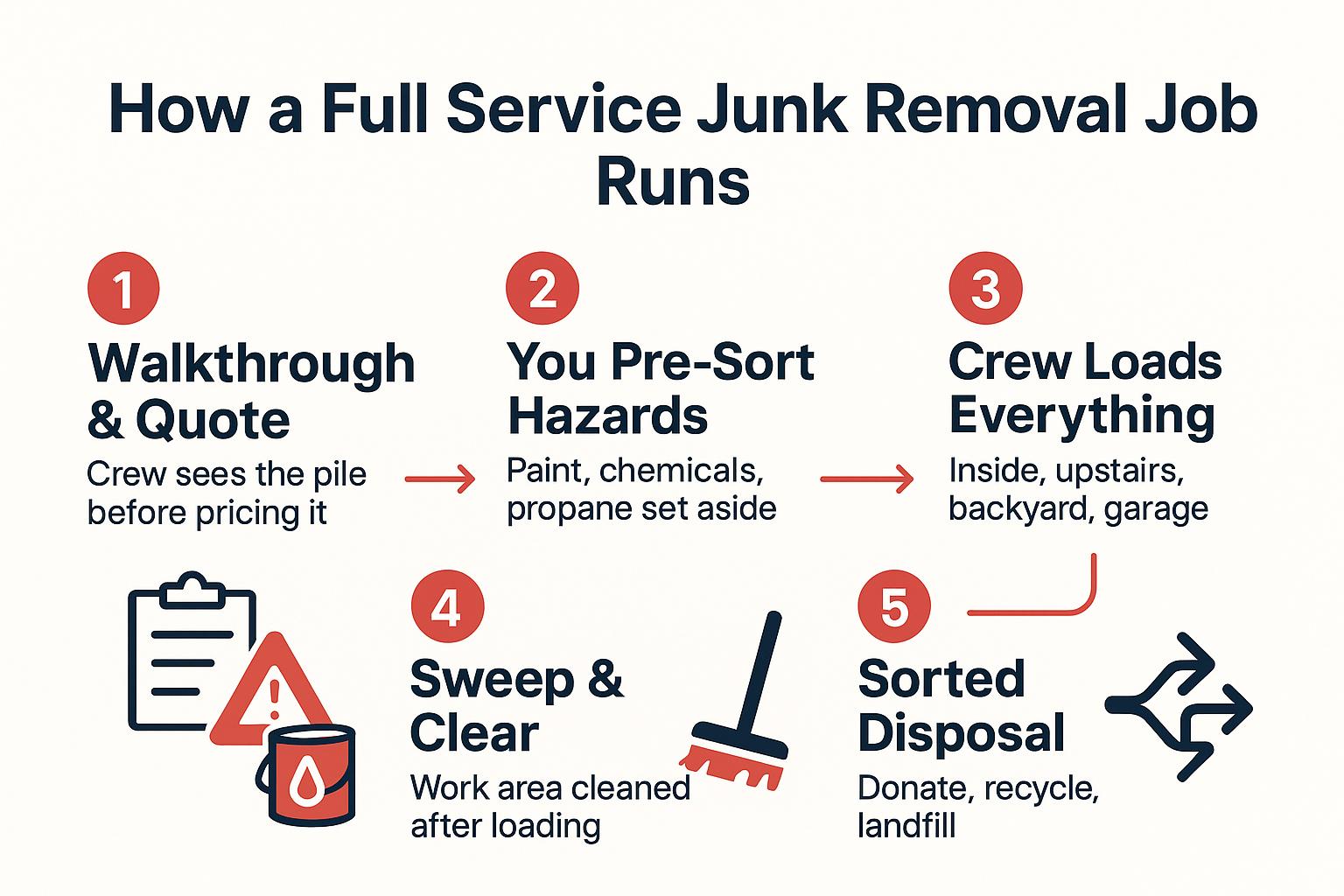
The Full Service Job, Step by Step
This is the order a typical full service haul actually runs in, from the first phone call to the swept floor.
Is taking things apart part of the deal?
Sometimes. This one honestly depends on the job.
A sectional couch that won’t fit through a doorway, a treadmill, a swing set, or a shed frame all take real time to break down. On many jobs that’s folded into the work. On tight-schedule jobs or oversized pieces, it can affect the quote.
Ask specifically when you call. Two questions get you an accurate number the first time:
- Does the price include taking apart the large items, and which ones?
- Are the items inside the house, or already in the garage or yard?
That second question matters more than people expect. Interior work means more trips, more door protection, and more crew time than grabbing pieces off an open driveway. It’s a real driver of what your job costs, along with volume and weight. If you want the full picture on pricing, here’s what junk hauling actually costs around Hollister and what moves the number up or down.
And if the pile is large enough that one truck clearly won’t cover it, large jobs get scoped differently than a single-load pickup.
Where does everything actually go after it leaves my driveway?
This is the question most people don’t think to ask, and it’s the one I’d want answered if I were hiring.
A load shouldn’t just go “away.” It gets sorted into three streams:
- Donation for furniture and household goods still in usable shape
- Recycling for metal, appliances, cardboard, and clean wood
- Landfill for what’s genuinely spent, which for local jobs typically means John Smith Road Landfill or a comparable transfer facility
Metal is the easy one. Appliances, water heaters, and scrap all have a recycling path that keeps them out of the ground. Construction and remodel debris follows its own route, which I’ve written about in more detail in where construction debris goes after a remodel.
Any hauler should be able to explain their routing in a sentence or two. If the answer is a shrug, that tells you something.
Frequently Asked Questions About Full Service Junk Removal
Do I need to be home while the crew works?
For most jobs, someone should be there at the start to point out what’s going and what’s staying, and at the end to confirm. After the walkthrough, plenty of customers go back inside or head to work. For rental turnovers and estate jobs, agents and family members often just leave access instructions and a marked list.
Can you take just one or two items, or is full service only for big jobs?
Single items are fine. A washer, a mattress, a couch, one broken fridge are all normal calls. The per-item cost is usually higher than the same volume inside a bigger load, because the truck and crew time are the same either way.
Will the price change once you see the pile?
A quote given over the phone is an estimate based on what you describe. Once the crew sees it, the number gets confirmed before any loading starts. The gaps almost always come from things nobody mentioned on the call, like a full attic or a shed nobody counted. Describe the job generously and the two numbers match.
How fast can this actually happen?
Same-day scheduling is often available when you call before noon, though it depends on what’s already booked that day. Fall tends to be busier around here as people clear out ahead of the holidays. If you have a hard deadline, like a tenant moving in or a listing photo shoot, say so up front.
What about an old car sitting in the driveway?
That’s a separate service from a household haul, but it’s handled locally too. Junk vehicles get picked up, loaded, and disposed of properly. Several customers have had cars that sat for years finally removed in a single morning.
Still not sure what your job needs?
If you’re in Hollister, Gilroy, or anywhere across San Benito and Monterey County, CA and you want a clear answer on what a haul would involve, a quick phone call usually sorts it out faster than a form. MG Transportation & Hauling handles free estimates at (831) 297-1972, and you can also find details at mgtransportationhauling.com. Describe the pile honestly and you’ll get a straight answer about what’s included and what isn’t.
