
Direct Answer: Junk hauling prices vary because volume, material weight, site access, and landfill disposal fees all change the real cost of a job, sometimes dramatically.
I’ve seen it happen more times than I can count. Two homeowners in Hollister call the same week, both needing a half-truck hauled away, and one pays noticeably more than the other. And at least one of them is confused about why.
The frustration is understandable. If both loads fill the same amount of space, shouldn’t they cost the same? That assumption is at the heart of most pricing surprises in this industry, and it doesn’t hold up once you understand what actually drives the number.
The truth is that volume, weight, material type, and access each play their own role in a hauling quote. Once you know what those variables do, you can read any quote more clearly, and get a more accurate one on the first call.
Volume and Weight Are Not the Same Thing
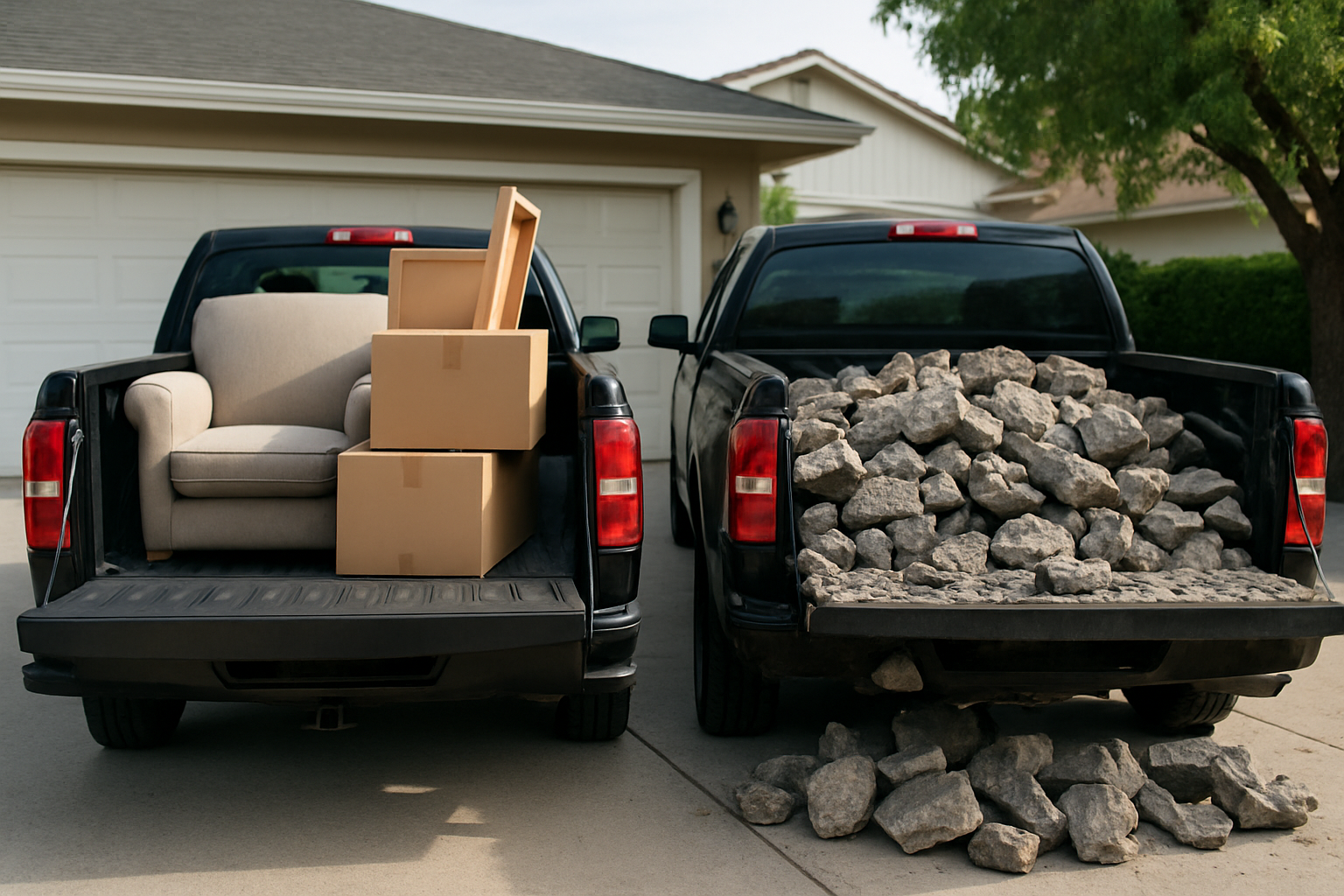
This is the one that catches people most off guard. A customer sees a half-truck of stuff and thinks, “that’s a half-truck price.” But if half that load is concrete pavers, soaked drywall, or broken tile, the cost can be significantly higher than a half-truck of old furniture and cardboard.
Here’s why: the John Smith Road Landfill out at 2650 John Smith Rd in Hollister, which is where a large share of construction and demolition debris from this area ends up, charges by the ton, not by the truckload. That per-ton gate rate is real, and for heavy material, it adds up fast. Any honest hauling quote for demolition debris or renovation waste has that disposal cost built in.
A load of old furniture is light. A crew can move a full truckload and the landfill scale barely flinches. A similar-looking load of concrete or tile can weigh three to four times as much and cost correspondingly more at the gate. For more on what happens once debris leaves your property, this breakdown of where construction debris actually goes explains the disposal chain in plain terms.
The materials that tend to carry the heaviest per-ton costs at disposal:
- Concrete, brick, and masonry
- Soaked or waterlogged drywall
- Ceramic and stone tile
- Roofing material and asphalt shingles
- Dirt and gravel
Light materials, furniture, boxes, clothing, plastic, dispose cheaply by weight. Heavy construction debris does not. That difference gets passed through in every honest quote, and any hauler who doesn’t mention it upfront is probably planning to add it after the fact.
Access Is the Hidden Labor Variable Nobody Mentions
Labor is the other side of the pricing equation, and the thing that changes labor cost more than anything else is site access.
A garage cleanout where our truck can back straight into the driveway is fast. The crew loads in a direct line, nothing gets carried more than ten feet, and the job moves quickly. Compare that to a backyard cleanout where every item has to be hand-carried through a narrow gate, around a parked car, and then loaded from the street. Or a second-floor room where furniture has to come down a tight stairwell.
Time is labor. Labor is cost. A job that takes three hours because of a tricky access situation costs more than a job that takes ninety minutes with a clear path, even if the volume is identical.
When you call for a quote, describing your access situation clearly makes a real difference. The more we know going in, the more accurate the number we can give you before anyone shows up. Things that are useful to mention:
- Whether the truck can get into the driveway or has to park at the curb
- Whether items are in a backyard, basement, or upper floor
- Whether there are stairs, narrow hallways, or gates involved
- How far material needs to be carried before it reaches the truck
For a deeper look at what else affects turnaround time, this piece on what speeds up a same-day haul covers the access question and a few others in detail.
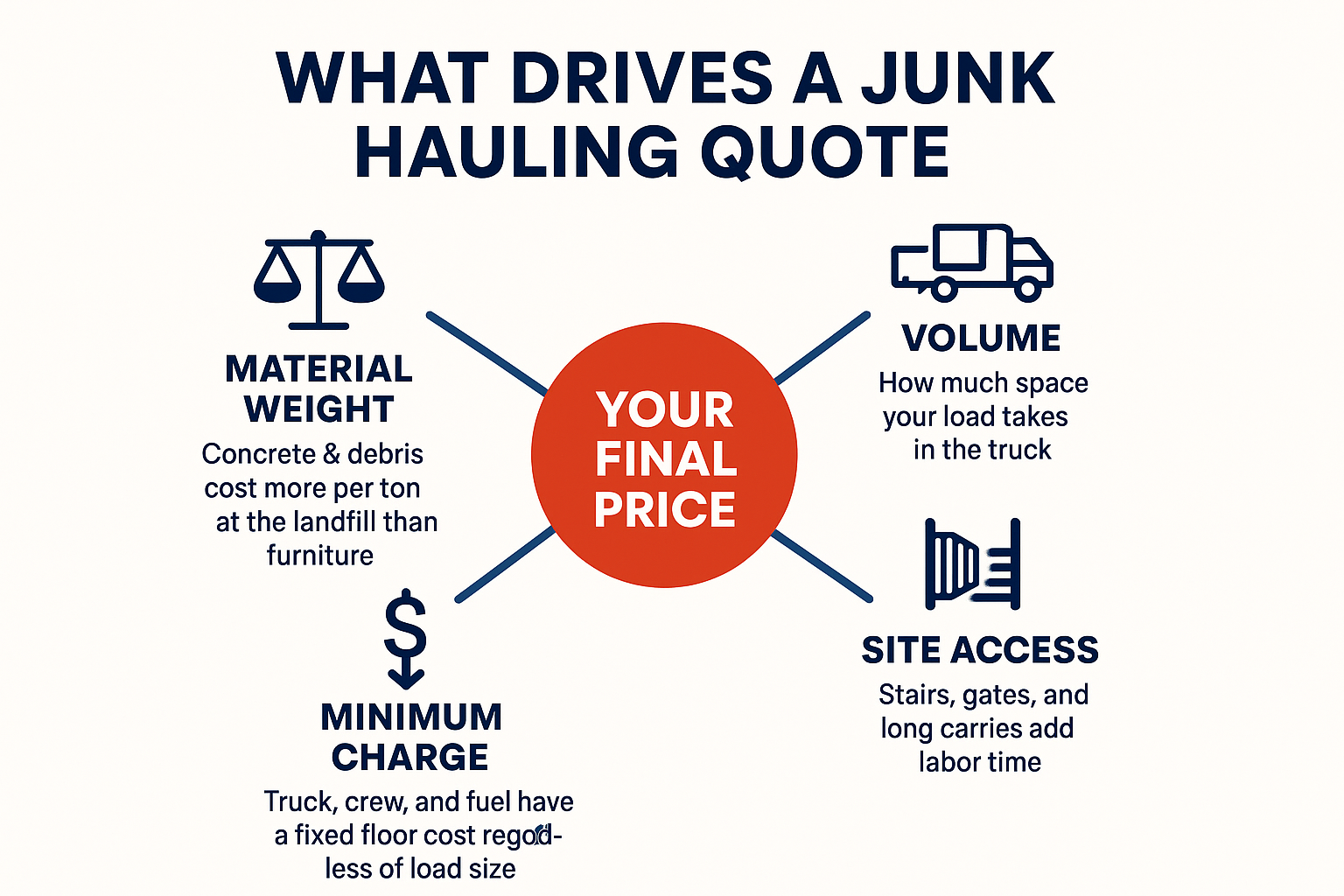
What Actually Drives a Junk Hauling Quote
These four variables show up in every quote we write, and together they explain why two jobs that look similar on the surface can land at very different prices.
Why Minimum Charges Exist (and Why They’re Not Price Gouging)
One of the more common moments of sticker shock comes when a customer wants to remove a single piece of furniture, a couch, a broken recliner, one old dresser, and the quote feels high relative to how little is going.
There’s a real explanation for that. Sending a truck and a crew to any address has a fixed floor cost: fuel to get there, labor for the time on site, and a landfill trip at the end regardless of how light the load is. That floor doesn’t disappear just because the job is small. A minimum charge reflects actual operating costs, not padding.
Once a job gets larger and the truck fills up, the per-item cost spreads across more material and starts to feel more proportional. But for small single-item pickups, customers sometimes find that a different approach makes more financial sense.
If you have multiple days of work ahead, a full garage cleanout, a post-renovation debris pile that will grow as you demo more, a dumpster rental may be a better fit than repeated full-service trips. You pay one flat rental fee, fill it at your own pace, and schedule pickup when you’re done. This comparison of dumpster rental versus full-service junk removal lays out which model makes sense for which situation.
How the Main Pricing Variables Stack Up
This table gives a general sense of how different job characteristics tend to affect the cost of a hauling job in the Hollister area.
| Variable | Lower Cost Scenario | Higher Cost Scenario |
|---|---|---|
| Material Weight | Light household items, furniture, boxes | Concrete, tile, soaked drywall, demolition debris |
| Volume | Small load, partial truck | Full truck or multiple loads |
| Site Access | Truck in driveway, straight load path | Backyard, stairs, narrow gate, long carry |
| Job Size | Large load, cost spreads across more material | Single item, minimum charge applies |
Where Free Bulky Pickup Fits In (and Where It Doesn’t)
A question that comes up regularly, especially from homeowners in Gilroy and San Benito County, is why they should pay for hauling when their waste program offers free bulky item pickup.
It’s a fair question, and the honest answer is: sometimes they shouldn’t. San Benito County residents served by Recology get two free bulky item pickups per year, scheduled curbside. Gilroy customers served by Recology South Valley have their own bulky item program as well. If you have one or two large items and you’re not in a hurry, those programs are genuinely worth using.
But they have real limits. The free programs are curbside only, the driver doesn’t come inside, doesn’t carry items down stairs, and doesn’t clear a whole property. You’re also limited on quantity, and scheduling can mean waiting days or weeks depending on availability.
Where a full-service crew adds value the free program can’t match:
- Loading from inside the home, including upper floors
- Clearing an entire property in a single visit
- Handling mixed loads of furniture and heavier debris in one trip
- Same-day or next-day availability when timing matters
For a more detailed look at where each option makes sense in this area, this guide on free bulky pickup versus hiring a hauler is worth reading before you decide.
The California Department of Resources Recycling and Recovery also maintains information on what materials local programs can and cannot accept, useful if you’re unsure whether your items qualify for curbside programs before you make any calls.
What a Price That ‘Holds’ Actually Means
The most common frustration people bring to our first call isn’t that a previous hauler charged too much. It’s that the price changed between the quote and the final bill.
Jennifer L., a local customer, put it plainly in her review: “They disclosed all information upfront and there were no hidden fees. The billing process was easy and understandable which helped make this a smooth process.” That’s not a high bar, but in this industry, it’s a bar that not everyone clears.
Roberto C. described a similar experience: “Within minutes he gave me a very fair price and was even able to take care of everything the same day.” The word “fair” shows up a lot in how customers describe a good hauling experience, and in practice it almost never means cheapest. It means the number they agreed to was the number they paid.
The way to get a quote that holds is to give as much detail as possible upfront: what you have, how heavy it is, where it’s located, and what the access looks like. The more honest information flows in both directions before the crew shows up, the fewer surprises there are after. If you want to understand more about the gap between an initial quote and a final bill, this article on why junk removal quotes and final bills don’t always match walks through the most common reasons.
Frequently Asked Questions About Junk Hauling Costs in Hollister
Why is my quote higher than I expected for what feels like a small load?
Small jobs still require a truck, a crew, and a landfill run. Those costs have a floor regardless of load size, which is why a minimum charge applies. If the load is genuinely small, it’s worth asking whether a dumpster rental makes more sense if you have several days of work ahead of you.
Does it matter what kind of junk I have, or just how much?
It matters a lot. Heavy materials like concrete, tile, and demolition debris cost more to dispose of because landfills like John Smith Road charge by the ton. A half-truck of furniture and a half-truck of broken concrete look similar in the truck but carry very different disposal costs.
How do I make sure my quote is accurate before the crew shows up?
Describe your load as specifically as you can: what type of material, how much of it, where it’s located, and what the access looks like. Mention stairs, narrow gates, or anything that requires extra carrying distance. The more detail you give, the more accurate the number you’ll get before anyone drives out.
Can I use the free bulky item pickup instead of hiring a hauler?
For one or two curbside items, yes, San Benito County Recology customers get two free bulky pickups per year, and Gilroy has a similar program through Recology South Valley. But those programs are curbside only, limited in quantity, and not available on short notice. If you need items carried out of the house, have a full property to clear, or need it done quickly, a full-service crew is a better fit.
What information should I have ready when I call for a quote?
The more you can tell us, the better. Useful things to have ready: a rough count of what you’re removing, the general type of material (furniture, appliances, construction debris, mixed), whether there are stairs or access restrictions, and your general timeline. If you’re not sure about the material type or weight, just describe what you have and we’ll work through it with you.
Ready to Get a Quote That Actually Holds?
If you’re somewhere in Hollister, Gilroy, or the broader San Benito County area and trying to figure out what a hauling job should actually cost, the best next step is a straight conversation. MG Transportation & Hauling offers free estimates with no pressure and no surprise billing, call (831) 297-1972 or visit mgtransportationhauling.com to tell us what you’ve got and get a real number before any crew shows up.