

Direct Answer: Junk removal quotes change when the actual load is heavier, larger, or harder to access than it appeared during a phone estimate. An on-site quote before work starts is the most reliable way to avoid surprises.
The single biggest fear most people in Hollister and Gilroy have before booking a junk removal job isn’t whether the crew will show up — it’s whether the price they heard on the phone is the price they’ll actually pay. That fear is completely reasonable, because a lot of haulers give you a number before they’ve seen a single item.
One reviewer put it plainly after a recent cleanout: the crew “disclosed all information upfront and there were no hidden fees” — and that was enough to land in a five-star review. The fact that pricing transparency feels remarkable tells you how rarely people actually experience it.
This article breaks down the three variables that cause most of the gap between a preliminary estimate and a final bill — volume, weight, and access — and explains what an honest, upfront pricing conversation actually looks like before any work begins.
Why Phone Estimates Are Almost Always a Guess
Most junk removal pricing starts over the phone, and that’s where the problems begin. A hauler asking “so what do you have?” and then giving you a firm number is essentially pricing a load they’ve never seen.
Homeowners describe their stuff in the most optimistic terms — “just a couch and some boxes” — and haulers who want to win the job quote conservatively to sound competitive. By the time the crew arrives and sees what’s actually there, the number has to change.
There’s nothing dishonest about a phone estimate shifting once someone sees the job in person. But a hauler who gives you a firm quote before seeing the load and then changes it after the work is done — that’s a different problem entirely. The best protection against that scenario is insisting on an on-site quote before anyone starts loading. For more on what a reliable crew’s quoting process looks like, What Separates a Reliable Hauling Crew From a Bad One is worth reading before you book.
The Three Variables That Actually Move Your Price
Once you understand what haulers are actually pricing, the gap between estimate and final bill makes a lot more sense. There are three things that drive almost every price difference.
1. Volume — how much space your load takes in the truck
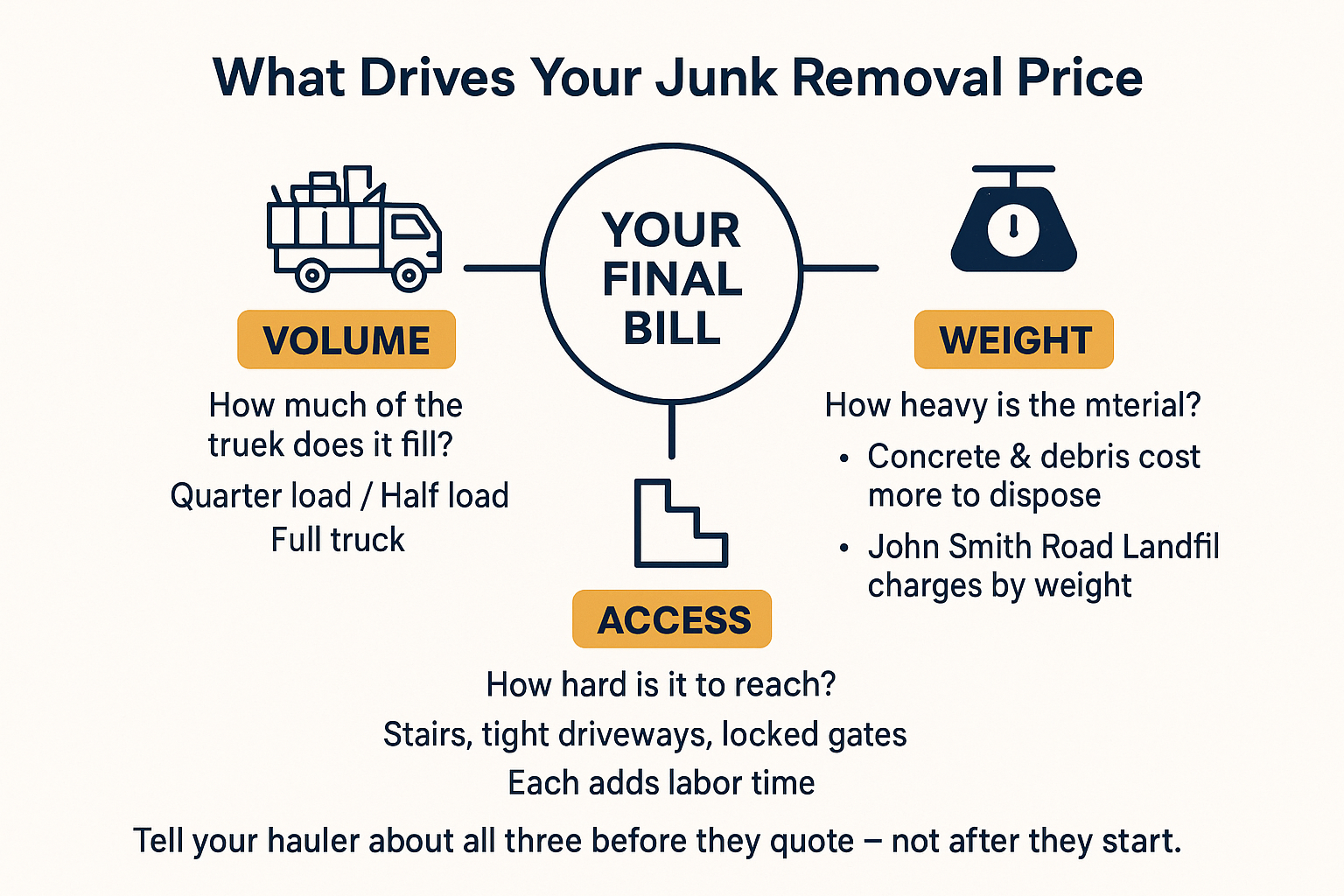
Most junk removal is priced by how much of the truck your items fill. A quarter load, a half load, a full truck — that’s the framework. The challenge is that volume is genuinely hard to estimate from a description. A garage that “looks like a half load” on the phone might actually be three-quarters once the crew starts stacking.
2. Weight — which matters more than most people realize
Two loads can fill the same amount of truck space and still cost very different amounts to dispose of. A couch and a pile of concrete rubble might both take up a quarter of a truck, but at a transfer facility like the John Smith Road Landfill off Bolsa Road in Hollister, weight-based disposal fees apply — and concrete is dramatically heavier per cubic foot than furniture. If your load includes construction debris like drywall, wood, or concrete, the disposal cost can climb even if the truck space doesn’t.
3. Access — how hard it is to actually get to your stuff
Access problems add time, and time adds cost. Common access issues include:
- Narrow driveways that prevent the truck from pulling close
- Items on a second floor that require stairs
- Locked gates or keypad-entry communities that require coordination
- Attic or basement items with tight clearance
- Disassembly required before anything can be moved
None of these are deal-breakers, but all of them affect how long the job takes. A hauler who knows about them before giving a number can price the job accurately. A hauler who finds out mid-job has a harder conversation ahead.

What Drives the Price of a Junk Removal Job
These are the three inputs that determine almost every junk removal quote — and the questions that help a hauler price each one accurately.
When a Higher Bill Is Legitimate — and How to Prepare for It
There are situations where a final bill coming in higher than an initial estimate is completely legitimate. The key is knowing which ones are reasonable and which ones are avoidable.
Legitimate reasons a bill can exceed a preliminary estimate:
- The load turned out to be a full truckload when it looked like three-quarters on the phone
- Heavy materials — concrete, tile, soil — pushed the weight-based disposal fee higher than expected
- Access issues (stairs, narrow path, disassembly) added significant labor time
- A second run was needed because the volume exceeded one truck
For large cleanouts, it’s worth reading Is One Truck Enough for a Large Cleanout? before the job starts — not after.
What you can do ahead of time to get the most accurate number:
- Walk the hauler through the entire job before they quote — every room, every pile, every heavy item
- Mention stairs, tight driveways, or gates upfront
- Be specific about materials: “there’s a broken concrete patio” is more useful than “some outdoor stuff”
- Ask whether disposal fees are included in the quoted price or billed separately
Customers who’ve been burned in the past describe the relief of an on-site quote almost as vividly as the cleanout itself. When a hauler walks your property, looks at everything, and then gives you a number — that’s a number they can actually stand behind. The uncertainty is gone before work starts, not after.
Phone Estimate vs. On-Site Quote — What’s the Difference?
Before booking any junk removal job, it helps to understand what kind of quote you’re actually getting and what it does or doesn’t account for.
| Factor | Phone Estimate | On-Site Quote |
|---|---|---|
| Based on | Your verbal description | Hauler physically sees the load |
| Accuracy | Approximate — subject to change | Much more likely to hold |
| Accounts for access? | Rarely | Yes — stairs, driveway, gates |
| Accounts for weight? | Sometimes | Yes — heavy materials identified |
| Price can change after work starts? | More likely | Less likely |
| Best for | Getting a rough ballpark | Making a real decision |
What ‘Upfront Pricing’ Actually Looks Like in Practice
People use the phrase “upfront pricing” loosely, but there’s a specific thing it should mean: you know the number, you know what it covers, and it doesn’t change once work begins.
Before any crew starts loading, a clear quote should tell you:
- Labor and loading — the cost of the crew’s time on-site
- Disposal fees — what it costs to drop your load at a facility like the John Smith Road Landfill or a licensed transfer station
- Any per-item charges — some materials (appliances, tires, mattresses) carry additional fees at the transfer facility
- What happens if the load is bigger than estimated — will they tell you before they load more, or after?
The customers who describe the best experiences consistently say the same thing: the hauler gave them a price, explained what it covered, and didn’t change it once work started. That’s not a high bar — but based on how often it comes up in reviews, it’s one a lot of haulers don’t clear.
If you want to understand how disposal fees factor into what you’re paying before you even call, What Higher Landfill Fees Mean for Hauling and Vehicle Removal in 2026 breaks that down in plain terms. And if you’re specifically dealing with construction material from a renovation, What Happens to Construction Debris After Your Renovation? covers how that material is handled and priced differently than household junk.
Frequently Asked Questions About Junk Removal Pricing in Hollister
Why did my junk removal price change after I got a quote on the phone?
Phone estimates are based on your description of the load — not what the crew actually sees when they arrive. If the volume was larger than described, the materials were heavier than expected, or there were access challenges like stairs or a tight driveway, those factors add cost that wasn’t visible on the phone. The best fix is to ask for an on-site quote before work begins.
Are disposal fees included in a junk removal quote, or added later?
It depends on the hauler, and this is one of the most important questions to ask before anyone starts loading. Some haulers roll disposal fees into their total price. Others quote labor and loading separately and add disposal at the end. Ask specifically: ‘Is disposal included in this number?’ A straightforward answer is a good sign.
Does it cost more to remove concrete or heavy materials?
Yes — often significantly more than furniture or household junk of the same volume. Transfer facilities like the John Smith Road Landfill in Hollister charge by weight, and concrete, tile, dirt, and similar materials are dense. A quarter truckload of concrete can cost more to dispose of than a half truckload of furniture. If your job involves construction debris, mention it upfront so the quote reflects it.
What questions should I ask before a junk removal crew starts working?
Three questions cover most of the ground:
– Is this a firm price, or an estimate that could change?
– Are labor, loading, and disposal all included?
– What happens if the load is heavier or larger than expected — will you tell me before you add to the truck?
A hauler who answers all three clearly and without hesitation is one you can trust to start work.
How do I know if a junk removal price is fair for Hollister or Gilroy?
Pricing in San Benito County and South Santa Clara County varies based on load size, material type, and how far the haul is from a disposal facility. Rather than comparing a dollar number without context, focus on whether the quote accounts for your specific load — volume, weight, and access — and whether disposal fees are included. How Much Should You Actually Pay for Junk Removal? walks through what drives pricing locally.
Want a Quote That Holds When the Crew Shows Up?
MG Transportation & Hauling serves homeowners, landlords, and property managers throughout Hollister, Gilroy, and San Benito County — and the process starts with a real look at your load before a number gets quoted. Call Marcus directly at (831) 297-1972 or visit mgtransportationhauling.com/ to request a quote and get a straight answer on what your job will actually cost.
