
Direct Answer: In California, TVs, monitors, printers, microwaves and anything with a cord or battery are banned from household trash. They need a separate pile and a separate drop-off or hauler stop.
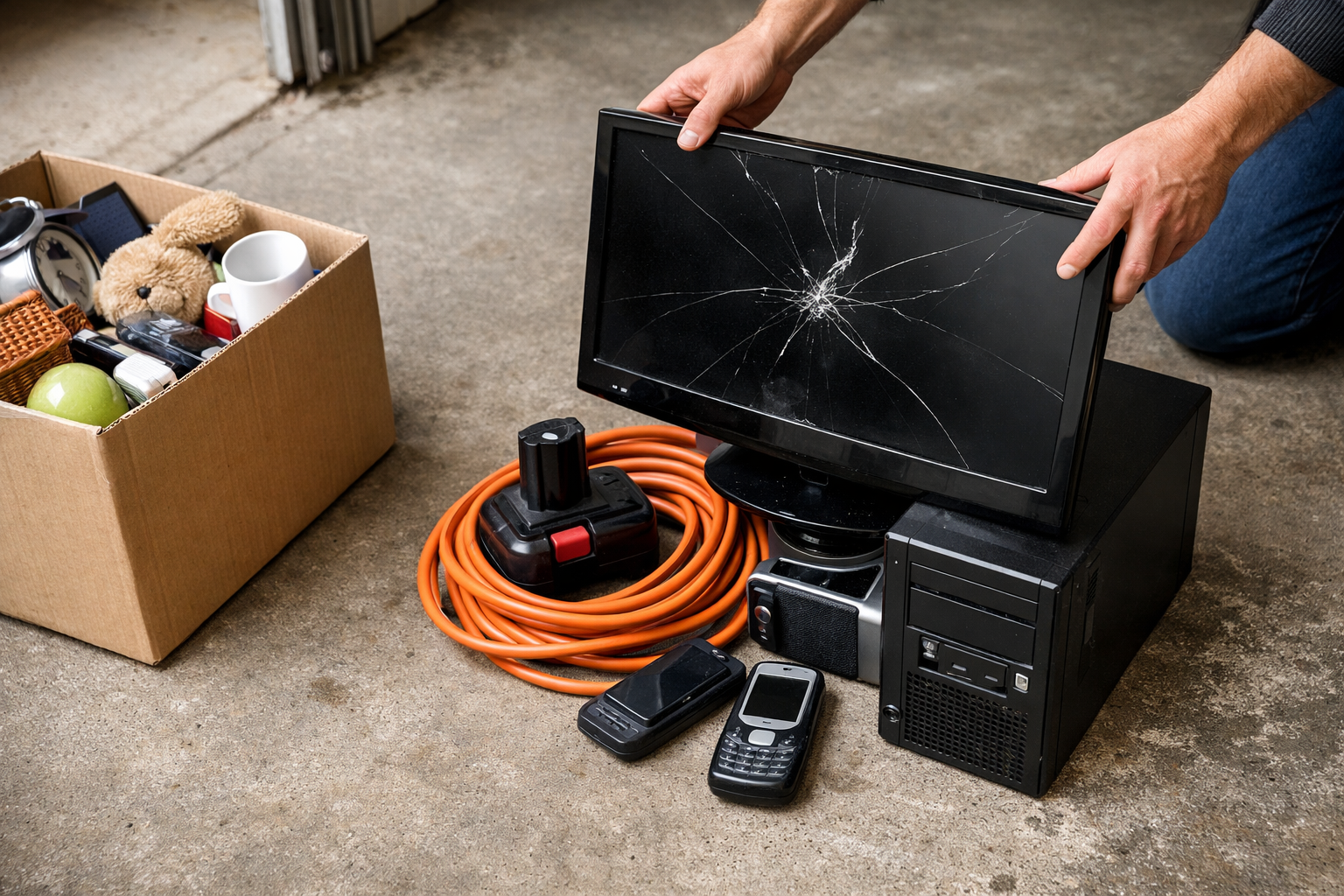
Almost every garage cleanout I walk into has the same corner. A flat screen that got replaced two Christmases ago, a printer that jammed in 2019 and never worked right again, a microwave with a busted door latch, and a tube TV nobody has been able to lift alone since it came off the stand.
Here is the part most homeowners get wrong: none of that is trash in California, and it never has been in your lifetime as a homeowner. The state banned these items from household garbage back in 2006, so that pile was never going to the curb or into a regular bin.
I want to be clear that this is not a problem, it is a routing question. Once you know which pile each item belongs in and where that pile goes around Hollister, Gilroy and the rest of San Benito and South Santa Clara County, you can clear it in an afternoon.
Why Electronics Can’t Go in Your Trash Can in California
The state treats old electronics as hazardous waste because of what is inside the glass and the circuit boards. Lead, mercury, and other metals are the reason your garbage hauler is not allowed to take them.
CalRecycle’s list of waste banned from the trash names the exact device categories most people have sitting around:
- Televisions and computer monitors, both tube and flat screen
- Laptops and desktop computer towers
- Printers, copiers and scanners
- Radios, stereos and VCRs
- Cell phones and tablets
- Microwave ovens
The microwave surprises people every time. It looks like an appliance, it sits next to the toaster, and it still cannot go in the bin.
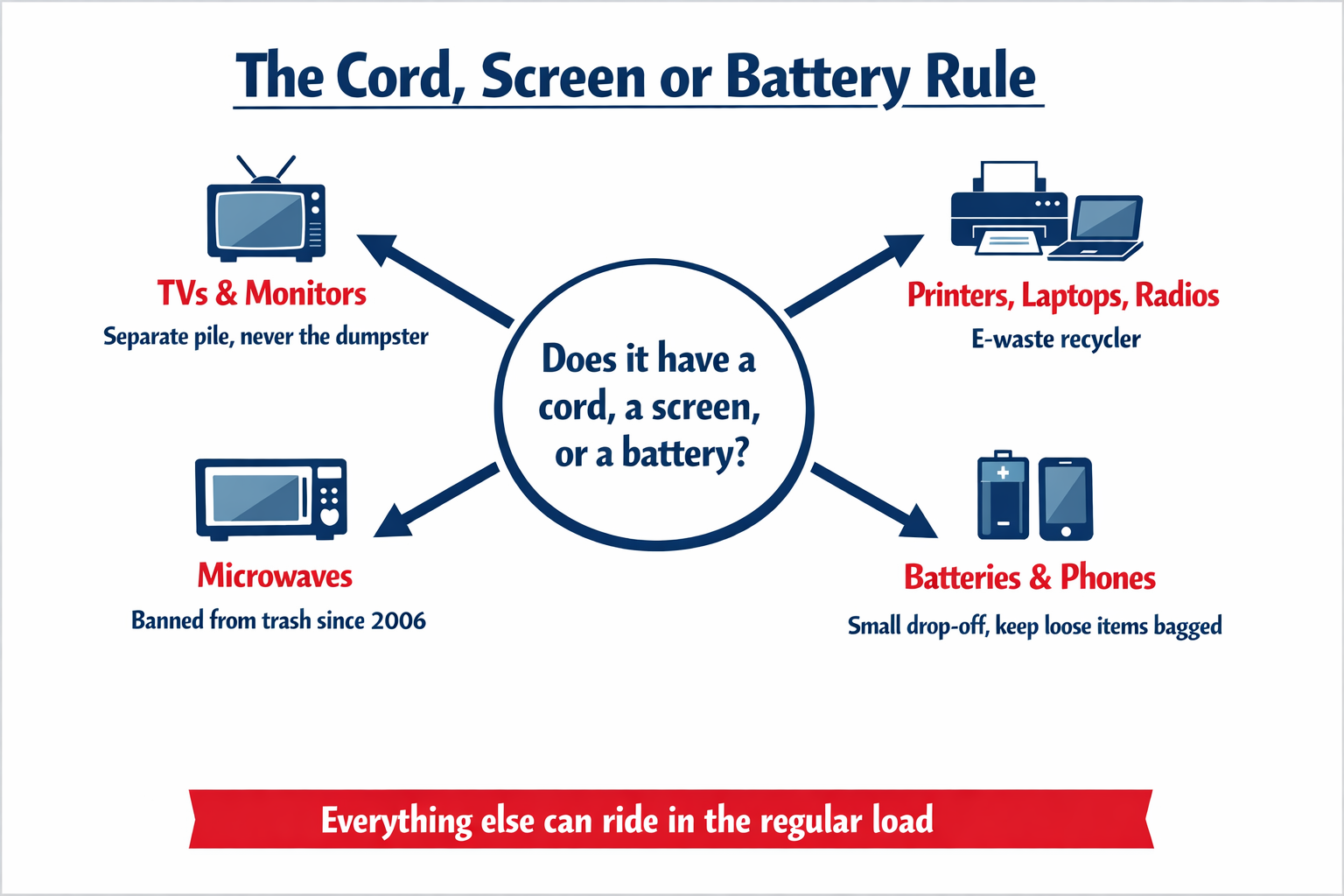
What this means in practice is simple. Anything with a cord, a screen, or a battery gets pulled out of the general pile before anything else happens. That one rule covers almost every item on the banned list without you having to memorize categories.
And it is not just about rules. A tube TV that gets crushed in a packer truck is a mess for the people handling it downstream, which is exactly why the loads get checked.
Where This Stuff Actually Goes Around Hollister and Gilroy
This is the part nobody local bothers to publish, so here it is plainly.
San Benito County runs household hazardous waste collection at the John Smith Road Landfill on the third Saturday of the month, in a morning window, with posted limits on how much one household can bring. The county also holds periodic free bulky item drop-off days that cap the number of items per household and ask for ID at the gate.
On the Gilroy side, the City of Gilroy’s recycling page points residents toward local electronics takers, including a recycler over on Automall Parkway and a big box retailer that accepts most consumer electronics at no charge. The city’s own advice is to call first about restrictions and hours, which is advice I would repeat to anyone.
A few things that save you a wasted trip:
- Call before you load the truck. Hours, dates and accepted items change, and a two minute phone call beats a 25 minute drive out Fairview Road for nothing.
- Check the item caps. Some programs count items, not weight, and a stack of six monitors can blow past the limit.
- Bring proof you live in the county if the program is residents only.
The honest limitation: these household programs are built for a couple of items at a time. If your garage holds a decade of dead electronics plus everything else, you are looking at multiple trips or one garage cleanout handled in a single pass.
Common Cleanout Electronics and Where Each One Goes
Here is how I sort the usual suspects when I walk a property. Fees and acceptance rules change by site, so confirm before you drive.
| Item | Can it go in household trash or a dumpster? | Typical route |
|---|---|---|
| Tube TV or flat screen | No | Certified e-waste recycler or county household hazardous waste day |
| Computer monitor, laptop, tower | No | E-waste recycler, often accepted at no charge |
| Printer, copier, scanner | No | E-waste recycler or retailer takeback program |
| Microwave oven | No | E-waste or scrap metal recycler, not the bin |
| Cell phones, tablets, cordless tool batteries | No | Battery and small electronics drop-off, never loose in a load |
| Refrigerator, freezer, window AC | No | Certified appliance handler because of the refrigerant |
| Couch, mattress, general furniture | Dumpster yes, trash no | Landfill or reuse, depending on condition |
The Five Minute Sort That Keeps You Out of Trouble
Before anything gets loaded into a box or a truck, this is the only sorting rule you need to remember.
Renting a Dumpster Does Not Solve the Electronics Problem
I get calls every month from people tackling a garage or a remodel who figure one old TV buried under drywall will not matter. I understand the thinking. The box is right there and the TV is heavy.
Here is what actually happens. Loads get weighed and inspected at the scale, banned material gets flagged, and the cost of sorting it out or hauling it back lands on whoever rented the box. That is a charge you would not see coming and would have no way to argue.
The fix takes five minutes:
- Pick one corner of the driveway or garage before loading starts
- Everything with a cord, a screen, or a battery goes in that corner
- Load the dumpster with everything else
- Deal with the small pile separately, either a drop-off run or a separate hauler stop
If you want the full picture of what else gets rejected, I covered what can’t go in a rented dumpster in more detail, and refrigerators and window AC units get their own treatment in the dead fridge piece because refrigerant changes the rules again.
What Happens to a Mixed Load After the Truck Leaves
When I look at what people in this area search before they call, nearly every question is about price or about what will not be taken. The one that comes up over and over is some version of “what won’t junk removal take.” Almost nobody asks about speed.
That tells me the real worry is a surprise charge and a vague answer about where everything ended up. Fair worry.
A mixed load does not go to one gate. We split it by destination. Electronics ride to a different place than a couch does, scrap metal goes somewhere else again, and anything still usable can go to reuse. I wrote more about that split in where a cleanout load actually ends up.
So ask any hauler you call one direct question before the job starts: which items on my pile go somewhere other than the landfill, and is that a separate stop? If they can answer without putting you on hold, they have done this locally before.
One of our customers put it this way in a review: “They disclosed all information upfront and there were no hidden fees.” That is the standard, and the question above is how you test for it.
Why Fall Beats January for This Job
There is a practical reason to handle the electronics corner in the next few weeks instead of after the holidays.
Search demand for junk removal around here sits in the low hundreds through fall, then jumps roughly ninefold in January when everyone decides at once to clear the garage. Drop-off events get crowded and crews book further out.
The weather argument matters more. Hollister gets nearly all of its rain between December and February, and July is effectively dry. Electronics sitting in a side yard or an open carport do not survive that stretch. A monitor that a recycler would have taken in October becomes a soaked mess by February, and soaked electronics are harder to hand off to anyone.
October and November are the quiet months on this calendar. A county collection Saturday before the rain starts is an easier morning than a January one. If you are weighing what else should move before the first storm, I laid that out in what to clear before the December rain.
Frequently Asked Questions About E-Waste in a Cleanout
Does it cost money to recycle an old TV or monitor?
Many certified e-waste recyclers in California accept consumer electronics from households at no charge, because the recycling fee was already paid when the device was bought. That said, rules differ by site and some locations charge for certain items or large quantities. Call the specific location before you drive out.
Is a microwave really banned from the trash?
Yes. Microwave ovens appear on the state’s list of devices that cannot go in household garbage. It feels like a kitchen appliance, but it gets routed with electronics or scrap metal.
What if I have 20 electronics, not two?
Household drop-off programs and county collection days are built around a couple of items per visit, with posted caps. Once you are past that, you are looking at repeat trips over several months or one hauler visit where the electronics get pulled and taken to a different destination than the rest of the load.
Can I put a TV in a dumpster if I bury it in the middle?
Don’t. Loads get inspected at the scale and banned material gets flagged, and the sorting or return cost falls on whoever rented the box. Keep anything with a cord, a screen, or a battery out of the box entirely.
What about the loose batteries and cords in the junk drawer?
Batteries, including the cordless tool packs, need their own drop-off and should never ride loose in a load. Cords and cables are generally accepted along with electronics at e-waste recyclers, so bag them together and send them with the rest of the pile.
Sorting out an electronics pile before a cleanout?
A crew working out of Hollister and covering Gilroy, San Benito County and down toward Salinas and Monterey County knows which pile goes where without looking it up, and that routing knowledge is the difference between one trip and three. We’re happy to answer questions about a mixed load or walk a property for an estimate before anything gets loaded. You can reach us at (831) 297-1972 or at mgtransportationhauling.com.
