
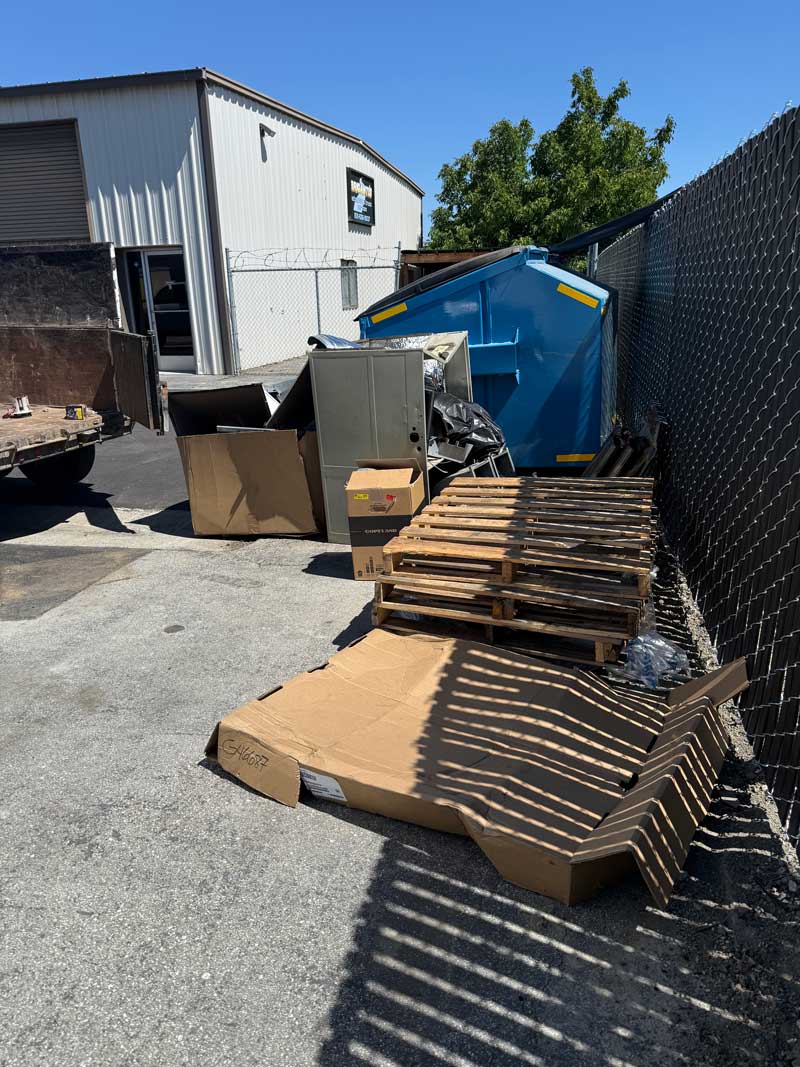
Direct Answer: One truckload goes to several places. Reusable goods get set aside for donation or resale, metal goes to scrap, electronics and appliances get processed separately, and only true trash reaches the landfill.
Most people call me worried about two things: what the job will cost and whether the crew will actually show up. But there is a third question that comes up almost every time, usually quieter and usually near the end of the call.
It sounds like this: where does all of this actually go? Someone clearing a parent’s house in Hollister, or a garage holding twenty years of things, wants to know if the couch gets a second life or if it all goes into a hole in the ground.
That is a fair question and it deserves a straight answer. So here is how a mixed household load gets split up after it leaves your driveway, which categories leave the truck fastest, and which local facilities are involved.
One Truck Does Not Mean One Destination
The biggest misunderstanding I run into is the idea that everything on the truck goes to the same place. It almost never does.
A single load from a bedroom and garage clearout usually gets broken into five or six streams before any of it hits a landfill scale. Some of that sorting happens right in the driveway while we load, and the rest happens at the yard before we make the drop runs.
The basic split on a household job looks like this:
- Reusable furniture and household goods that are clean, dry, and structurally sound
- Scrap metal such as bed frames, water heaters, exercise equipment, old fencing, and metal shelving
- Electronics and TVs, which are handled as e-waste and cannot go in with general trash
- Appliances that hold refrigerant, like fridges, freezers, and window AC units, which need separate processing
- Mattresses and box springs, which have their own recycling path in California
- True disposal material with no other outlet
Who decides? On our jobs, the crew does, while loading. We are pulling metal and electronics out as we go because those categories have a better destination and because they change what the load costs to unload.
What Actually Leaves the Load, and What Stays
People are usually surprised by how much metal comes out of an average house. Between bed frames, a water heater, a dead treadmill, and a pile of old fence posts, metal can be a real share of the load by weight and it has a recycling path every single time.
Electronics go the same way. Old tube TVs, flat screens, monitors, printers, and computer towers all get set aside as e-waste because California bans them from regular trash disposal.
The categories that end up as actual landfill tonnage are more predictable than most people expect:
- Soiled or wet carpet and padding from pet damage, leaks, or long-term storage
- Broken particleboard furniture that falls apart when you lift it, which is most flat-pack furniture after one move
- Wet cardboard and water-damaged boxes that can no longer be recycled
- Mixed, dirty household debris from the bottom of a garage pile
There is a cost side to this too. Disposal is priced by weight and by material category, so a load that is heavy on scrap metal and electronics unloads differently than a load that is mostly soaked carpet and crumbling pressboard.
That is one of the reasons two jobs that look the same size can price out differently. If you want the full breakdown of what moves the number, I wrote about what junk hauling actually costs in Hollister separately.
Where Each Category From a Household Cleanout Goes
Here is the quick version of how a typical mixed load gets routed once it leaves the property.
| Category | Typical Destination | Why It Gets Separated |
|---|---|---|
| Sound furniture, housewares, tools | Donation or resale outlet | Still usable and worth keeping in circulation |
| Bed frames, water heaters, exercise gear, fencing | Scrap metal recycler | Metal has a steady recycling market |
| TVs, monitors, computers, printers | E-waste handler | Banned from regular trash disposal in California |
| Fridges, freezers, window AC units | Appliance processor | Refrigerant must be removed before scrapping |
| Mattresses and box springs | Mattress recycling program | Funded by a statewide fee on new mattress sales |
| Wet carpet, broken particleboard, soaked cardboard | Landfill | No reuse or recycling outlet once damaged |
| Paint, solvents, pool chemicals, batteries, auto fluids | County household hazardous waste event | Not accepted on the truck or in a dumpster |
How One Household Load Splits Up
A visual version of the sorting above, showing the main streams a single cleanout load breaks into.
The John Smith Road Landfill and Why Local Capacity Matters
For San Benito County jobs, the disposal end of the trip usually runs out to the John Smith Road Landfill at 2650 John Smith Road, east of Hollister. Public hours generally run around 8am to 4pm on weekdays with shorter weekend hours, and it is worth checking current hours before you plan a trip.
If you are thinking about self-hauling, know what you are walking into. The site prices material by the ton, or by the yard for smaller trailer loads, and anyone entering the working area is required to wear a hard hat, safety vest, and safety glasses. I have watched plenty of people turn around because they showed up in shorts and sandals with a packed pickup.
Over on the Gilroy side, most residents have access to bulky item pickup through Recology South Valley as part of their regular service, which is a reasonable option for a couple of large pieces rather than a full house.
The capacity question is real here. Local reporting has put the county landfill’s remaining permitted life in the range of a decade or so, and a large expansion proposal was withdrawn in 2024 after heavy public opposition. I covered what that means for local jobs in fewer than 13 years left at the county landfill.
So keeping metal, electronics, and usable furniture out of the pile is not a slogan around here. It is a local math problem.
Paint, Batteries, and Pool Chemicals Do Not Ride Along
This is the clearest example of something that does not go with the rest of the load, and people are often surprised when we set it aside.
We do not haul household hazardous waste, and no dumpster takes it either. The right answer is the county program.
San Benito County Integrated Waste Management holds free household hazardous waste collection events on the third Saturday of each month at the John Smith Road Landfill, roughly 9am to noon. You need proof of residency and there are limits on how much you can bring, so check the details on the county’s household hazardous waste program page before you load the car.
That event is where these belong:
- Leftover paint, stain, and solvents
- Pool chemicals and yard chemicals
- Motor oil, antifreeze, and other automotive fluids
- Batteries of nearly every type
- Fluorescent tubes and CFL bulbs
If you are renting a dumpster instead of booking a crew, the same restrictions apply. I broke those down in what can’t go in the dumpster you just rented.
Mattresses Have a Recycling Path Almost Nobody Uses
Mattresses show up in nearly every bedroom clearout, rental turnover, and estate job I take. And most homeowners have no idea California already built a recycling system for them.
The state funds mattress recycling through a fee collected on every new mattress, futon, and foundation sold here. That fee rose to $18 per unit on April 1, 2026, and it pays for free drop-off recycling instead of landfill disposal.
There is a second piece worth knowing. State law requires retailers to take your old mattress when they deliver a new one, including online purchases, so a homeowner replacing a bed often has a no-cost option they were never told about.
If you are replacing a bed anyway, ask the retailer about takeback before you pay anyone to move the old one. That is free information, not a pitch.
Ask Whoever You Hire This Question First
Before you book any crew, ask them a simple one: which categories do you pull out of my load, and where does each one go?
A local operation that unloads at the same county facility week after week can answer that without stalling. A call center in another state routing your job to whoever is nearby cannot, and that gap tells you a lot about what you are actually buying.
The same goes for pricing. One customer put it plainly in a review: “They disclosed all information upfront and there were no hidden fees.” That is the standard to hold people to on both the money and the disposal side.
One more thing worth saying: this article is about household goods. Remodel and demolition material follows a different set of rules and pricing, and I covered that over in what happens to your renovation debris after the crew leaves.
Frequently Asked Questions About Where Cleanout Items End Up
Can I ask you to donate specific items from my house?
Yes, and it helps to point them out before we start loading. Items that are clean, dry, and still structurally sound have the best shot. Upholstery with stains, water damage, or pet damage usually will not be accepted by any donation outlet, so I will tell you straight if something is not going to make it.
Does recycling more of my load lower the price?
It can affect it, because disposal is priced by weight and by material category. A load heavy on scrap metal and electronics unloads differently than one that is mostly wet carpet and broken pressboard. Size, access, and labor still drive most of the number, so the only way to know is a free estimate on the actual pile.
Why won’t you take my old paint cans with the rest of the junk?
Household hazardous waste is not something we handle, and it is not accepted at a regular disposal site mixed in with general trash. San Benito County runs free collection events on the third Saturday of each month at the John Smith Road Landfill, roughly 9am to noon, with proof of residency required and limits on quantity.
What happens to an old refrigerator?
It gets separated from the rest of the load because refrigerant has to be removed by someone equipped to do it before the metal can be scrapped. It does not just get crushed with the couch.
Do you serve Gilroy and the surrounding areas, or just Hollister?
Both. Our crews work Hollister, Gilroy, San Benito County, and South Santa Clara County, plus surrounding Central Coast communities. Gilroy residents also have bulky item pickup through their regular Recology South Valley service, which can make sense for one or two large pieces.
Want to know where your load would go before you book?
Our crews work Hollister, Gilroy, and the surrounding San Benito, South Santa Clara, and Monterey County, CA areas, and we handle the loading and the cleanup on every job. If you want the disposal side explained before anything goes on the truck, we are happy to walk through it. You can reach us at (831) 297-1972 or at mgtransportationhauling.com.
