
Direct Answer: Your renovation debris gets sorted at the truck. Clean wood, metal and concrete go to recycling facilities. Mixed loads go to a C&D transfer station or landfill and are charged by the ton.
You finish a bathroom remodel or tear out a kitchen, and suddenly your driveway looks like a job site. Broken tile, drywall scraps, old cabinets, a rolled up carpet, and a few paint cans nobody wants to touch.
Most people I talk to in Gilroy and Hollister already know the debris has to go. What they don’t know is where it actually goes once the truck pulls away, and why one load costs more than another that looks the same size.
I want to walk you through the real routing. How a load gets sorted, which materials go where in this part of the Central Coast, what can’t ride along at all, and why the paperwork behind it matters more than you’d think.
Construction Debris Removal in Gilroy Starts With Sorting, Not Hauling
Here is the part most homeowners never see. The sorting decision happens at your driveway, before anything gets loaded.
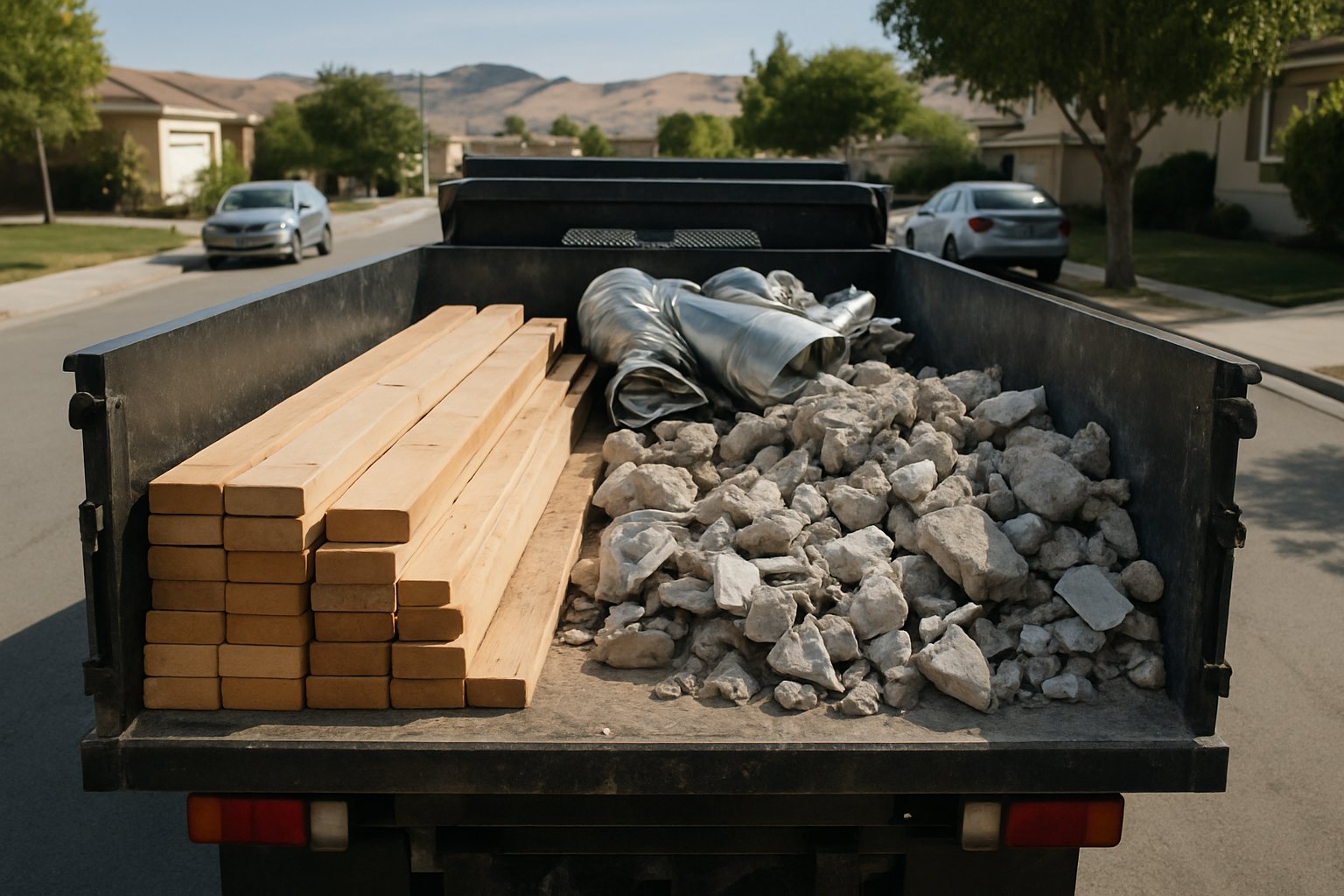
Renovation debris almost never leaves as one thing. A single kitchen tear out can produce five or six different material streams, and each one has a different destination.
A typical Gilroy remodel load breaks down like this:
- Clean wood such as framing lumber, plywood, and trim with no paint or treatment
- Inert material like concrete, brick, tile, and old mortar
- Drywall, which is heavy and often handled on its own
- Scrap metal, including old ductwork, pipe, and appliances
- Mixed debris, meaning everything that can’t be cleanly separated
- Household junk from the cleared rooms, which is a separate category entirely
When those streams get kept apart on the truck, clean loads can go to a recycler. Places like Pacific Coast Recycling on Obata Way in Gilroy or RJR Recycling on San Felipe Road in Hollister take sorted material.
When everything gets thrown in together, that option disappears. The whole load becomes mixed construction and demolition waste and gets routed to a C&D transfer station or to the John Smith Road Landfill, where it’s charged at the C&D per ton rate. If you want the broader version of this, I covered it in where construction debris actually goes after a remodel.
Why Load Composition Drives Your Price More Than Load Size
This is the question I get on almost every remodel call. Two piles look identical, but the quotes come out different. The reason is weight and routing, not volume.
Disposal facilities in San Benito and south Santa Clara County charge by the ton, and the rate is not the same for every material. Mixed C&D typically carries a higher per ton rate than clean, separated material because someone downstream has to do the sorting you didn’t do.
That means a few things for your bill:
- Tile, concrete, and plaster are dense. A small pile can weigh more than a truck bed of cabinets.
- Drywall soaks up weight fast, especially if it sat in the rain.
- Carpet and padding are light but eat truck space, so they drive volume cost instead.
- Contamination matters. One bucket of wet joint compound in a clean wood pile can send the whole stack to mixed.
Rates change year to year, and local tipping fees have been trending up, so I won’t quote you a number in a blog post. What I can tell you is that a small single room tear out and a full kitchen gut land in very different places, and the honest way to price it is to look at the pile.
If you want a deeper breakdown of what moves the number, what junk hauling actually costs in Hollister walks through the cost drivers in plain terms.
Where Each Material From Your Remodel Usually Ends Up
This is the general routing for a residential remodel load in the Gilroy and Hollister area. Facility acceptance can vary, so treat it as a map rather than a rule.
| Material | Typical destination | Effect on your cost |
|---|---|---|
| Clean framing lumber and plywood | Wood recycling facility | Lower rate when kept separate and free of paint or nails-heavy waste |
| Concrete, brick, tile, mortar | Inert or aggregate recycler | Very heavy, but cleaner routing keeps the rate down |
| Drywall scrap | C&D transfer station, sometimes handled separately | Adds significant weight, especially if wet |
| Carpet and padding | Mixed C&D or landfill | Light but bulky, drives volume more than weight |
| Scrap metal, ductwork, appliances | Metal recycler | Often the easiest stream to divert from the landfill |
| Mixed, unsortable debris | C&D transfer station or John Smith Road Landfill | Charged at the C&D per ton rate, usually the highest cost stream |
| Paint, stain, adhesive, solvents | Household hazardous waste program, not the truck | Must be separated before loading |
The Path Your Debris Takes After Pickup
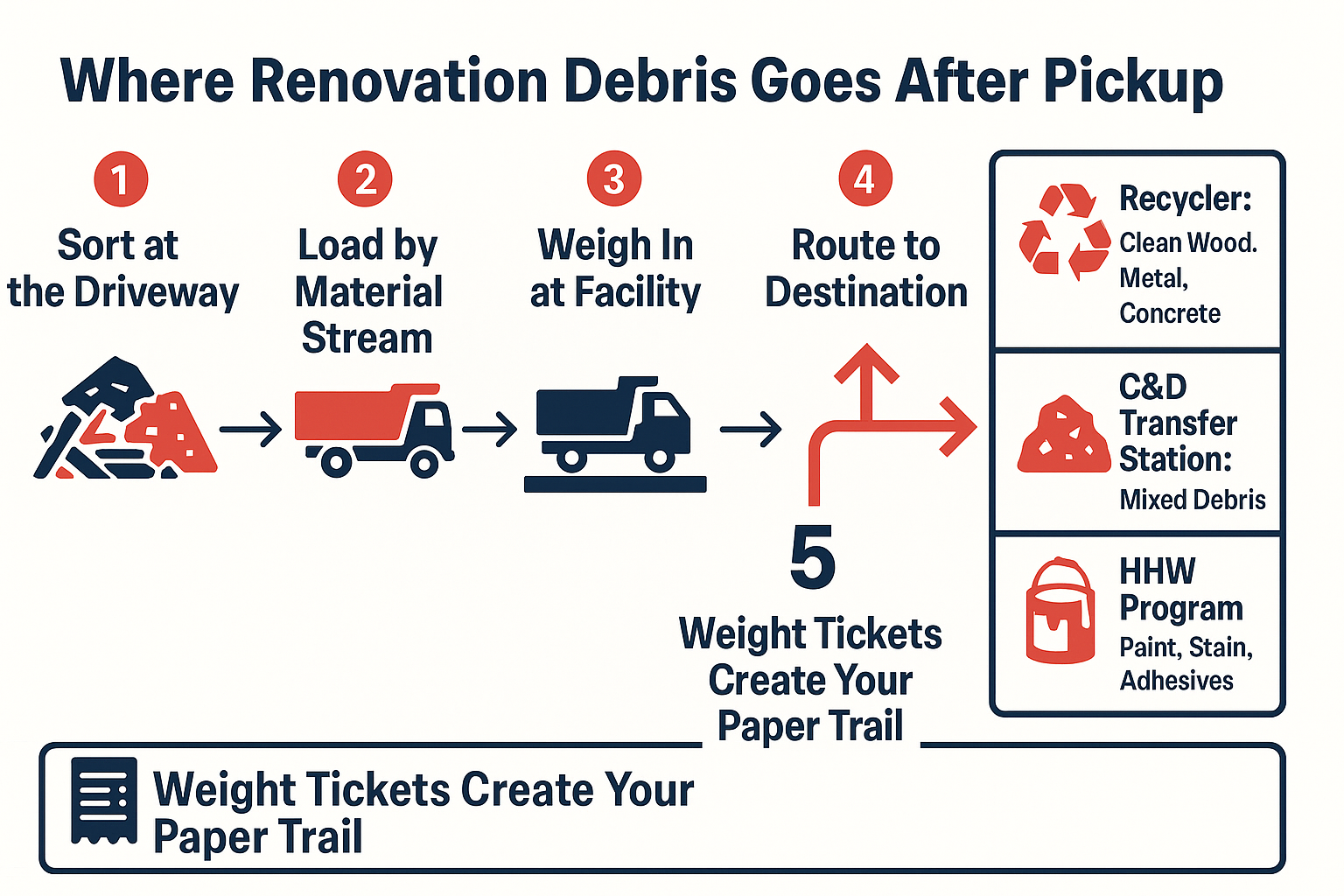
Here is the same routing shown as a simple flow, from your driveway to the final facility.
The Materials That Can’t Ride Along at All
This is where a job goes sideways mid load. A crew is halfway through and finds a shelf of half used paint cans behind the water heater.
A general landfill or C&D facility won’t take certain items, and a hauling crew can’t simply toss them in the truck. The usual suspects from a remodel:
- Paint, stain, and primer, including old cans that are only partly full
- Adhesives, solvents, and caulk tubes with wet product inside
- Some treated or pressure treated lumber, depending on the type
- Certain insulation products
- Automotive fluids and batteries that got stashed in the garage you’re clearing
We do not handle hazardous material, and honestly, no general hauler should tell you otherwise. Those items go through the proper program.
For San Benito County residents, the free household hazardous waste events at the John Smith Road Landfill handle a good portion of this category. Gilroy residents work through Santa Clara County’s HHW program. CalRecycle’s construction and demolition guidance is a solid state level reference if you want to read up on how these streams are classified.
My advice is simple. Before your hauling date, walk the space and pull anything liquid, sealed, or chemical into one corner. Fifteen minutes of that saves an awkward conversation and a delay on the day of pickup.
Why the Paper Trail Matters More Than People Expect
Most homeowners never think about disposal documentation until a building inspector asks for it.
San Benito County and the City of Gilroy Building Division both have C&D waste management expectations tied to certain permits. If your remodel required a permit, closing it out can mean showing where the debris went and how much was diverted from the landfill.
That’s the practical reason to care whether your hauler uses permitted facilities:
- Weight tickets from a facility show actual tonnage, not an estimate
- Diversion records show what got recycled instead of landfilled
- Facility receipts confirm the material went somewhere legitimate
A crew that dumps a load on a back road or on somebody else’s property leaves you holding the responsibility. That’s the legal side, and I wrote about it separately in what you’re responsible for after a remodel.
This is one place where a local operator has a real edge. Knowing which Gilroy and Hollister facility takes which stream, and what each one wants, is not something you can pick up from a national dispatch center.
Frequently Asked Questions About Construction Debris Removal in Gilroy
Do I need to separate my debris before the crew shows up?
You don’t have to, and we sort on site as we load. But separating clean wood, metal, and concrete ahead of time can reduce what the load costs to dispose of, because sorted material often routes to a recycler instead of a mixed C&D rate. If you have the time and space, it’s worth doing.
Can you take a load that has both remodel debris and regular household junk in it?
Yes. That’s extremely common on kitchen and garage projects, and we handle both. The two streams get separated at the truck because they go to different places.
What happens to old appliances pulled out during a remodel?
Appliances are mostly metal, so they usually go to a scrap metal recycler rather than a landfill. Refrigerators and freezers get handled through the appropriate refrigerant recovery process, which is why they are treated differently than a stove or dishwasher.
Is a dumpster cheaper than having a crew haul it away?
It depends on how long the project runs and who is doing the lifting. A dumpster makes sense when debris comes out over several days. A crew makes more sense for a one time pile you want gone by tomorrow. We break the comparison down in more detail in our dumpster versus full service guide.
How fast can renovation debris get picked up in Gilroy?
We schedule Monday through Saturday and same day pickup is often possible when you call before noon, though it depends on crew availability and how big the load is. For a full gut with multiple truckloads, plan on scheduling ahead.
Have a Remodel Pile You Want Gone the Right Way?
If you’re staring at a driveway full of drywall and old cabinets somewhere between Gilroy, Hollister, and down into Monterey County, we’re happy to look at it and tell you honestly what’s involved. Estimates are free, the pricing is upfront, and we’ll explain where each part of the load is headed. You can reach us at (831) 297-1972 or at mgtransportationhauling.com when you’re ready to talk through it.
