
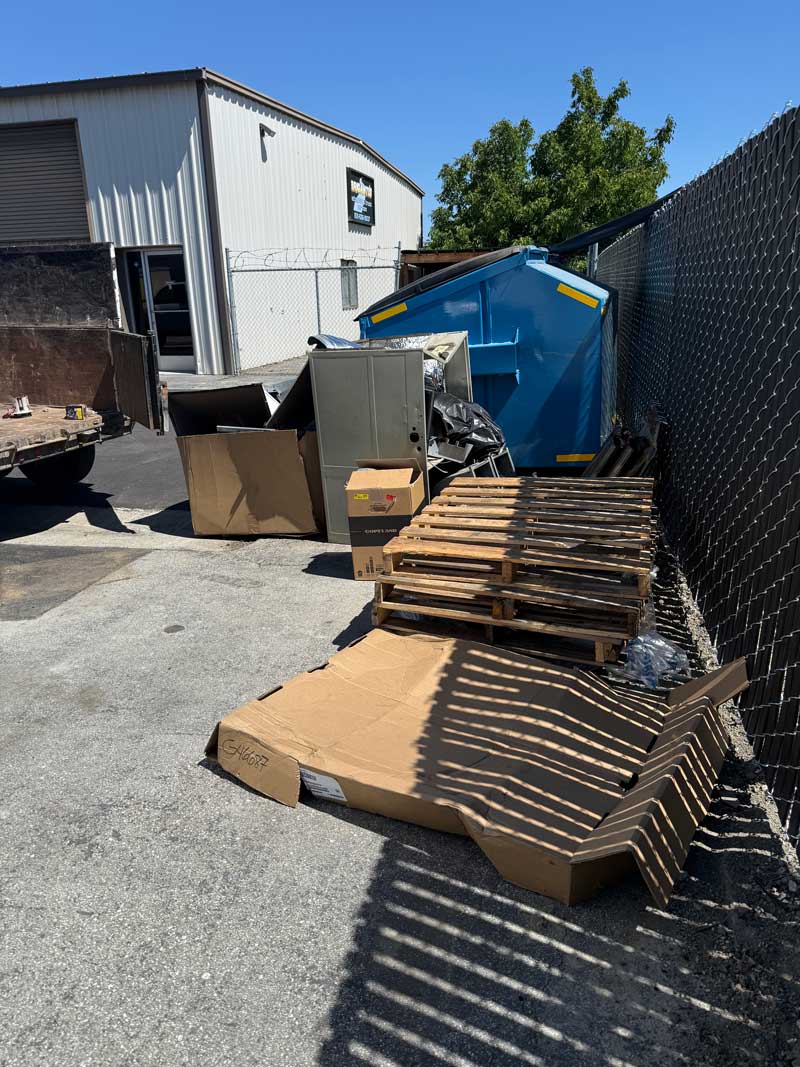
Direct Answer: A roll-off must be loaded level with the walls so it can be tarped. If debris is left over, your options are a swap, a second box, or a crew load.
You spent the weekend clearing the garage. The box is loaded to the top rails, your back hurts, and there is still a pile sitting on the driveway with a tarp thrown over it.
I get this call constantly from homeowners in Hollister and Gilroy, usually on a Sunday night before a Monday pickup. The worry is always the same: is this going to stall the job, and is it going to cost more than the quote.
An overfilled dumpster is a normal, fixable thing. What follows is how the level-load rule actually works, why volume and weight problems are two different animals, and the three honest ways the leftover pile gets handled.
Why a Heaped Box Stops the Truck Before It Starts
A roll-off has to be loaded flat and level with the walls. That is not a preference. The driver has to tarp the load and secure it for the road, and a tarp will not lay flat over a mattress corner or a couch arm sticking three feet above the rail.
So when a box comes in mounded over the top, one of two things happens:
- Material comes back off at the curb before the truck leaves, which means somebody stands on your driveway pulling items out
- The pickup gets rescheduled, which pushes your whole timeline and can extend the rental window
Neither one is dramatic. Both are avoidable with a phone call.
I would much rather hear “it’s a little over the top, what do you want me to do” the day before than roll up to a load nobody can legally move. When we know ahead of time, we can bring the right truck, plan a swap, or send a crew to take the remainder in the same visit.
One thing worth saying plainly: hauling an unsecured load on a public road is on the hauler, not on you. We are not being picky when we ask for a level load. We are keeping the material off Highway 25 and 101.
Two Different Problems: Volume Over the Rails vs. Weight Over the Allowance
People mix these up all the time, and the difference changes what it costs you.
Volume overage is the box stacked above the rails. It is a loading and transport problem. You fix it by pulling material off or swapping the box, and it usually does not add a tonnage charge by itself.
Weight overage is tonnage past the allowance included in your rental. That one sneaks up on you, because dirt, concrete, roofing, tile, and soaked carpet will blow past the limit while the box still looks half empty.
Here is the simple test I give customers:
- If you cannot lay a tarp flat across the top, it is a volume issue
- If the box is sitting low but packed with concrete, dirt, or rain-soaked material, it is a weight issue
- If it is both, call before pickup day and we will sort out which one is driving the cost
I am not going to quote you a tonnage figure here, because allowances and landfill rates move. Disposal costs at the John Smith Road Landfill and transfer sites in the region are not static, and they feed straight into what any hauler can charge. Ask for current rates when you book.
If heavy debris is your real situation, we covered that side in detail in how dumpster weight charges work.
The Three Ways the Leftover Pile Actually Gets Cleared
Once the box is maxed out and material is still on the ground, you have three real options. The right one depends on how much is left, not on what is most convenient for the hauler.
Option 1: Swap the box. We haul the full one off and drop an empty one. This makes sense when what is left is close to another container’s worth, like a second room of a house cleanout or a continuing demo job. Worth knowing: a swap generally restarts a rental window, so you are paying for another cycle.
Option 2: Run a second box alongside the first. On larger demo and full-property cleanouts, two boxes on site beats waiting on swaps. One customer in our area went through multiple dumpsters on a single project, and staging two at once saved days of stop-and-start.
Option 3: Have a crew load the remainder. When the leftover is awkward furniture, a few appliances, and odds and ends rather than another full box, a full-service crew load in one visit is usually the cheaper answer. No new rental cycle, no second drop-off window.
I will say the quiet part out loud: the swap is the bigger ticket. If one truckload clears your driveway, do not pay for a second rental cycle to move it. If you are still deciding between doing it yourself and hiring help, this breakdown of dumpster rental vs. full-service removal lays out both sides.
Picking the Right Fix for What’s Left Over
Use this as a quick gut check before you call. Final cost depends on volume, weight, and access, so treat this as a decision guide and not a price list.
| What’s Left on the Ground | Best Fix | What to Expect |
|---|---|---|
| A truckload or less of furniture and boxes | Full-service crew load | One visit, crew loads and sweeps, no new rental cycle |
| Close to a full container’s worth | Box swap | Full box hauled, empty dropped, rental window typically restarts |
| Ongoing demo or whole-house cleanout | Second box on site | Two boxes staged, less downtime between loads |
| Heavy material only, box looks half full | Call before pickup | Likely a tonnage issue, not a volume one |
| Items the box cannot legally take | Separate handling | Tires, batteries, paint and similar go to their own programs |
The Overfilled Dumpster Decision Path
Here is the same decision laid out as a flow you can follow in about thirty seconds standing in your driveway.
Why You Want This Gone Before the First Real Storm
Hollister gets somewhere around 15 inches of rain a year, and almost all of it lands between December and February. Mid-October through mid-November is the last dependable dry stretch we get.
A tarped pile beside the dumpster does not stay the same weight. Cardboard, upholstered furniture, mattresses, and untreated lumber soak up water fast, and wet material costs more to dispose of because disposal is priced by the ton.
That is how a borderline load turns into an overage charge without you adding a single item. It is also how items that could have been separated and diverted turn into plain landfill material.
On the sorting side, state rules matter here. CalRecycle’s organics collection guidance confirms organic material has to be diverted from landfill disposal, which is why yard waste and untreated lumber in a mixed load get pulled out and routed separately instead of buried. Once that material is soaked and mixed into everything else, separating it gets a lot harder.
If you have demo debris sitting out right now, what it costs you to leave it through the first rain goes deeper on the math.
Filling a Box vs. Packing One
Most overflow is not a sizing mistake. It is a loading mistake, and it is fixable on the next job.
Air is the enemy. A cleanout quietly loses several yards of space to gaps under tables, hollow appliances, and furniture tossed in whole.
What works:
- Put flat, heavy, stackable items on the floor first to build a level base
- Break furniture down instead of throwing it in assembled, especially bed frames, shelving, and tables
- Fill the air pockets inside and under bulky items with bags and small debris
- Keep the top level with the rails as you go rather than building a mound at one end
- Stop and reassess at the halfway mark instead of at the end
One more thing that costs you nothing: ask about swap availability when you book, not when you are standing next to a full box. Knowing the answer up front turns a scramble into a scheduled stop. And if you are not sure how many days you actually need, a realistic rental timeline is worth five minutes before you commit.
Frequently Asked Questions About Overfilled Dumpsters and Leftover Debris
Can the driver just take the load anyway if it’s a little over?
No. The load has to be level with the walls so it can be tarped and secured. A small amount over the rails usually means a few items come off at the curb, which takes a couple of minutes if we know ahead of time.
Does a swap restart my rental period?
Generally yes. A swap is a new box with a new window, so you are paying for another rental cycle. If the leftover is one truckload of furniture and boxes, a crew load in a single visit is usually the cheaper route.
My box is only half full but I’m already over. How?
Concrete, dirt, roofing, tile, and water-logged material hit the tonnage allowance long before they fill the space. That is a weight issue, not a volume one, and it is priced differently.
What if some of the leftover pile is stuff the dumpster can’t take?
Tires, batteries, paint, and electronics have their own handling paths, and county programs in San Benito and south Santa Clara County cover most of it. Set those items aside separately so they do not get buried in the load.
How much notice do you need to deal with an overfilled box?
Call as early as you can. We schedule seven days a week and can often work same-day when you call before noon, but availability depends on the day and the equipment the job needs.
Got a Full Box and a Pile That Won’t Fit?
When one local outfit runs both the roll-off boxes and the crews, an overfilled load is usually a phone call, not a second vendor search. One customer put it simply after a long project: “Great service over multiple dumpsters. I don’t normally leave reviews but seriously impressed and thankfull.” – Matt W. We handle cleanouts and hauling across Hollister, Gilroy, San Benito County, and into Monterey County, CA, and it is always worth asking how swaps and remainder loads are handled before you book anything. Questions are welcome at (831) 297-1972 or mgtransportationhauling.com.
