
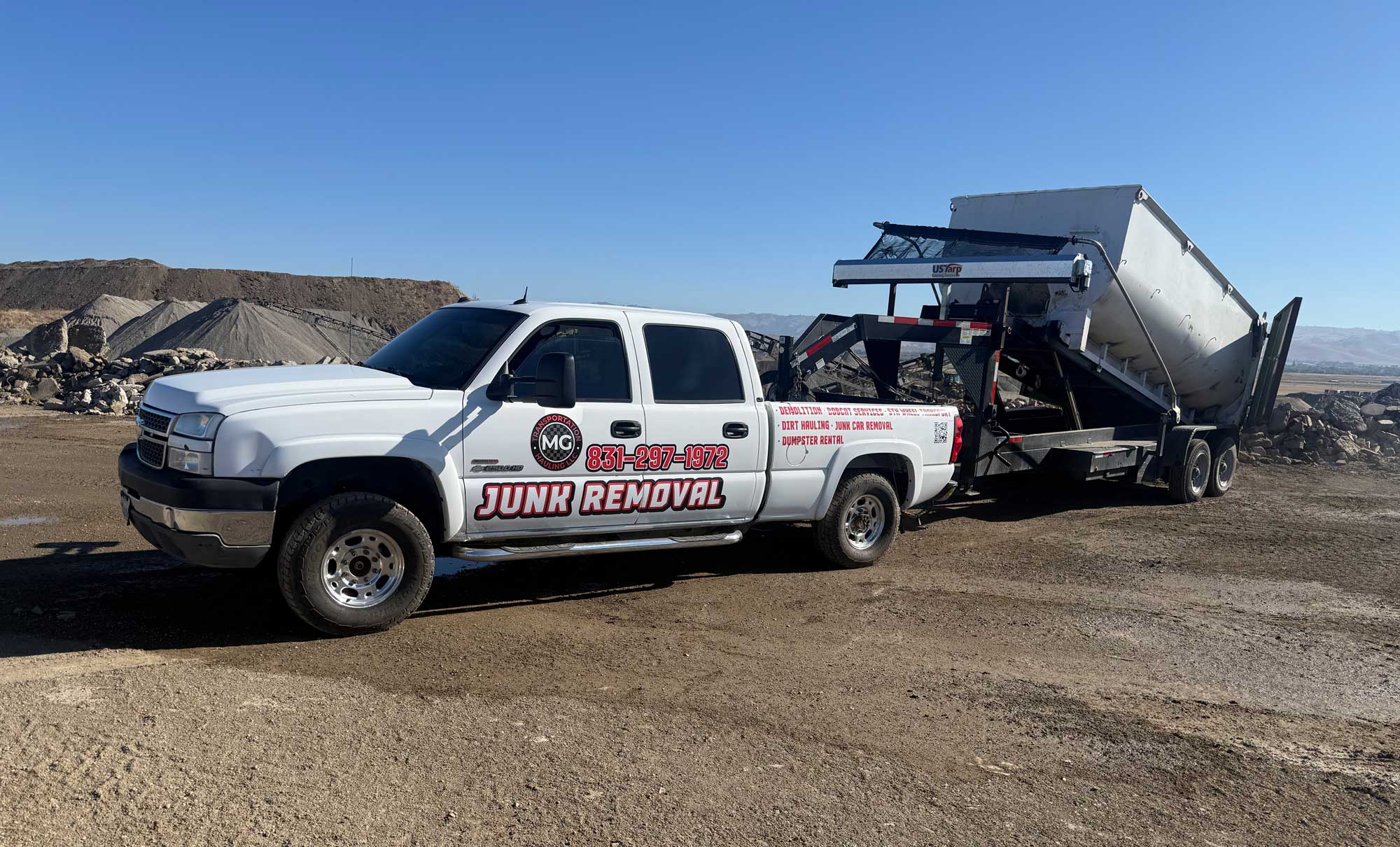
Direct Answer: Whoever generated the debris is responsible for it. Most demo contractors do not include disposal, so the property owner arranges a dumpster or a full-service hauling crew that can sort and legally dispose of it.
The demolition part usually goes smoother than people expect. Walls come down, the patio gets broken up, the old shed disappears in an afternoon. Then everybody stands there looking at the pile.
That’s the call I get most often from homeowners and contractors around Hollister, Gilroy, and out through Monterey County. The demo crew is gone, the next trade shows up Monday, and nobody planned for who actually hauls the mess away.
Here is what I’ve learned doing this work locally: with demolition debris, the type of material matters more than the size of the pile. That one fact changes your cost, your timeline, and who is legally on the hook.
Demolition Debris Is Not Regular Junk, and Local Disposal Treats It That Way
Most people assume debris from a demo project falls under normal junk removal or curbside pickup. It does not, and that assumption creates problems fast.
Residential garbage carts in San Benito County are not meant for construction and demolition material. Concrete, drywall, framing lumber, and roofing all get handled under a separate stream, and stuffing a cart with it usually means the cart doesn’t get emptied.
The transfer stations and landfills that serve our area, including the John Smith Road Landfill outside Hollister, charge based on weight and material type. A truckload of old couches and a truckload of broken concrete are not priced the same, even if they look like the same amount of stuff.
That’s why two demo jobs on the same street can produce wildly different disposal bills:
- Concrete, brick, and dirt are heavy and priced by the ton
- Wood and drywall are light but take up huge volume
- Mixed loads often get charged at the highest applicable rate because nothing is separated
- Contaminated loads can be rejected at the gate, which means paying to haul it right back out
I’ve watched a load get turned away because a few sheets of unidentified material were buried in the middle of it. That’s a wasted trip, a wasted afternoon, and a pile that’s still sitting in the driveway.

The Three Buckets Demolition Material Falls Into
When my crew walks a demo site, we’re sorting in our heads before we touch anything. Almost everything falls into one of three groups.
Heavy inert material. Concrete, brick, block, tile, asphalt, and soil. It’s dense, it’s priced by weight, and it often has its own recycling path that keeps it out of the landfill entirely. Loading it wrong also wrecks trucks, so it usually gets its own load.
Mixed light debris. Drywall, framing lumber, insulation, cabinets, subfloor, trim. Light per piece, enormous in volume. This is where a 25-yard container fills up faster than anyone expects on a whole-room teardown.
Material that needs identification first. Older floor tiles and their adhesive, painted trim from pre-1978 homes, and certain roofing materials can require special handling before anything goes in a truck. We do not do abatement work, and no honest hauler should pretend otherwise.
What we do is stop and flag it instead of loading it and hoping. In older neighborhoods around Hollister and downtown Gilroy, that comes up more than you’d think, and finding out at the transfer station is the expensive way to learn.
If you want more on where all this material ends up, I broke it down in what happens to construction debris after your renovation.
How Different Demolition Materials Get Handled
This is roughly how we sort a demo site before loading. Disposal outcomes vary by facility and by the condition of the material.
| Material Category | Common Examples | Why It Gets Handled Separately |
|---|---|---|
| Heavy inert | Concrete, brick, patio slab, dirt, asphalt | Priced by weight, often has a dedicated recycling path |
| Clean wood | Framing lumber, subfloor, fencing | Can frequently be diverted if it’s free of nails, paint, and treatment |
| Mixed light debris | Drywall, insulation, cabinets, carpet, trim | High volume, low weight, usually a mixed C and D rate |
| Metal | Ductwork, rebar, appliances, pipe | Often recycled separately rather than landfilled |
| Needs identification | Old floor tile, pre-1978 painted trim, some roofing | May require testing or specialty handling before any hauler touches it |
Dumpster on Site or Full-Service Haul After? Both Are Right, Depending on the Job
Contractors running demo for a client have one real problem: the debris has to be gone before the next trade shows up. That timing pressure is where loose disposal plans fall apart.
A dumpster dropped at the start gives you a controlled staging point. Crews toss as they go, the site stays walkable, and nothing piles up on the sidewalk. It works well for phased work that runs several days or longer. Our containers come in 10, 15, and 25 yard sizes, and rentals generally start around $500 for a two-day rental, with the final number depending on size and material.
Full-service hauling after the fact is often faster for demo that moves quickly. We show up with the crew, sort, load, sweep, and leave. Nobody on your team spends a half day dragging concrete across a yard, and there’s no container sitting in a driveway for a week.
A quick way to decide:
- Multi-day project with steady debris flow, go with a container on site
- One-day teardown with a hard deadline, go with a crew and a truck
- Tight driveway, HOA restrictions, or no legal place to set a box, go with a crew
- Heavy concrete only, ask about a dedicated load rather than mixing it
I walk through the tradeoffs in more detail in dumpster rental vs. full-service junk removal, and there’s no universal winner. It depends on how fast your job moves.
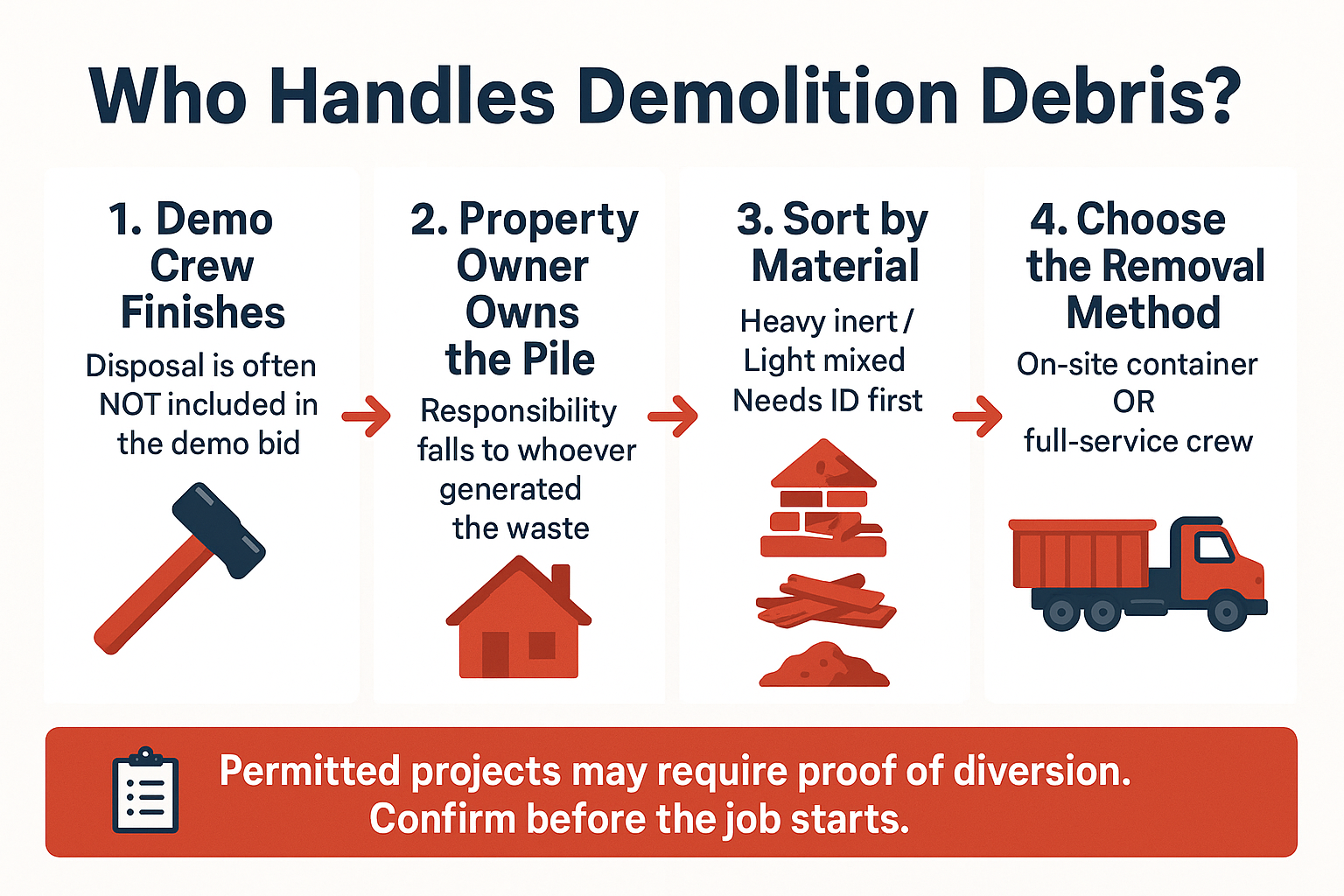
Who Handles What After the Demo Crew Leaves
A quick reference for figuring out where responsibility lands once the walls are down.
Permitted Projects Come With Paperwork Most People Don’t Expect
This is the part that surprises homeowners the most. If your project pulled a permit, the debris may not be a private matter between you and your hauler.
The City of Gilroy Building Division requires construction waste from permitted projects to be managed under the city’s construction and demolition debris recycling ordinance. For some projects, that means you need documentation showing how much material was diverted from the landfill.
On the San Benito County side, Integrated Waste Management administers waste reduction programs under state CalRecycle mandates, which shape how demolition material is supposed to be diverted rather than dumped.
Ask these questions before the first wall comes down:
- Does my permit require a waste management plan or diversion report?
- Will my hauler provide weight tickets and receipts by material type?
- Which local facility is the material actually going to?
A crew that works this county every week already knows the answers. A rotating driver sent out by a national brand usually does not, and you’re the one holding the paperwork gap at final inspection.
If you’re still sorting out who is on the hook, I covered that specifically in demolition debris and who’s actually responsible for removing it.
What Actually Drives the Price
I won’t quote a number on a blog page, because the honest answer is that it depends on what’s in the pile. But the variables are not a mystery.
- Weight, especially with concrete, tile, and dirt
- Volume, which drives the truck or container size
- Sorting time, since mixed debris takes longer to load correctly
- Access, meaning stairs, narrow side yards, and long carries
- Disposal facility rates, which differ by material category
One local customer put it plainly in a review after we finished: everything was disclosed upfront and there were no hidden fees. That’s the standard we hold, and it’s why I’d rather walk your site and give you a real number than guess online.
If you want to understand why estimates and final bills sometimes move, here’s what causes that gap.
Frequently Asked Questions About Demolition Debris Removal
Does my demolition contractor automatically haul away the debris?
Not always. Plenty of demo bids cover the teardown only and leave disposal to the property owner. Ask before you sign whether removal, disposal fees, and diversion documentation are included, because that line item can shift the total meaningfully.
Can I just put demolition debris in my regular trash cart?
No. Residential carts are not set up for construction and demolition material, and overloaded or contaminated carts commonly get skipped. Heavy material like concrete can also damage collection equipment.
What if there’s old tile or painted trim in the pile?
We stop and flag it rather than loading it blind. We do not perform abatement, and material that may need testing or specialty handling has to be cleared before anyone hauls it. That’s a safety issue and a rejected-load issue at the same time.
How fast can debris be off my site?
For many jobs in Hollister and Gilroy we can schedule same day when you call before noon, though availability depends on the calendar and the size of the load. Larger demo cleanups sometimes need a scheduled window so we can bring the right crew and truck count.
Do you separate materials, or does it all go in one load?
We sort as we load. Separating heavy inert material from light mixed debris usually lowers disposal cost and keeps recyclable material out of the landfill, which also helps if your permit requires diversion records.
Planning a Demo Project on the Central Coast?
If you have a teardown coming up anywhere from Hollister and Gilroy down through Monterey County, it’s worth sorting out the debris plan before the first wall comes down rather than after. We handle both container drop-offs and full-service demo cleanups, and we’re happy to walk a site and talk through which one fits your timeline. You can reach us at (831) 297-1972 or at mgtransportationhauling.com when you’re ready to compare options.