
Direct Answer: AB 2310 amends Penal Code 374.3 effective January 1, 2027. It makes transporting debris to dump it a crime, raises the maximum fine to $5,000 for a fourth or later violation, and reaches property owners.
Someone quotes you half of what everyone else did. They show up in a pickup, throw your busted patio concrete and drywall scraps in the back, take cash, and drive off. You feel like you won.
Then a county code officer finds that pile in a ditch off a rural road, digs through it, and finds a piece of mail or a permit card with your address on it. Now it’s your problem, not theirs.
A new state law makes that scenario a lot more expensive starting January 1, 2027. I work cleanouts and demo debris jobs around Hollister, Gilroy, and across into Monterey County, and this is the change I’d want a homeowner or landlord to understand before they hire anybody.
What the California illegal dumping construction debris law changes in 2026
The bill is AB 2310 (Carrillo). It appears in the Governor’s legislative update dated September 30, 2026, and it amends Section 374.3 of the Penal Code, the state’s illegal dumping law.
Here’s what it does, in plain terms:
- It makes it a crime to transport waste, rocks, concrete, asphalt, dirt, or other construction debris for the purpose of dumping it. The hauling itself is now part of the offense, not just the drop.
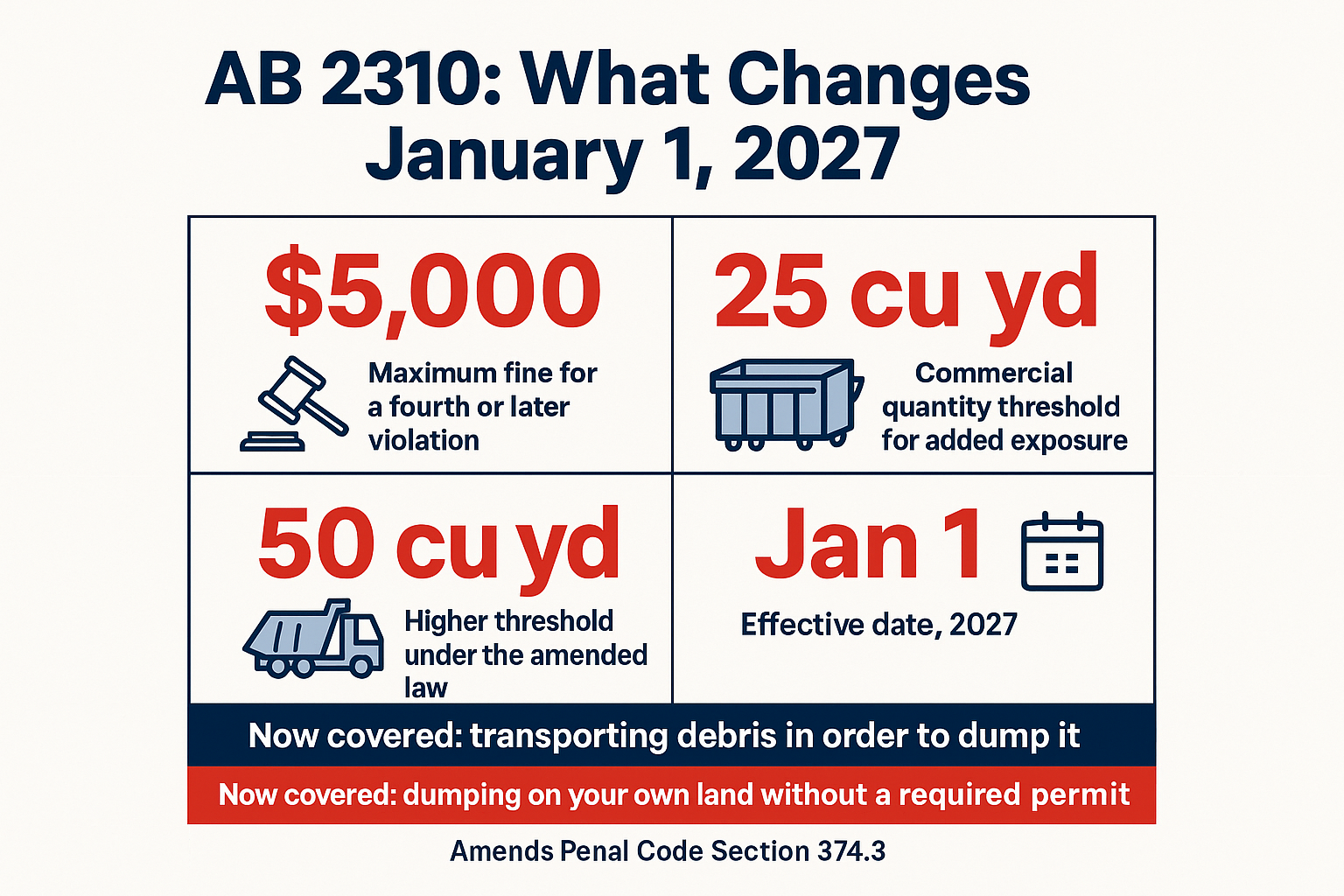
- It raises the maximum fine to $5,000 for a fourth or later violation.
- It adds escalating misdemeanor and felony exposure for commercial quantities over 25 cubic yards and over 50 cubic yards.
- It closes a loophole so people can be prosecuted for dumping, or allowing dumping, on property where a state or local permit or license was required and was not obtained. That includes land you own.
You can read the bill text yourself at California Legislative Information. The Rural County Representatives of California also flagged it as it moved through committee in April 2026, specifically calling out the consequences for landowners and transporters moving more than 25 cubic yards.
For scale, 25 cubic yards is roughly one of the larger roll-off dumpsters. That’s a kitchen gut or a small slab tear-out. It is not an exotic amount of material.
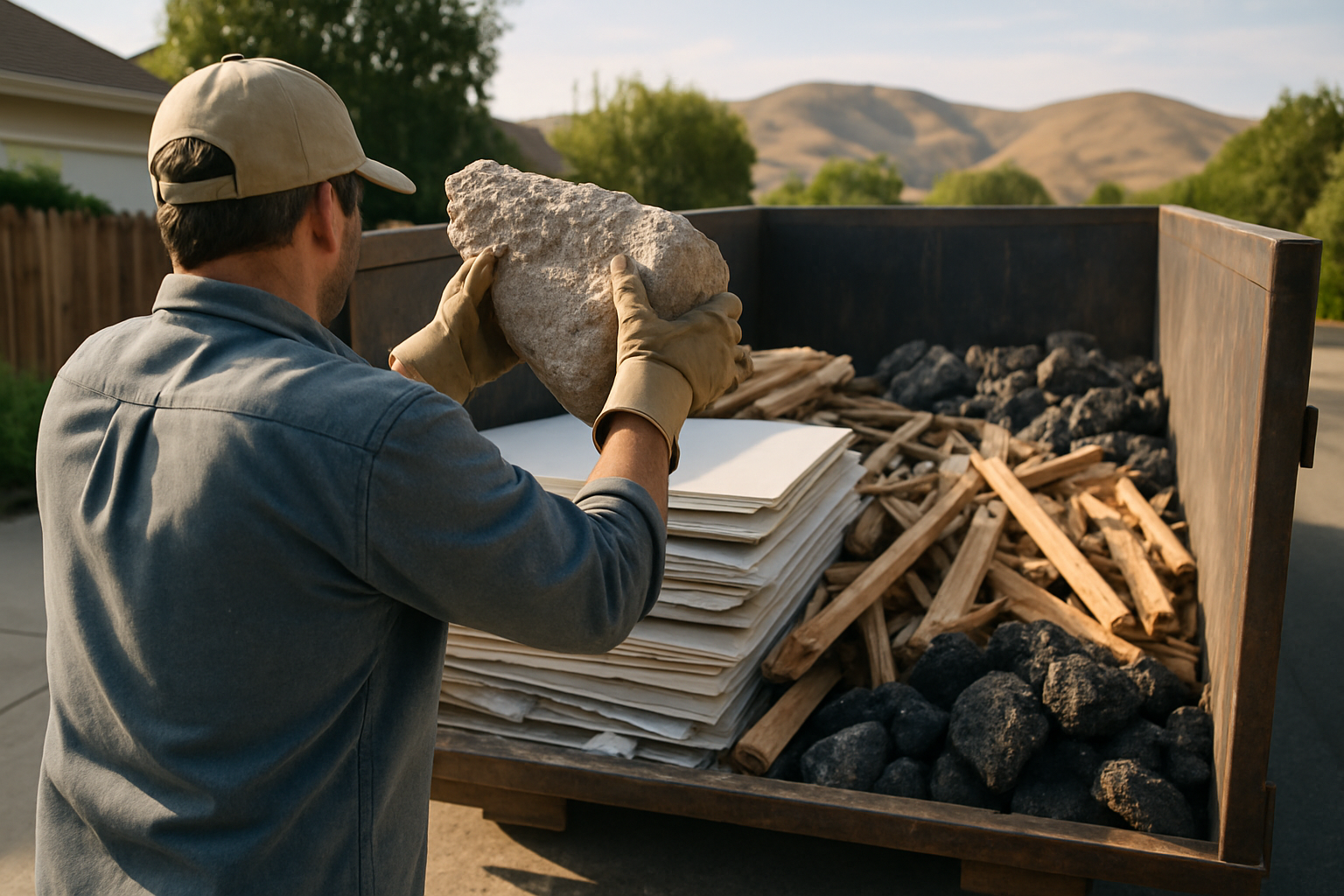
Why this lands on property owners, not just the guy with the truck
Most people assume the dumper carries the risk alone. That has never been fully true, and after January 1 it’s even less true.
The part of AB 2310 that should get your attention is the land piece. If debris gets dumped on property where a permit or license was required by a state or local agency and nobody got one, the person who allowed it is now in the frame too.
I see three situations around San Benito County and South Santa Clara County where that gets uncomfortable fast:
- The back acre. A property owner with land out past the city limits lets a contractor pile broken concrete and dirt “out back” instead of paying to haul it. That has always been a gray area people counted on. It’s spelled out now.
- The rental turn. A landlord hires the cheapest crew to clear a unit between tenants. The crew dumps it somewhere off a county road. The paper trail inside those boxes points back to the property.
- The estate cleanout. A family clears a parent’s house under a deadline, hands everything to whoever answered the phone first, and never asks where it went.
Contractors already know some of this. Homeowners usually don’t, and they’re the ones who end up explaining a pile to a code officer. I’ve written before about who is actually responsible for removing demolition debris, and this law tightens that answer.
Where common demo materials actually need to go locally
Different materials take different paths, and mixing them is what turns a cheap haul into an expensive one. This is general local context, not a substitute for calling the facility.
| Material | Typical legal path in our area | Why people get it wrong |
|---|---|---|
| Broken concrete, asphalt, rock | Taken to a facility that accepts clean inert material for recycling or fill | It’s heavy, so disposal is priced by weight and people look for a shortcut |
| Drywall | Handled separately at a permitted landfill; often has its own handling rules | Looks harmless, so it gets tossed in with general trash or left on site |
| Dirt and soil | Needs a receiving site that will take it; it cannot just be spread on land that requires a permit | Owners assume dirt is not waste. Under the amended code, it is listed |
| Mixed demo debris (wood, metal, trim, scrap) | Sorted first, then split between recycling and landfill such as John Smith Road Landfill in San Benito County | Sorting takes labor, and skipping it raises the tipping cost |
| Household bulky items | City and county programs exist, including Recology South Valley bulky item service in Gilroy | Programs have limits on count, size, and frequency that catch people off guard |
AB 2310 at a glance
Here’s the short version of the numbers and dates that matter if you have debris to move.
What to ask before anyone loads your debris
The practical takeaway is simple. The cheapest quote is only cheap if the material ends up somewhere legal.
Before you hand off a load, ask:
- Where is this going? You want the name of a facility, not “we have a spot.”
- Can I get a disposal receipt? A legitimate hauler pays tipping fees and can show it. If your job is tied to a permit, you may need that paperwork anyway.
- Are you sorting it? Concrete, drywall, metal, and general trash don’t all go to the same place.
- Is the business real and local? A name on the truck, a business address, and an actual phone line that gets answered.
- What’s included in the price? Labor, loading, hauling, and dump fees should all be on the table before the truck shows up.
If you’re closing out a permitted project, that last receipt matters more than people expect. I’ve covered the debris paperwork that holds up permit sign-off because it catches Gilroy and Hollister homeowners every single remodel season.
One review I keep coming back to put it plainly: “They disclosed all information upfront and there were no hidden fees.” That’s the standard, and after January it’s also the safer choice.
What legal disposal actually costs, and why quotes differ so much
People call me and ask why one hauler said one number and someone else said half that. Usually the answer is weight and destination.
Concrete and dirt are priced by the ton at the scale. A truck full of broken patio weighs several times what the same truck full of furniture weighs, so the disposal cost alone can swing the quote hard. Costs vary by load and facility, so I’d rather explain the drivers than throw out a number that won’t hold.
The things that move a price around here:
- Material type and weight, especially inert material like concrete, asphalt, and soil
- Volume, measured in truckloads or cubic yards
- Access, meaning stairs, narrow driveways, tight side yards, or a long carry to the truck
- Sorting labor, since mixed loads cost more to dispose of than separated ones
- Timing, because squeezing a job in same day takes crew juggling
Our dumpster rentals start at $500 for a two-day rental, and the right size depends on the project, with 10, 15, and 25 yard options. For full-service hauls where we load everything, the estimate is free and the number comes before the work.
If you want the longer breakdown, I wrote about what junk hauling actually costs in Hollister and what drives the number, and about why two hauling jobs can cost completely different amounts.
Frequently Asked Questions About the 2026 Illegal Dumping Law
When does AB 2310 take effect?
It takes effect January 1, 2027. The bill was listed in the Governor’s legislative update dated September 30, 2026, and it amends Section 374.3 of the Penal Code.
Can I really get in trouble for dumping debris on my own property?
That’s one of the main things the bill addresses. It allows prosecution of people who dump, or allow dumping of, waste matter on property where a state or local permit or license was required and was not obtained. Owning the land is not automatically permission. If you’re planning to place fill, dirt, or concrete on your own parcel, check with your local agency first.
Is the $5,000 fine for a first offense?
No. The $5,000 figure is the raised maximum for a fourth or later violation. Earlier violations carry lower amounts, and the bill also adds escalating misdemeanor and felony exposure for commercial quantities over 25 and over 50 cubic yards.
How do I know a hauler is disposing of my stuff legally?
Ask where it’s going and ask for a disposal receipt. A crew that pays tipping fees at a permitted facility has no problem telling you the destination. If the answer is vague, that’s your answer.
Does this affect a normal garage or estate cleanout, or just construction debris?
The amended code language lists waste matter broadly along with rocks, concrete, asphalt, dirt, and other construction debris. A household cleanout is less likely to hit the cubic yard thresholds, but the basic rule has not changed: it has to go somewhere permitted. Hoarder house and estate cleanouts often produce far more volume than people expect, so it’s worth asking the question up front.
Planning a cleanout or demo job before the new rules kick in?
If you have concrete, drywall, dirt, or a full property cleanout sitting in front of you anywhere from Hollister and Gilroy out through San Benito County and into Monterey County, it’s worth knowing where the material is headed before anybody loads it. MG Transportation & Hauling handles full-service junk removal, property cleanouts, dumpster rental, and demolition debris, with free estimates and upfront pricing. You can reach us at (831) 297-1972 or at mgtransportationhauling.com when you want a quote and a straight answer on disposal.
