
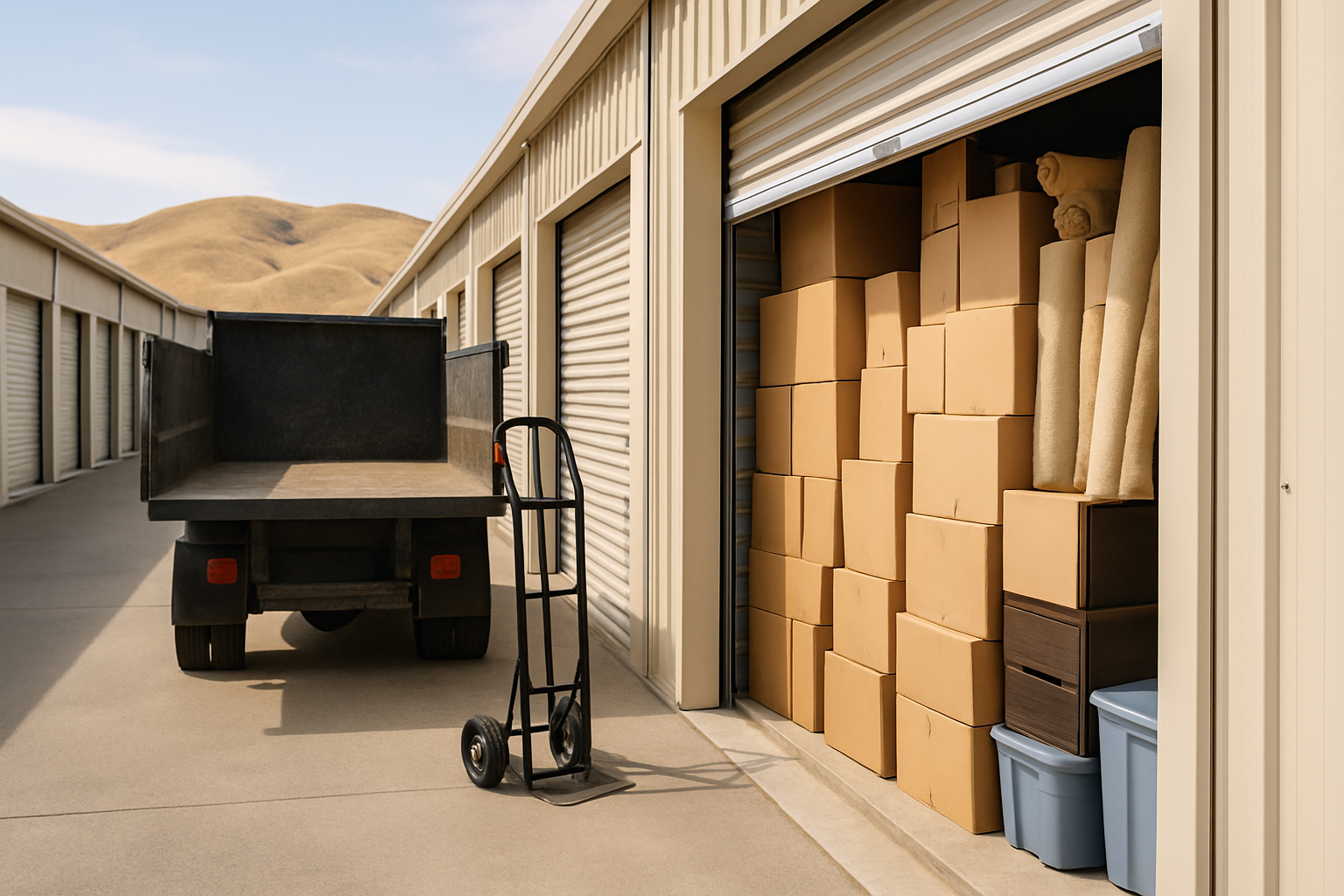
Direct Answer: A storage unit cleanout is usually a load-and-haul job with a truck, not a dumpster job, because most facilities ban on-site dumping and won’t allow a roll-off in the drive aisle.
You rented the unit during a move, or right after a parent’s house got cleared out. It was supposed to be a few months. Now the card auto-bills every month and nobody has opened that door in over a year.
I’ve scoped a lot of these around Hollister, Gilroy, and out toward the Monterey County line, and the thing people get wrong is assuming it works like cleaning out a garage. It doesn’t. Storage facilities have rules that decide how the job gets done, and those rules are the reason a dumpster usually isn’t an option.
So here’s the honest walkthrough: whether the unit is worth keeping, why storage cleanouts are load-and-haul jobs, what actually drives the price, and the two things that quietly slow every one of these down.
First, Run the Math on What’s Behind the Door
Before anything else, pull up your invoice and multiply it by twelve. That’s your real question: is a full year of rent worth what’s inside?
Storage rates around Hollister and the Gilroy corridor swing hard depending on unit size and whether the space is climate controlled. A small non-climate unit and a large climate controlled one are not in the same universe, so use your own number, not an average off the internet.
Then be honest about the contents. In my experience, what’s in a long-forgotten unit usually breaks down like this:
- Genuinely valuable items you’d repurchase today if they vanished
- Sentimental items that matter to somebody in the family, even if they have no resale value
- Documents and records you may still need
- Everything else, which is furniture you replaced years ago, boxes you can’t identify, and things that got stored because throwing them out felt worse than paying to keep them
If that last group is most of the unit, you already have your answer. Paying rent on it is the more expensive choice, and it gets more expensive every renewal.
Facility Rules Are the Part Nobody Plans For
This is the section that actually saves people a wasted Saturday. Storage facilities are built for tenants moving boxes in and out, not for a cleanout crew moving a unit’s worth of material out in one shot.
Here’s what you run into at most sites in this area:
- No dumping in the on-site bins. Those bins are for a broken-down box, not your unit. Facilities watch this closely, and some charge tenants who fill them.
- Gate access runs on set hours. Often something like 6am to 9pm or 7am to 7pm, not around the clock. Your access code stops working after hours.
- Multi-story sites require booking the elevator or loading bay. One elevator, one bay, and other tenants moving in the same day.
- Roll-off dumpsters usually aren’t allowed in a drive aisle. A container sitting in the aisle blocks every other tenant, so most managers say no before you finish the sentence.
Add those up and you get the core difference: a storage unit cleanout is a load-and-haul job with a truck, not a dumpster job. A garage cleanout at a house is the opposite. At a house we can drop a container, you fill it over a few days, we pick it up.
At a storage unit, everything has to come out of the unit, travel to where a truck can legally park, get loaded, and leave the property the same visit. Call your facility manager before you schedule anything and ask two questions: where can a truck park, and what are the access hours on the day I want.
Storage Unit Cleanout Versus a Garage Cleanout at Home
These two jobs sound similar and get handled almost nothing alike. Here’s the side by side.
| Factor | Garage or Home Cleanout | Storage Unit Cleanout |
|---|---|---|
| Dumpster option | Usually available, drop it in the driveway | Rarely allowed in a drive aisle |
| Time window | Can spread over several days | Limited to posted gate hours, usually one visit |
| Truck parking | Driveway or curb, steps from the load | May be a long carry from unit to aisle or bay |
| Vertical access | Ground level in most cases | Elevator or loading bay booking at multi-story sites |
| On-site disposal | Curbside and local programs may apply | Nothing goes in the facility’s bins |
| Finish requirement | Leave it as you like | Unit must be swept and empty to close the contract |
What Actually Drives the Size and Price of the Job
Storage contents price differently than household junk, and it catches people off guard. Three levers move the number.
Volume. Units get packed tight and stacked to the ceiling because you were paying by the square foot. A 5×10 you remember as “half full” is often stacked eight feet high and wall to wall. I’ve seen small units produce more truck volume than a two-car garage.
Weight. Boxes of books, files, tools, tile, and paperwork weigh far more per cubic yard than couches and mattresses do. Disposal facilities charge by the ton, so a dense unit and a bulky unit are not the same job even when they look the same size.
Access. This is the quiet one. Distance from the unit door to where the truck can park, stairs or elevator, aisle width, and whether we can back in all change the labor hours.
Which is why nobody can give you a real number over the phone from a description alone. An accurate estimate comes from someone looking at the unit, in person or from clear photos with the door open and the aisle visible. If a unit turns out bigger than expected, that’s the same conversation as how large cleanout jobs actually get scoped, and it’s better to have it before the truck shows up.
The Storage Unit Cleanout, Step by Step
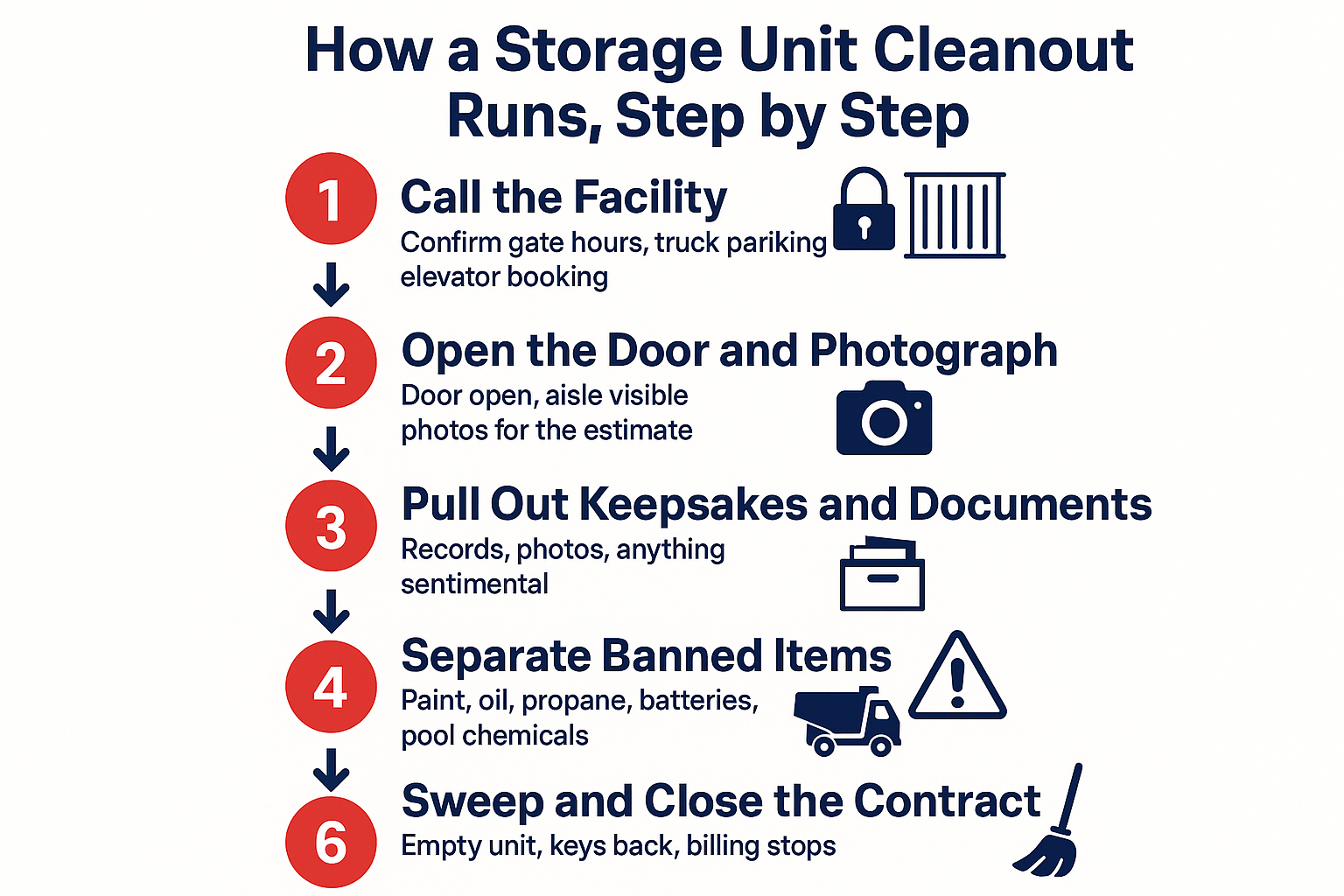
Here’s the order these jobs run in when they go smoothly, from the first phone call to handing back the keys.
Storage Units Are Where the Items We Can’t Legally Take Hide
Almost every long-term unit I open has at least one of these tucked in a back corner. They get stored during a move and then forgotten for years.
- Old paint cans and stain
- Motor oil, gas cans, and solvents
- Propane bottles
- Car batteries
- Pool chemicals and cleaning chemicals
No licensed hauler in California can load that material onto a regular truck, so it has to be pulled aside before pickup. A crew finding these items mid-load stops the job, which costs you time you’re paying for. Twenty minutes of sorting the day before is worth it.
San Benito County runs household hazardous waste collection at the John Smith Road Landfill, generally on the third Saturday of the month from 9am to noon, with per-visit limits in the range of 15 gallons or 125 pounds. Dates and limits change, so confirm with the county before you load anything into your car. Their bulky item and disposal program page is also worth a look if you’re deciding what you can drop off yourself versus what needs a crew and a truck. Gilroy residents should check what Recology South Valley covers for bulky items, since the programs are not the same across the county line.
Time It Around the Rain and Your Renewal Date
Two calendar things matter here, and both are local.
Most units in this area are not climate controlled. October is the last dependable dry stretch before the winter rain, and once damp air settles in, cardboard sags, mattresses and upholstered furniture soak it up, and everything gets heavier. Wet material weighs more when it hits the scale, and weight is what you pay for. The same logic applies to what to clear out before the December rain.
The second one is your billing date. Clearing the unit before the next renewal is the difference between paying for one more month and being done with it.
Count backward from that date and give yourself a full weekday window, not a Sunday afternoon. The facility office needs to be open to close your contract, and gate hours are usually shorter on weekends. If you’re not sure whether you can handle it solo, the same signals apply that show up in 8 signs your cleanout job is too big to DIY.
The Two Things People Are Actually Worried About
Almost every caller has the same two fears, and they rarely say them out loud.
Not knowing the number in advance. The fix is simple. A walkthrough or a clear set of photos with the door open and the aisle visible produces a real estimate instead of a guess. Upfront pricing is the whole point, and one customer put it about as plainly as it gets: “They disclosed all information upfront and there were no hidden fees.” That’s Jennifer L., and it’s the standard we work to.
Not knowing where the contents end up. Reusable items, metal, and appliances generally get separated out from what goes to the landfill. If there are things in the unit you want donated or set aside for family, say so before loading starts. Sorting in advance always goes better, which is the same idea behind sorting a house full of stuff before a crew arrives.
Frequently Asked Questions About Storage Unit Cleanouts
Can I just rent a dumpster and park it at the storage facility?
Usually not. Most facilities won’t let a roll-off sit in a drive aisle because it blocks every other tenant, and a few won’t allow one on the property at all. Call the facility manager first. If they say no, the job becomes a load-and-haul with a truck, which is how the majority of these get done anyway.
How much does it cost to clear out a storage unit?
It depends on volume, weight, and access, and those three vary enormously between two units of the same size. A unit packed with books and files costs differently than one holding a couch and a mattress. Free estimates are standard for this kind of work locally, so get someone to look at photos with the door open before you plan a budget.
Do I have to be there when the unit gets cleared?
Not always, but you do need to arrange gate access and someone has to close out the contract with the office. Plenty of out-of-area families handle a parent’s unit remotely by coordinating access through the facility manager.
What if there are things in the unit I still want to keep?
Pull them before the crew arrives, or mark them clearly and point them out at the start. Documents, photos, and small sentimental items are the ones people regret losing, and they’re usually in unlabeled boxes at the back.
Does the unit have to be swept out before the facility stops billing me?
In most cases, yes. Facilities want the unit empty and broom clean before they’ll close the contract, and a unit that’s 95 percent cleared still bills. Make sure whoever handles the load also handles the sweep so you can hand back the keys the same day.
Thinking About Finally Clearing That Unit?
One last thing people forget: the facility won’t close your contract until the unit is empty and swept, so plan for the broom, not just the truck. We handle storage cleanouts across Hollister, Gilroy, San Benito County, and out toward Monterey County, and free estimates are part of how these jobs get scoped locally. If you want a real number before you commit to anything, call (831) 297-1972 or send photos with the door open through mgtransportationhauling.com.
