

Direct Answer: Large cleanouts are scoped by volume, weight, and site access, not item count. A crew walks the property first, then plans multiple loads, a staged dumpster, or a multi-day approach.
By the time someone calls me about a big cleanout, they have usually already tried to handle a piece of it themselves. A weekend in the garage, three trips to the dump in a pickup, and the room looks about the same as when they started.
A packed two-car garage in Hollister is one kind of job. A six-room house where the interior doors will not open is a completely different one, and a four-unit building in Gilroy that needs clearing after an eviction is different again.
If you already know the job is past DIY, this is the next part of the story. I want to walk you through how large jobs get scoped, why that conversation is not the same as booking a standard pickup, and what a crew is actually planning around before anyone touches a box.
First, Figure Out Which Size of Job You Actually Have
Most people describe their cleanout in rooms. I think about it in loads and hours, because that is what decides how the work gets structured.
There are roughly three tiers I see across San Benito County and South Santa Clara County:
- Single-load jobs. One packed garage, a storage unit, a patio full of old furniture. A crew and one truck, usually a few hours.
- Multi-load jobs. A full garage plus a backyard, a two-bedroom rental after a tenant leaves, a small warehouse bay. This is where truck turnaround time starts costing you daylight.
- Full-property jobs. Hoarder homes, estate clearances, multi-unit buildings, commercial spaces. These need a plan, not just a truck.
Curbside programs are built for the first tier and nothing beyond it. Gilroy residents have a bulky item pickup option through Recology South Valley, and San Benito County Integrated Waste Management posts drop-off rules for residents hauling their own material to the John Smith Road Landfill. Both are fine for a couch and a mattress.
Neither one is built for a house. If you are still deciding whether you are past the DIY line at all, the 8 signs your cleanout job is too big to DIY list covers that threshold in detail.

Why Volume, Weight, and Access Are Harder to Judge on Big Jobs
On a normal pickup, you can see everything. Six items in a driveway, done. On a large cleanout, three things get genuinely hard to estimate, and all three change the price and the timeline.
Volume. When a room is stacked floor to ceiling, you cannot see the floor, so you cannot measure the footprint. I have walked into rooms that looked half full and turned out to be three loads once we started pulling from the back.
Weight. This is the one that surprises people. Under a pile of clothes and boxes there is often wet carpet, tile, dirt, old tube televisions, or a disassembled bed frame. Disposal facilities charge by the ton, so weight moves the number even when volume stays the same. That is a big part of why two hauling jobs in Hollister can cost completely different amounts.
Access. Access decides how fast a crew can move, and it is the factor customers almost never mention on the phone. Older homes near downtown Hollister with alley-only parking, second-story units with one narrow stairwell, long gravel driveways off Highway 25 that a loaded truck should not sit on. Each one adds carry distance, and carry distance adds hours.
What to Have Ready Before You Call for a Quote
You do not need to measure anything. But a few honest answers make the estimate far more accurate, and they cut down on surprises later.
Here is what I ask about on large jobs:
- Approximate size of the space. Square footage, number of rooms, or just “two-car garage plus a shed.”
- Accessible or buried. Can we walk through the space right now, or do we have to dig a path first?
- Stairs and tight spots. Second floor, basement, narrow hallway, no driveway room for a truck.
- Sorting or straight removal. Is anything staying, or is the whole space a removal job?
- Heavy or unusual items. Appliances, safes, pianos, dirt, concrete, an old car on the side yard.
- Your deadline. A listing photo date, a tenant move-in, a probate timeline.
Photos or a short video walkthrough help more than any description. Upfront pricing only works when the person quoting can actually see what they are quoting, which is why I would rather look at a site than guess over the phone.
If sorting is part of your job, do that thinking before the crew shows up. There is a practical order to it in how to sort a house full of stuff before a cleanout crew arrives.
How Job Size Usually Maps to Approach
This is a general guide based on what I see locally, not a price sheet. Every site changes the math, so treat it as a starting point for the conversation.
| Job scale | What it usually looks like | Common approach | Rough timeline |
|---|---|---|---|
| Single load | One packed garage, storage unit, patio clearout | Crew plus one truck | A few hours, often same day |
| Multi-load | Garage plus yard, one full rental unit | Repeat truck loads or a 10-15 yard container | Most of a day |
| Full property | Estate or hoarder home, 3+ bedrooms | Staged 25 yard container plus crew, or multiple trucks | One to three days |
| Commercial or multi-unit | Warehouse bay, post-eviction building, pre-sale commercial space | Container on site, phased passes, coordination with other trades | Multiple days, sometimes staged over a week |
The Scoping Conversation, Step by Step
This is the sequence a large cleanout follows from first call to final sweep.
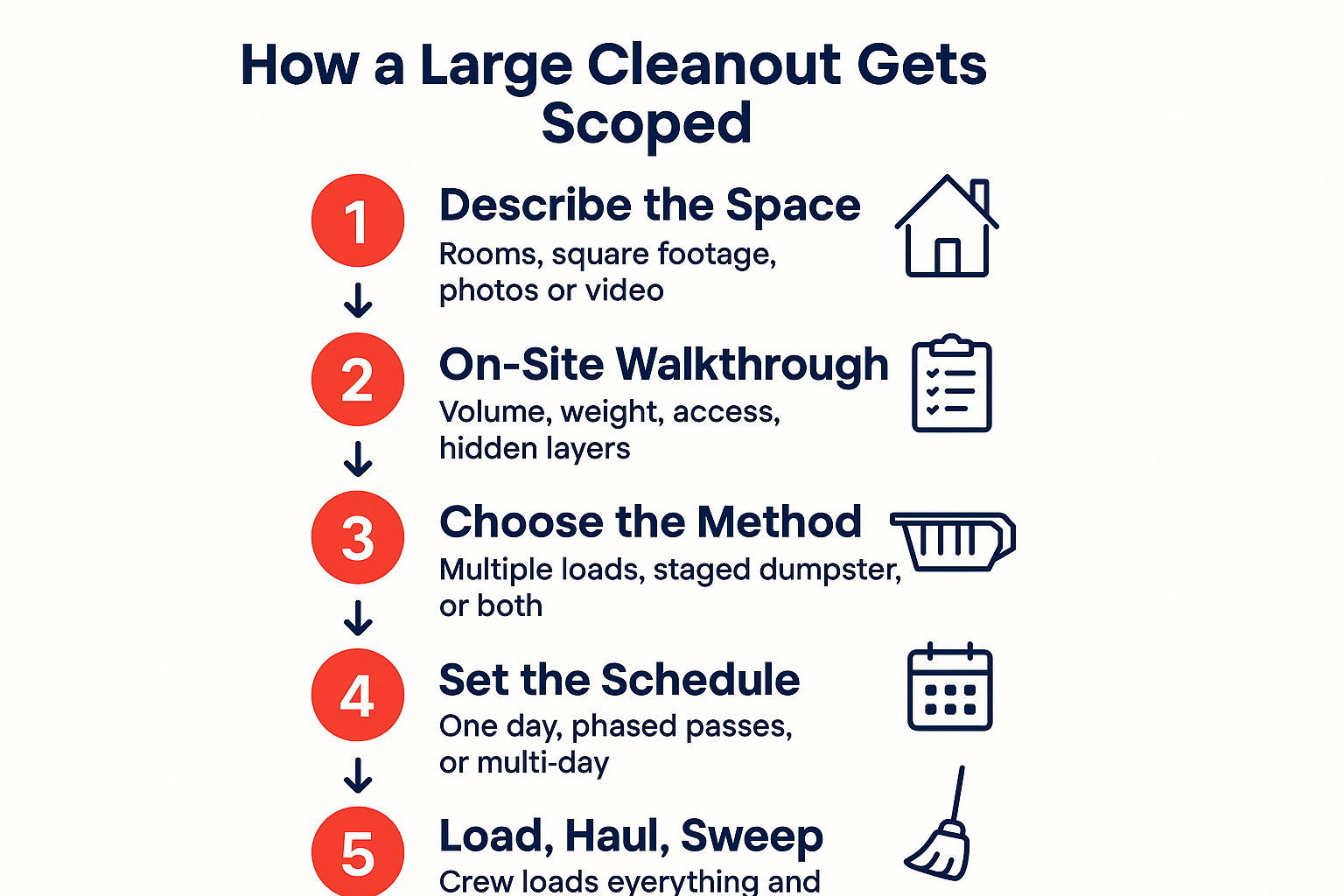
Multiple Loads, a Staged Dumpster, or Both
Here is the part most people do not realize: a large cleanout does not have to happen in one visit. Trying to force it into one is usually what makes jobs go sideways.
With a truck-only approach, the crew loads, drives to the disposal site, unloads, and comes back. On a full-property job that turnaround time can eat a big chunk of the working day, especially with a landfill run and a return trip through afternoon traffic.
A container staged on site changes that. The crew fills continuously and nobody stands around waiting on a truck. We run 10, 15, and 25 yard sizes, and on big residential clearances the 25 is usually the right call. If you are unsure what fits, how much a 10, 15, or 25 yard dumpster actually holds breaks it down by room.
The other structure that works well is a phased job:
- Day one: large furniture, appliances, mattresses, the bulk items that eat volume fast.
- Day two: the residual layer, loose debris, closets, garage shelving, whatever was buried underneath.
- Final pass: sweep-out so the space is ready for photos, paint, or a walkthrough.
On cost, our dumpster rentals start at $500 for a two-day rental, and the size and rental length move the number from there. Full-service cleanout pricing depends on load count, weight, and access, so the honest answer comes after someone sees the site. If you want the general logic behind it, what actually determines the price of junk removal covers the factors.
Commercial and Multi-Unit Jobs Have a Coordination Layer
Residential cleanouts are mostly about the stuff. Commercial and multi-unit jobs are about the stuff plus everybody else on the schedule.
Property managers and contractors in Gilroy and Hollister generally need three things from a hauling crew beyond the hauling itself:
- Working around other trades. Painters, flooring installers, and plumbers all need the space at some point. The debris removal has to slot in without stalling them.
- A record of what left. For remodel and demolition debris, knowing what was removed and where it went matters. California tracks construction and demolition material diversion closely, and CalRecycle publishes the state framework behind those requirements. If your project pulled a permit through the City of Gilroy Building Division, keep your disposal paperwork with the job file.
- Room for a second pass. Scope grows on eviction and warehouse jobs. There is almost always a back room, mezzanine, or exterior yard nobody counted.
On post-eviction work in particular, I plan for the scope to be bigger than the walkthrough suggested. Tenants leave more behind than anyone expects, and the unit still has to turn on schedule. The expectations side of this is covered in what property managers need from a hauling crew.
Big Jobs Are a Logistics Problem, Not a Muscle Problem
Manpower matters, but sequencing matters more. Which room clears first, where the container sits so it does not block a driveway, where items get staged before they load, whether a car in the side yard needs to move before a truck can back in.
That is the difference between a job that wraps in two days and one that drags for a week. Customers notice it in the small stuff. One reviewer described a 25 yard dumpster for a garage and backyard cleanup with “super timely delivery and pick-up,” and another said the pricing was disclosed up front with no hidden fees.
Jobs that need multiple trucks, multiple days, or a real site plan are the work my crew and I built this business around. Plenty of haulers pass on those. We would rather scope them properly and get them done.
Frequently Asked Questions About Scoping Large Cleanouts
Do you need to see the property before giving me a price on a big cleanout?
For anything past a single load, yes, or at least clear photos and a video walkthrough. On a packed house I cannot see the floor, and I cannot guess what is buried under the pile. Estimates are free, and a real look is the only way the number holds up.
Can a large cleanout be split across more than one day?
Absolutely, and often it should be. A common structure is bulk items and furniture on day one, then a second pass for the residual debris and closets. Splitting it also lets you make decisions between passes instead of under pressure.
Is a dumpster or a full-service crew better for a whole-house cleanout?
It depends on whether you want to do the loading. A container works if you have time and help. Full-service means the crew loads everything and cleans up, which is usually the right call for estate and hoarder situations. Many large jobs use both, with a container staged on site and a crew filling it.
How fast can a large job actually get scheduled?
Same-day is often possible when you call before noon, though large multi-day jobs usually need a bit of planning around crew and container availability. If you have a listing date or a tenant move-in, tell me the deadline first and we will build the schedule backward from it.
What happens to everything after it leaves my property?
Material gets sorted for the right destination rather than dumped in one pile. Metal, appliances, and vehicles go one direction, general debris goes to the appropriate disposal facility, and construction material follows the state’s diversion rules. If you need to know where a specific load went, ask and I will tell you.
Planning a Large Cleanout Across the Central Coast?
If your job needs multiple loads, a staged container, or more than one day on site, it helps to talk it through before anything gets scheduled. MG Transportation & Hauling works throughout Hollister, Gilroy, San Benito County, South Santa Clara County, and out toward Monterey County, CA, and estimates are free. You can reach us at (831) 297-1972 or at mgtransportationhauling.com whenever you are ready to figure out the scope.
