
Direct Answer: Junk hauling costs in Hollister depend on volume, weight, access difficulty, and disposal fees — not a flat rate. Getting a visual quote upfront is the best way to know your real number.
When most people search for affordable junk hauling in Hollister, they’re really asking two things at once: how much is this going to cost me, and am I going to get ripped off? Those are fair questions — and the honest answer to the first one is that pricing in this area is not standardized, which is exactly why so many customers feel uncertain before they call.
I’ve worked through enough cleanout jobs in Hollister and Gilroy to know that the number on a quote means nothing if you don’t understand what’s behind it. A crew shows up, looks at your stuff, and names a price. Without knowing the variables that built that number, you have no way to know if it’s fair.
This article walks through exactly what drives junk hauling costs in San Benito County and the surrounding area — so you can make sense of any quote you receive, know roughly where your job falls before you pick up the phone, and avoid the surprises that frustrate people most.
The Four Things That Actually Determine Your Price
Every junk hauling quote is built from a handful of real costs — not guesswork. When you understand what goes into the number, you can estimate your job before you even call.
Volume is usually the biggest driver. Most haulers charge based on how much space your load takes up in the truck — a quarter load, half load, full load, and so on. A few bags of miscellaneous junk costs much less than a garage full of broken furniture and old appliances. The more of the truck you fill, the more it costs — because disposal fees at the receiving facility scale with volume too.
Weight becomes a separate factor when you’re dealing with heavy materials. Concrete, dirt, roofing shingles, tile, and large appliances can weigh significantly more than the same visual volume of lighter junk. Facilities like the John Smith Road Landfill in Hollister charge by the ton — and that cost passes through to the customer. A load that looks modest can run up disposal costs fast if the material is dense.
Access difficulty is the variable most customers don’t think about until it’s a problem. Consider:
– A second-floor bedroom that requires carrying items down stairs
– A long, narrow driveway where a truck can’t get close
– Items that have to be disassembled before they’ll fit through a doorway
– A backyard with no side gate access
Each of those adds labor time, and labor time costs money.
Disposal fees are real overhead that every legitimate hauler carries. Even if the load is small, every truck run ends at a facility that charges to accept the material. That cost is built into every quote — and it should be. If a quote seems oddly cheap, it’s worth asking where the material is actually going.
Why the Minimum Charge Exists (and Why It Makes Sense)
One of the most common sources of sticker shock I hear about is the minimum charge on a small job. A customer has two or three items — an old dresser, a broken TV stand, a beat-up mattress — and the quote comes back higher than they expected.
That’s not padding. Every service call in Hollister — no matter how small — requires a truck, fuel, a crew member’s time, and a trip to a disposal facility. The economics of that service call have a floor. You’re not just paying for the items; you’re paying for everything it takes to show up and deal with them properly.
Knowing this upfront saves a lot of frustration. If you have just one or two bulky items and budget is the main concern, it’s worth knowing that Gilroy residents have a built-in option worth checking first: the City of Gilroy offers residential customers two free bulky item collections per calendar year through their municipal program. That can work well for a single couch or appliance sitting at the curb.
But for anything beyond one or two items — a full garage, an estate cleanout, a hoarder situation, or any job involving heavy material — that program has real limits on what it accepts and how much it handles. For those jobs, hiring a crew is almost always the faster and more complete solution. You can read more about how to think through that decision in this comparison of dumpster rental vs. full-service junk removal if you’re still figuring out which approach fits your job.
Rough Cost Factors by Job Type — What to Expect
These aren’t fixed prices — costs vary based on volume, weight, and your specific property. But based on what we see on jobs throughout San Benito County and South Santa Clara County, here’s a general sense of where different job types tend to land in terms of cost complexity.
| Job Type | Main Cost Drivers | Relative Cost Range |
|---|---|---|
| Single item pickup (couch, appliance) | Minimum charge + disposal fee | Lower end — but minimums still apply |
| Garage cleanout | Volume, multiple load trips, mixed material weight | Mid-range — scales with how full the garage is |
| Estate or full house cleanout | Volume, labor hours, potential multi-day crew | Higher end — see how long it takes to clear a house |
| Hoarder house cleanout | Volume, access difficulty, labor intensity | Highest complexity — pricing built after visual assessment |
| Demolition debris removal | Weight-heavy material (concrete, drywall), landfill fees | Driven heavily by tonnage — see who’s responsible for debris removal |
| Junk car removal | Vehicle condition, title status, pickup logistics | Varies — often offset by scrap/salvage value |
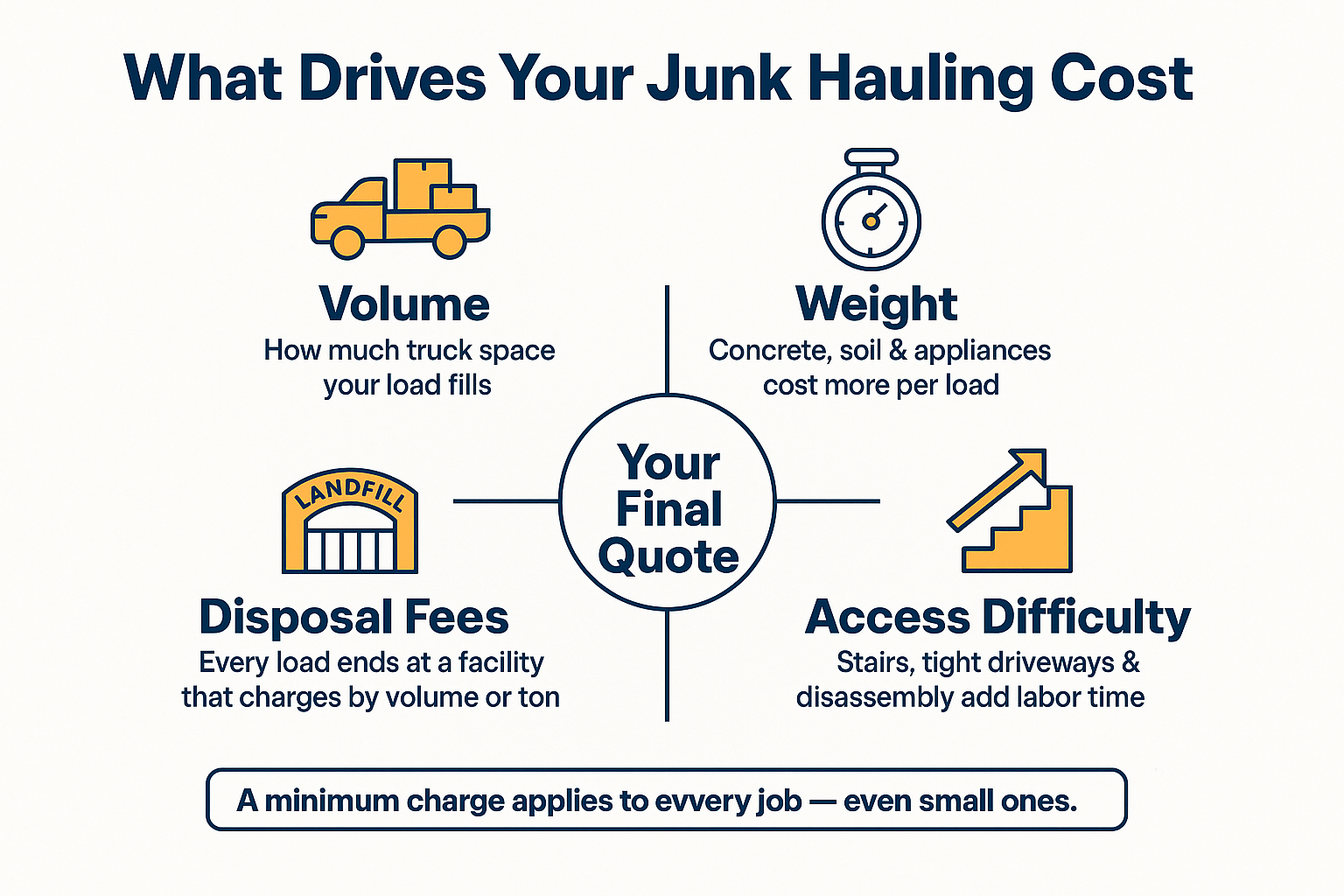
The Four Cost Drivers at a Glance
Here’s a quick visual breakdown of what goes into a junk hauling quote — and how each factor pushes the price up or down.
How to Get a Quote That Actually Holds
The customers who walk away happiest are the ones who got a quote based on a real look at the job — not a number pulled from a website form with vague answers about how much stuff they have.
I’ve seen the frustration when a quote and a final bill don’t match. It’s almost always traceable to incomplete information at the start. You can read more about why junk removal quotes and final bills sometimes differ — but the short version is this: the more the hauler can see, the more accurate the number.
Here’s what a smart quoting process looks like:
- Send photos if an in-person visit isn’t possible yet — clear shots of the space, the volume of material, and any access challenges
- Ask what’s included — labor, loading, fuel, disposal fees, and final cleanup should all be part of the quoted price, not line items that appear later
- Ask specifically whether anything about your job could change the number — heavy material, a second floor, or a particularly large volume should all be flagged upfront
- Get it confirmed in writing before the crew starts — even a text thread works
One customer in Hollister described it well: she said the thing that made her confident was that all information was disclosed upfront with no hidden fees, and the billing process was easy to understand. That’s exactly how a quote should work.
For jobs with a lot of moving parts — like an estate cleanout or a hoarder house — it’s almost always worth an in-person walk-through before any number is agreed on. You can see what that kind of job actually involves in what a hoarder house cleanout looks like from start to finish. The volume and labor on those jobs can vary widely, and a walk-through protects both sides.
What Disposal Actually Means in San Benito County
A question I get fairly often is where the stuff actually goes. It’s a reasonable thing to wonder — especially after reading about illegal dumping or haulers who disappear material in ways that could cause problems down the line.
In San Benito County, the primary receiving facility for residential and mixed junk loads is the John Smith Road Landfill, managed under the San Benito County Integrated Waste Management program. Disposal there is permitted, regulated, and tracked by weight — which is one reason weight matters so much to your quote. The California Department of Resources Recycling and Recovery (CalRecycle) oversees disposal standards statewide and sets the framework local facilities operate under.
Items that can be diverted from the landfill — metals, certain appliances, items in resalable condition — often go to recyclers or donation channels instead. A good hauler separates material where it makes sense. That diversion doesn’t always lower your price, but it’s part of responsible disposal.
If your job involves demolition debris specifically — drywall, concrete, wood framing — the handling is a bit different. Material type matters for where it can legally go. We cover that in more detail in whether drywall, wood, and concrete can be thrown away the same way.
Frequently Asked Questions About Junk Hauling Costs in Hollister
Is there a ballpark price range for a basic junk removal job in Hollister?
Costs vary too much to quote a single number — but many homeowners in San Benito County and South Santa Clara County describe spending somewhere in the low-to-mid hundreds for a modest load, and more for larger or heavier jobs. The only accurate number is one built after someone actually sees your job. Contact MG Transportation & Hauling for a quote based on your specific situation.
Why does a small job still cost a certain minimum?
Even a single-item pickup requires a truck, fuel, a crew member’s time, and a disposal run. Those costs exist regardless of load size. The minimum charge reflects the real floor of what it costs to show up and do the job properly — not an arbitrary markup.
I’m in Gilroy — can I use the city’s bulky item program instead of hiring a hauler?
Yes, and for a single item or two, it’s worth checking first. Gilroy residential customers get two free bulky item pickups per calendar year through the municipal program. But for anything involving a full cleanout, multiple loads, heavy material, or time pressure, that program has limits that make hiring a crew the more practical choice.
What happens if the job turns out to be bigger than expected after they arrive?
This is exactly why you want a quote based on a real look at the job — not a guess. If the scope changes on the day of service, a good hauler communicates that before continuing, not after. Ask upfront what scenarios would change your quote. Get the original number confirmed before work starts. That one step prevents most billing disputes.
Do heavy materials like concrete or soil cost more to haul?
Yes — significantly in some cases. Disposal facilities charge by weight, and dense materials like concrete, packed dirt, or tile can hit those weight thresholds fast. A load that looks small can carry real disposal costs if the material is heavy. If you have a lot of that kind of material, mention it when you call so the quote accounts for it.
How do I know a hauler is actually disposing of my stuff legally?
Ask where they take material and whether they’re licensed to operate in San Benito County or Santa Clara County. A reputable local hauler should be able to answer that without hesitation. In Hollister, the primary licensed facility is the John Smith Road Landfill. An operator who can’t or won’t tell you where your load ends up is a red flag.
Ready to Get a Quote That Actually Makes Sense?
If you’re in Hollister, Gilroy, or anywhere in San Benito County and you want a number built around your actual job — not a ballpark pulled from a web form — we’re easy to reach. Call MG Transportation & Hauling at (831) 297-1972 or visit mgtransportationhauling.com/ to request a quote. We’ll take a look, tell you what we see, and give you a price you can count on before anyone lifts a thing.
