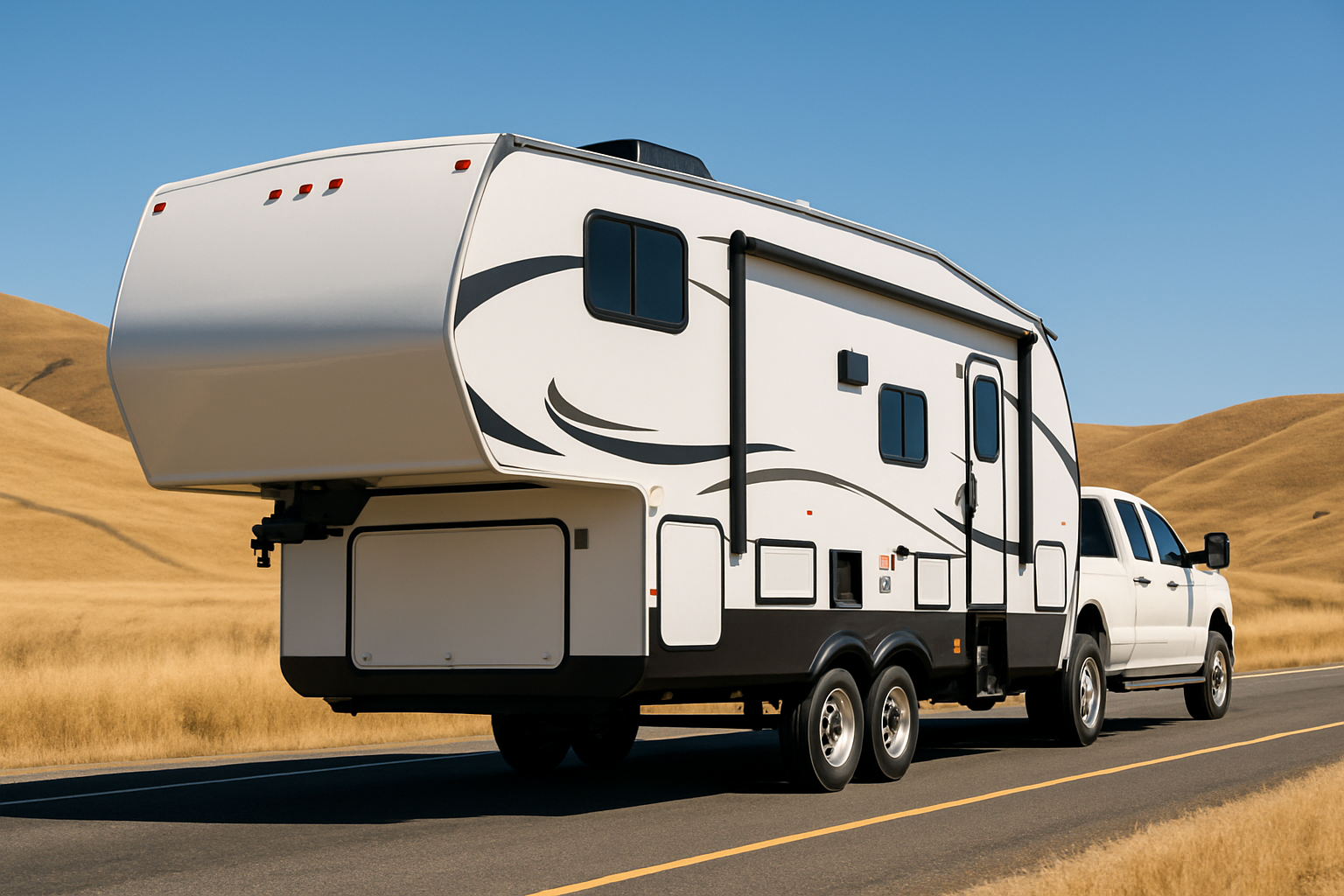
Direct Answer: A 5th wheel connects to a specialized hitch in the truck bed, requires significantly higher towing capacity, and faces California size regulations that standard trailers don’t. Most owners hire a transport service when they lack the right truck or need the unit moved somewhere they can’t drive themselves.
If you’ve been searching for information on moving a 5th wheel RV and keep landing on pages that don’t actually answer your questions, you’re not alone. This is one of the most searched topics in our area — and one of the least well-covered. Most of what’s out there is either generic towing advice that doesn’t apply, or manufacturer content that assumes you already own the right truck.
The reality is that a 5th wheel is not a standard trailer. The way it connects, the equipment it requires, and the California regulations that apply to it are all different — and those differences matter a lot when you’re trying to figure out whether you can move it yourself or whether you need a 5th wheel transport service to handle it.
I’ve worked through these moves in and around San Benito County and South Santa Clara County enough to know where the confusion usually starts. This article covers the three things that actually matter: what makes a 5th wheel different to move, what California law says about it on public roads, and which situations make hiring a professional the practical call.
Why a 5th Wheel Isn’t Just a Big Trailer
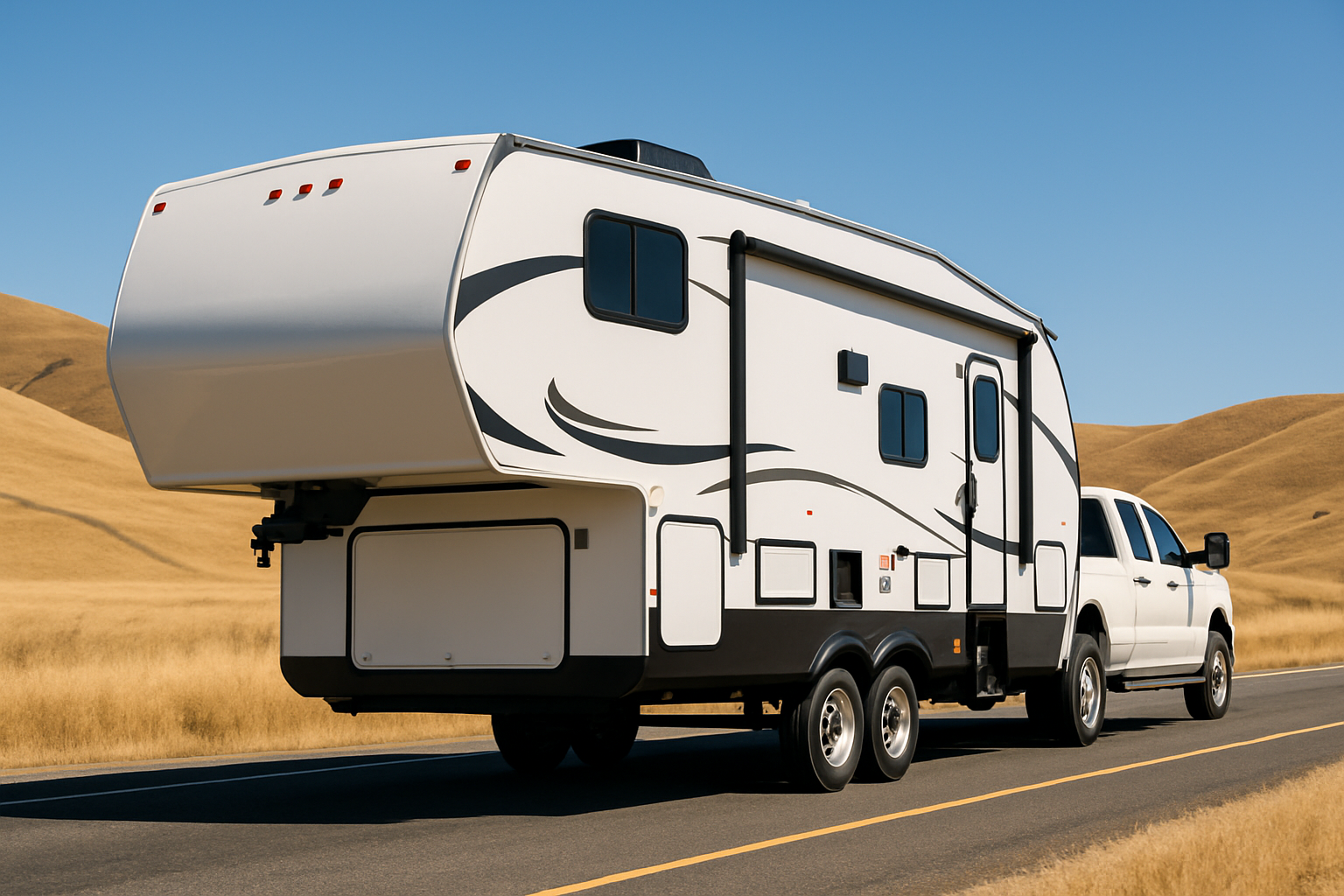
A standard trailer uses a ball hitch attached to the rear of a tow vehicle. A 5th wheel uses a kingpin and a specialized plate-style hitch mounted in the bed of the truck — the same general concept used by commercial semi-trucks. That design shifts a portion of the trailer’s weight directly over the truck’s rear axle, which changes the physics of the tow entirely.
Because the weight distribution is different, the towing capacity requirement goes up significantly. Most full-size 5th wheels weigh between 12,000 and 20,000 pounds loaded, and some larger luxury units push well beyond that. A half-ton pickup truck — the kind a lot of people own — typically maxes out around 13,000 to 15,000 pounds of 5th wheel towing capacity in ideal conditions. Pull a heavier unit with an underpowered truck and you’re not just dealing with slow acceleration. You’re dealing with brake fade, sway, and handling problems that become dangerous on grades or in crosswind conditions.
This is the most common reason people call us. They own a truck, they assume it can handle the job, and then they check the owner’s manual and realize they’re 3,000 pounds short of what they need. Or they call a friend with a bigger truck, that friend backs out, and now the move is stalled. Knowing the actual towing capacity of any vehicle doing the pull isn’t optional — it’s the starting point.
California’s Size Rules for 5th Wheel Transport
This is the part that surprises most people, and it’s worth understanding before you assume any move is straightforward.
The California DMV draws a clear line for 5th wheel trailers on public roads. A unit that exceeds 40 feet in overall length or 8.5 feet in width is classified as oversize. Oversize units cannot be registered through standard DMV channels, and transporting them on public roads requires permits, specific routing, and in some cases, escort vehicles depending on the dimensions involved.
For units that fall within legal dimensions, the combined length of the tow vehicle and the trailer still matters — California generally limits combinations to 65 feet total on most public roads, though certain highway types allow more. The California DMV’s towing and size regulations spell this out in full, and it’s worth a look if you’re unsure where your unit falls.
Why does this matter for route planning? Because not all roads in our area are the same. Some of the narrower routes through the Gavilan Range between Hollister and Gilroy present real width and clearance challenges for larger units. A transport professional who moves 5th wheels regularly has already mapped those problem spots. An owner making a one-time move learns about them at the worst possible moment.
On the question of oversize permitting specifically: if your unit falls into that category, the logistics of the move change substantially. Permits have to be pulled in advance, routes may be restricted to certain hours, and some roads may simply be off the table. This isn’t a reason to panic — it’s a reason to know your unit’s dimensions before you start planning.
The Three Situations Where a 5th Wheel Transport Service Makes Sense
Most people land in one of three situations when they realize they can’t move the unit themselves. Here’s what each one looks like.
The Three Scenarios That Drive Most 5th Wheel Transport Calls
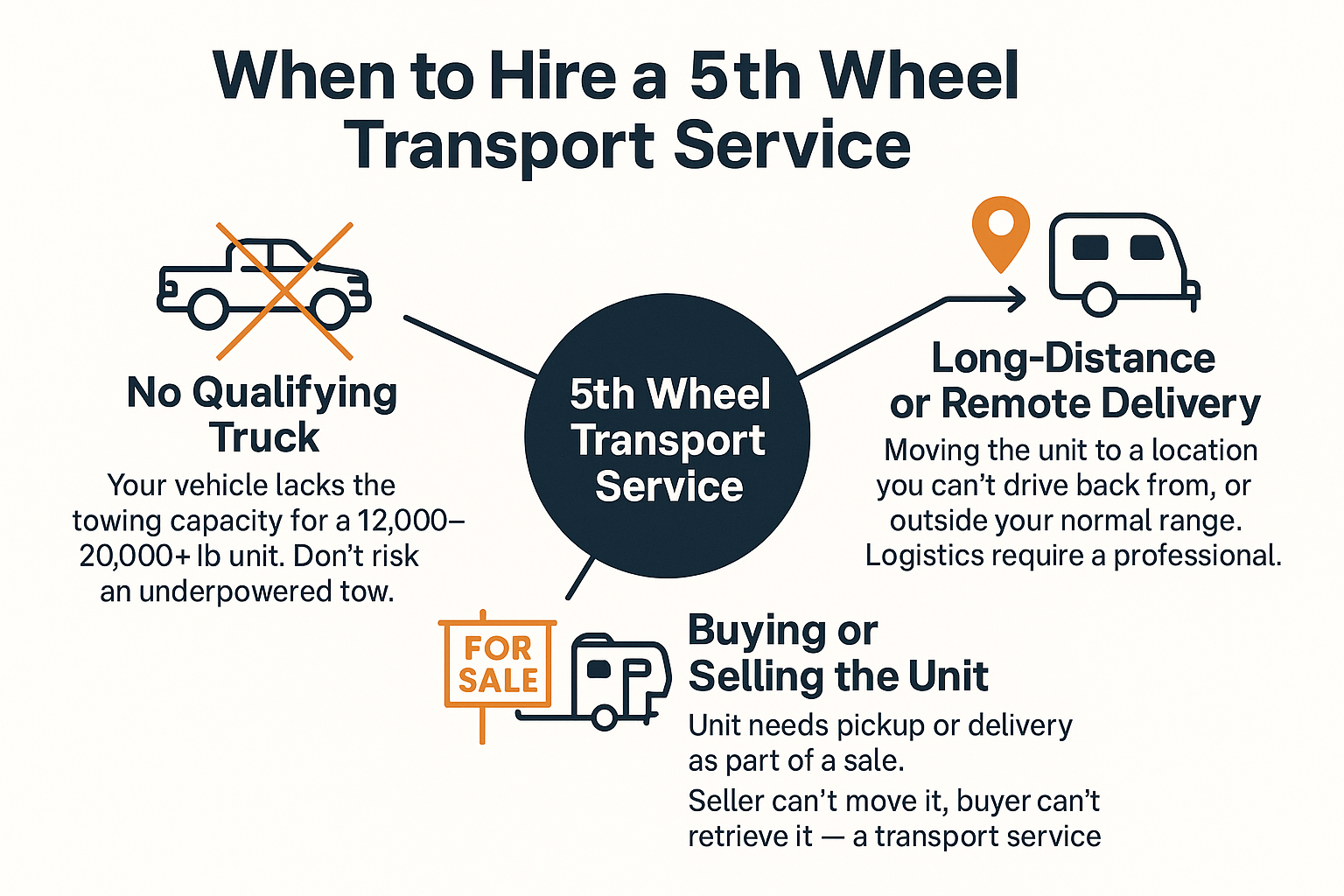
When people contact us about moving a 5th wheel, the situation almost always fits into one of three categories. Knowing which one applies to you helps clarify what the move actually requires.
Scenario 1: You don’t have the right truck. This is the most straightforward. Your unit weighs more than your truck is rated to tow safely, and renting or borrowing a qualified truck either isn’t practical or isn’t available on your timeline. A professional transport service brings the right equipment for the unit’s weight and size.
Scenario 2: You need the unit moved somewhere you can’t follow. A long-distance move, a delivery to a storage facility across the region, or a move to a campsite in an area you’d need to drive back from — these all require someone who can handle the transport end-to-end without you needing to be behind the wheel.
Scenario 3: You’re buying or selling the unit. This is more common than most people expect. A seller may not have the equipment to get the unit to a buyer’s location. A buyer may be purchasing remotely and need the unit delivered before they can inspect it in person. In both cases, the transport needs to happen independently of either party’s personal vehicle.
Each of these situations has slightly different logistics, but the common thread is the same: the unit needs to move, and a personal vehicle isn’t the right tool for the job. What separates a reliable hauling crew from a bad one applies here just as much as it does to any other large haul — equipment, experience, and communication are what separate a clean move from a problem one.
5th Wheel vs. Standard Trailer: Key Differences at a Glance
If you’re comparing these two options or trying to explain the difference to someone else, this breakdown covers the main points.
| Factor | Standard Trailer | 5th Wheel |
|---|---|---|
| Hitch Type | Ball hitch, rear of vehicle | Kingpin plate, inside truck bed |
| Towing Capacity Needed | Varies widely — can be low | Typically 15,000–25,000+ lbs for full-size units |
| Vehicle Requirement | Many pickups and SUVs qualify | Heavy-duty pickup (3/4-ton or 1-ton) usually required |
| Typical Unit Length | Under 30 ft common | 30–45 ft common; some exceed 45 ft |
| CA Oversize Threshold | Varies by type | Over 40 ft length or 8.5 ft width = oversize permit required |
| Combined Length Limit (most CA roads) | 65 ft total | 65 ft total (truck + trailer) |
| Occupants During Transport | Not permitted in most cases | Allowed under specific CA conditions (see FAQ) |
Route Planning: The Part Most Owners Don’t Think About
Moving a 5th wheel isn’t just about having the right truck. It’s about knowing what the road between Point A and Point B actually looks like for a unit that may be 40 feet long and 8.5 feet wide.
Around Hollister and Gilroy, this matters more than it might in flat, open terrain. Some rural routes through San Benito County and the Gavilan Range area have tight turns, low clearances, or weight-restricted bridges that aren’t obvious until you’re already committed. A GPS designed for passenger cars won’t flag these. A routing system built around oversize vehicles will.
When we handle a 5th wheel transport, route planning is part of the job — not an afterthought. That means knowing in advance which roads to avoid, where clearance could be a problem, and what the backup route looks like if the primary isn’t usable. For an owner doing this move once, those are things you learn by trial and error. That’s not a great approach with a unit worth tens of thousands of dollars sitting behind you.
This is also where the California permit requirements connect back to routing. If your unit qualifies as oversize, the permitted route is typically specified in the permit itself. You can’t just pick the shortest path on the map. That kind of detail is standard for a transport professional — it’s new information for most owners.
Frequently Asked Questions About 5th Wheel Transport
Can someone ride inside the 5th wheel while it’s being towed?
California law does allow occupants in a moving 5th wheel under specific conditions — the unit must have safety glass in all windows, a two-way communication device between occupants and the driver, and a functioning exit door. But most transport professionals, ourselves included, advise against it. Road vibration, sudden stops, and shifting cargo make the interior of a moving trailer genuinely hazardous regardless of what the law technically allows.
What if my 5th wheel is oversize — can it still be transported?
Yes, but the process is more involved. Oversize units (over 40 feet or 8.5 feet wide by California definition) require permits before they can legally move on public roads. Those permits specify the route, the allowed travel hours, and in some cases require escort vehicles. A licensed transport operator handles this as part of the service — it’s not something you want to figure out the morning of the move.
How much does it typically cost to have a 5th wheel transported?
Costs vary based on the size of the unit, the distance of the move, and whether permits are required. From what we see in the San Benito County and South Santa Clara County market, shorter local moves can run a few hundred dollars, while longer or more complex transports with oversize permitting involved will cost significantly more. The only way to get an accurate number is to describe your specific unit and move — that’s what a quote call is for.
What if my unit is being sold and the buyer is in another city?
This is a very common situation. The seller can’t always deliver, and the buyer may not have equipment to retrieve the unit. A 5th wheel transport service handles the pickup at the seller’s location and delivers to the buyer’s — making it essentially a third-party logistics solution for the sale. Coordinate the timing with both parties in advance so someone is present at each end.
Do I need to do anything to prepare the 5th wheel before transport?
A few things matter. Slide-outs should be fully retracted, all interior items secured or removed, the hitch and landing gear inspected, and tire pressure checked. If the unit has been sitting for a while, tires and brakes are worth a close look before the move — a transport professional will often walk through this before hooking up.
Need a 5th Wheel Moved in the Hollister or Gilroy Area?
If you’re trying to figure out whether your unit can be moved legally, whether it qualifies as oversize, or whether a transport service makes sense for your specific situation, we’re happy to talk it through. MG Transportation & Hauling handles 5th wheel transport in and around San Benito County and South Santa Clara County — with the equipment and route knowledge to do it right. Call (831) 297-1972 or visit mgtransportationhauling.com/ to describe your unit and get a straight answer.
