

Direct Answer: The hardest part of an estate cleanout isn’t hauling the items — it’s making decisions under grief, time pressure, and uncertainty. A good hauler walks through first, clarifies what goes, and handles the rest.
Most people who call us about an estate cleanout aren’t just clearing out a house. They’re doing it in the middle of losing someone. A parent passes away in Hollister or Gilroy, and within weeks there’s a property to deal with — a lease end date, a probate timeline, a real estate agent with a showing already scheduled. The logistics don’t wait for the grief to settle.
I’ve worked enough of these jobs to know that the stuff itself is rarely the hardest part. It’s the decisions. What goes? What stays? What does Dad’s family want to keep? What’s worth donating versus hauling? And who’s supposed to figure all of that out when everyone is exhausted and operating on a deadline?
This article is about what actually makes estate cleanouts difficult — and what a thoughtful, organized approach looks like when a crew shows up to help.
The Real Pressure Behind an Estate Cleanout
In most estate situations I’ve seen around San Benito County and South Santa Clara County, there’s a hard deadline involved. Probate has a window. The property needs to be listed. A sibling flew in from out of state and can only be there for one weekend. That time pressure changes everything about how the job feels.
When a hauler doesn’t answer calls quickly, shows up late, or leaves the job half-finished, it doesn’t just create inconvenience — it collapses the entire plan. A real estate agent in Gilroy who has a showing scheduled can’t reschedule a listing because a hauler didn’t show. That’s real money and real stress on top of an already hard situation.
Responsiveness matters more in estate cleanouts than almost any other job type. When a customer says Marcus showed up right on time and answered every question — that’s not a small thing in this context. That’s exactly what the job requires.
The timeline pressure also affects how the job gets scoped. Many families haven’t had time to go through everything before the crew arrives. That’s normal. But it means the hauler needs to be ready to work around that — not just start loading.
Why ‘Not Everything Is Junk’ Changes How the Job Gets Done
A home that belonged to someone for twenty, thirty, forty years has layers. There are obvious things — broken furniture, old appliances, bags of stuff with no clear value. But mixed in with all of that are tools that still work, clothing in good condition, household goods a family member might want, and documents that should never end up in a dumpster.
When a crew shows up without a walk-through and starts loading everything in sight, they’re not being efficient — they’re creating a problem. I’ve heard from families who called us after another hauler had already been through and removed things they wished they’d kept. That kind of mistake can’t be undone.
The right approach starts before a single item moves:
- Walk the full property first — every room, garage, shed, and outbuilding
- Get clear direction from the family on what’s going and what’s staying
- Flag items that may be donations before they get mixed in with disposal loads
- Identify documents or personal effects that need to be set aside, not hauled
Once that walk-through happens and everyone is aligned, the actual hauling goes faster and cleaner. The family isn’t second-guessing the crew mid-job. And nothing important ends up at the John Smith Road Landfill by accident.
For a closer look at how this kind of methodical process plays out on large jobs, What Happens During a Full Property Cleanout? walks through it in detail.

What to Do About Items You Want Donated, Not Disposed Of
This comes up on almost every estate job. A family doesn’t want a parent’s furniture going to a landfill if it’s still in decent shape. Clothing, kitchenware, books — there’s an emotional weight to disposal that donation doesn’t carry the same way.
The practical answer is simple: tell the hauler before the job starts, not during it. Once items are loaded into a truck with general debris, sorting them back out is difficult or impossible. If you want specific pieces set aside for a local donation drop — places like the Salvation Army or Goodwill locations that serve the Gilroy and Hollister areas — that needs to be part of the original job plan.
We handle this by noting it in the walk-through. If a couch is going to a donation organization, it gets stacked separately and handled accordingly. It doesn’t cost extra to communicate this upfront. But trying to sort it out after the truck is packed is a different story.
One thing worth knowing: not every item can be donated. Donation centers have their own condition standards, and some furniture, mattresses, or appliances won’t be accepted regardless of intent. If you’re not sure whether something qualifies, ask the hauler during the walk-through — a crew with local experience will generally know what’s likely to be accepted and what isn’t.
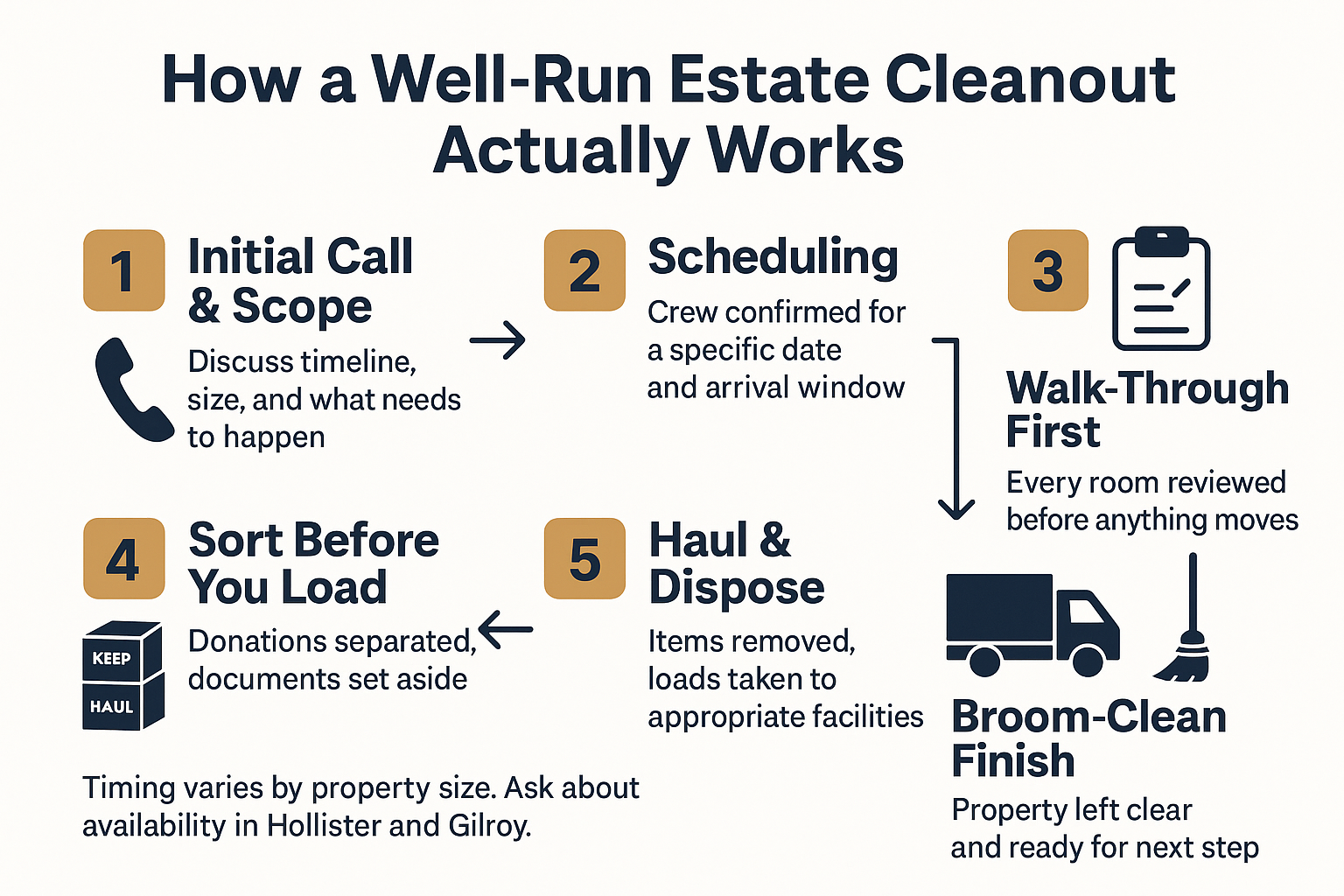
How a Thoughtful Estate Cleanout Actually Flows
Most people don’t know what to expect when a crew shows up for an estate job. This lays out how a well-run cleanout should go, from first contact to a broom-clean property.
Estate Cleanout Situations and What They Usually Require
Estate jobs aren’t all the same. Here’s a general breakdown of common situations and what each one typically involves from a hauler’s perspective.
| Situation | What’s Usually Involved | Key Consideration |
|---|---|---|
| Single-family home, fully furnished | Multiple rooms, garage, shed — furniture, appliances, personal effects | Walk-through critical; may take a full day or more depending on volume |
| Partial cleanout after family has sorted | Remaining furniture, bulk items, garage contents | Faster job; still worth confirming what stays before crew starts |
| Hoarder situation or long-term accumulation | High volume, multiple load trips, narrow pathways | Crew size and equipment matter — one truck may not be enough |
| Property being prepped for sale | Fast turnaround needed; broom-clean finish expected | Coordination with real estate agent timeline is common |
| Rental unit after tenant or estate | Furniture, appliances, miscellaneous debris | Landlord often managing remotely — clear communication essential |
The Difference Between a Hauler Who Gets It and One Who Doesn’t
I’ve seen what it looks like when an estate cleanout goes well and when it doesn’t. The gap usually isn’t about the size of the truck or how fast the crew works. It’s about whether the people doing the job understand what they’ve been asked to do.
A hauler who treats an estate cleanout like any other truckload job — load it, haul it, done — misses the whole point. The family watching that crew work is grieving. They’re trusting strangers to handle the physical remnants of someone’s life with some degree of care. That context deserves to be acknowledged, not ignored.
What actually separates good estate cleanout experiences from bad ones, based on what customers tell us:
- The crew arrived on time and stuck to the schedule
- Pricing was explained upfront — no surprises at the end of the job
- Items were handled carefully, not thrown or dragged
- The property was left broom-clean when the crew walked out
- The family felt heard, not managed
One customer who used us after her mother passed away specifically mentioned that Marcus was “compassionate and understanding” of the situation. That word — compassionate — doesn’t usually show up in reviews about hauling. But it shows up in estate cleanout reviews, because that’s what the moment actually calls for.
If you’re also trying to understand what separates a reliable hauling crew from a bad one in general terms, that’s worth reading before you hire anyone for a job this significant.
And if the property involved has more complexity — years of accumulation, narrow access, or rooms that haven’t been opened in a while — it may share some characteristics with the jobs described in What a Hoarder House Cleanout Actually Looks Like, Start to Finish.
What Estate Cleanouts Generally Cost in This Area
I won’t give you a flat number here, because the honest answer is that estate cleanout pricing depends heavily on the specific job. Volume, access, the number of load trips required, and whether items need to be sorted for donation all affect the final cost.
What I can tell you is that in the Hollister and Gilroy area, families generally see cleanout costs ranging from a few hundred dollars for a partial job to well over a thousand for a fully furnished home — and in some cases, larger properties run higher than that. Factors that typically push costs up include:
- Multiple stories or difficult access (narrow hallways, no driveway access)
- High overall volume requiring multiple loads or multiple trips to the John Smith Road Landfill or other disposal sites
- Items requiring special handling — appliances, mattresses, or oversized furniture
- Tight timelines that require a larger crew or same-day scheduling
For a broader breakdown of what drives pricing on any cleanout job, How Much Should You Actually Pay for Junk Removal? is a good reference. And if you’ve ever gotten a quote that looked reasonable and then gotten a final bill that didn’t, Why Your Junk Removal Quote and Your Final Bill Don’t Always Match explains exactly why that happens.
The best way to get a real number for your specific situation is to call and describe the job. A walk-through — even a brief one — gives us enough to quote accurately.
Frequently Asked Questions About Estate and Property Cleanouts
Do I need to sort everything before the crew arrives?
No — and honestly, most families in estate situations don’t have the time or bandwidth to do a full sort before we get there. That’s part of what the walk-through is for. We go through the property together, you tell us what goes and what stays, and the crew works from that plan. The more direction you can give us upfront, the smoother it runs.
What if I want some items donated instead of thrown away?
Tell us before the job starts, not after the truck is loaded. We can set aside furniture, clothing, and household goods for donation organizations — places like Goodwill or the Salvation Army near Gilroy — as long as it’s part of the plan from the beginning. Keep in mind that donation centers have their own standards, so not everything will be accepted. We can help you figure out what’s likely to qualify during the walk-through.
How do you handle documents and personal paperwork?
We don’t touch those — that’s your call entirely. During the walk-through, we’ll flag any areas where paperwork is present and make sure nothing gets loaded until you’ve had a chance to review it. Documents, financial records, and personal papers are outside our scope to decide on.
How long does a full estate cleanout take?
A fully furnished single-family home in Hollister or Gilroy typically takes anywhere from a few hours to a full day, depending on volume, access, and how much sorting is needed. Larger properties or homes with garages, sheds, or long-term accumulation can take longer. We’ll give you a realistic time estimate after the walk-through — not a guess before we’ve seen the property.
Can you work around a probate or real estate timeline?
Yes, and this is something we deal with regularly. If you have a showing date, a probate deadline, or a lease end that’s driving the schedule, tell us when you call. We’ll be upfront about what we can commit to and when. We know that in estate situations, the timeline isn’t flexible — and we take scheduled commitments seriously.
What does ‘broom-clean’ actually mean when you’re done?
It means the property is cleared of all items we agreed to remove, floors are swept, and the space is ready for whatever comes next — a showing, a walkthrough, a cleaning crew, or handoff to a real estate agent. We’re not a cleaning service, but we don’t leave debris, dust, or staging behind when we walk out.
Dealing With an Estate Cleanout in Hollister or Gilroy?
If you're managing a property cleanout under a deadline — or just trying to figure out where to start — MG Transportation & Hauling works with families throughout San Benito County and the Gilroy area who are in exactly that situation. We do a walk-through first, quote you straight, and handle the job with the kind of care the moment calls for. Call (831) 297-1972 or visit mgtransportationhauling.com/ to talk through what you've got.
