
Direct Answer: A $175 dumpster rental price is almost always a base rate, not a finished price. It typically excludes delivery, extra rental days, tonnage past the allowance, and heavy material surcharges.
You see a number online. Maybe it was $175, maybe it was a little higher, attached to a dumpster photo that looked exactly like what you need for the garage. Then you call a local company, describe the job, and the number you hear back is nowhere close.
The first thing most people assume is that somebody is padding the bill. I get that call often enough that I want to settle it plainly: that advertised number is a starting base rate, not a finished price. The gap between the two is made of specific line items you can ask about before you book.
I work these roads every week, from Hollister out to Gilroy and down into the Monterey County, CA side of the job board. Below is what a base rate usually leaves out, why disposal costs here are set locally, and the short list of questions that make two quotes actually comparable.
Why the $175 Dumpster Rental Price Rarely Matches a Local Quote
A headline price is built to get a phone call. It usually assumes the smallest box, the shortest rental window, the lightest possible load, a short drive, and a clean driveway drop.
Change any one of those and the number moves. Most real jobs change three or four of them at once.
Here is what I mean in practice. A homeowner calls about “just the garage,” and by the time we talk it through, the job includes:
- A couch and a mattress, which take volume and add weight
- Old fence boards stacked along the side yard since spring
- A week-long rental, not two days, because family is helping on the weekend
- A street drop, because the driveway is too narrow for the truck
None of that is hidden pricing. It is a different job than the one the ad priced.
The honest version of the conversation sounds like this: tell me what is going in the box, how long you need it, and where it can sit, and I can give you a real number. An exact price comes from describing your actual job to a local company, not from a headline rate built for the easiest version of it.

What a Teaser Base Rate Usually Does Not Include
Nobody around here publishes this list, so I will. These are the line items that sit between an advertised rate and a finished quote:
- Delivery and pickup. Some ads price the container and treat both truck trips as add-ons.
- Rental days. A two-day window and a seven-day window are different products at different prices.
- Tonnage allowance. Every quote should include a weight you can throw away before extra charges start.
- Rate past the allowance. If it goes over, what does the next ton cost?
- Drive distance. A drop in town is not the same as a drop out on a rural road past Tres Pinos.
- Placement. A box on a public street can require a city permit, and that is on you to arrange unless the company handles it.
- Material type. Concrete, dirt, roofing, and construction debris get routed and priced differently than household junk.
When you call, you do not need to argue price. You need to ask which of those seven are inside the number you were just given.
If a company will not answer those on the phone, that tells you something useful. If they answer all seven without flinching, that also tells you something.
Disposal Here Is Priced by the Scale, Not by How the Pile Looks
This is the part that surprises people most. A tonnage allowance is not a company invention to squeeze you. It exists because the landfill weighs the truck.
Loads from Hollister jobs run to the John Smith Road Landfill, and the scale decides what that load costs us. San Benito County’s own solid waste rate materials note that local rates get adjusted annually for inflation, fuel, and disposal and processing costs.
So disposal economics here are local and weight-driven. A national-looking ad rate has no way to account for what our scale charges on the day your box comes back.
Season matters too. Hollister gets nearly all of its roughly 15 inches of annual rain between December and February, and cardboard, mattresses, and untreated lumber that sat in a side yard through the first storms come out of there noticeably heavier than they went in.
That is a real reason to move a planned cleanout earlier rather than later. I have written separately about how weight charges get billed when a load goes over, so I will leave the math there. The point for pricing is simply that the allowance exists because somebody is paying by the pound at the gate.
Five Questions That Turn a Base Rate Into a Real Price
Ask these before you book. A clear answer to all five means you are comparing real numbers instead of headline numbers.
| Question to ask | Why it moves the price | What a clear answer sounds like |
|---|---|---|
| How many days are included? | A two-day window and a week-long window are priced differently | Seven days included, with a set rate for each extra day |
| How many tons are included? | Disposal is charged by weight at the scale | A stated tonnage allowance plus a per-ton rate past it |
| Are delivery and pickup both in that number? | Some ads price only the container | Both truck trips included in the quoted total |
| What is going in the box? | Concrete, dirt, and construction debris get handled and routed differently | Mixed household is fine; heavy material needs its own load |
| Where will the box sit? | Street placement can require a city permit; tight access changes the truck | Driveway drop with boards down, no permit needed |
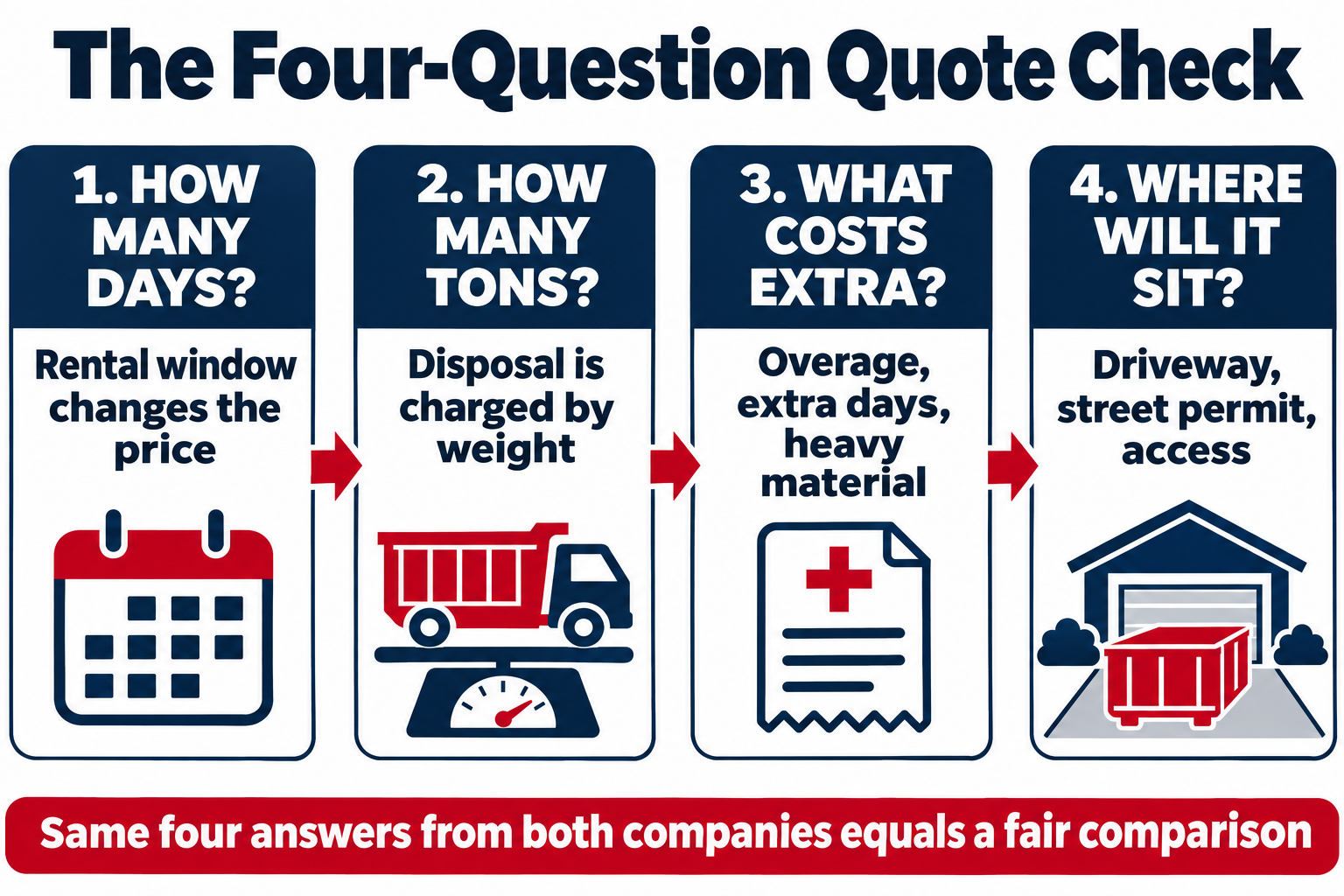
The Four-Question Quote Check
If you only remember four things from this article, make it these. They turn two mismatched quotes into an honest comparison.
Two Quotes, Same Size Box, Different Numbers
Two companies can quote the same 15-yard box in the same county and land in different places without either one being dishonest.
Three things usually explain the spread:
- Where the box will sit. A narrow driveway, a gate, a slope, or a street-only option all change how the truck has to work.
- How far we drive. A Gilroy drop and a drop out on a rural San Benito County road are not the same trip.
- What material is going in. Construction and demolition debris generally has to be identified when you order, because it is handled differently than household junk.
Placement is the one people forget. It is also the question I get asked most often, which is why I wrote a whole piece on where a rented dumpster can legally sit rather than repeating permit rules here.
A quote is only as accurate as the details you give on the phone. If you leave out the gate, the slope, or the half ton of old tile, the number will move later and it will feel like a surprise.
Shop on What Is Included, Not on the Sticker
After enough of these calls, I have come to think the sticker price is the least useful thing in the conversation. What people remember a month later is whether anything surprised them.
One of our reviewers put it better than I can: “The service provided was excellent! They disclosed all information upfront and there were no hidden fees.” That was Jennifer L., and that sentence is the whole standard.
Other reviews repeat the same two themes: a rental window long enough to actually finish the job, and booking that is simple to understand. Another customer who rented a 25-yard box for a garage and backyard cleanup mentioned timely delivery and pickup, not the price tag.
So when you have two quotes in front of you, line up the days, the tons, the overage rate, and the extras. Then pick. If one company gave you all four without hedging and the other gave you a number and a shrug, you already have your answer.
It also helps to know roughly how long you should actually keep the box before you ask for a quote, because the rental window is one of the biggest levers on the final number.
Frequently Asked Questions About Dumpster Rental Pricing
Is a $175 dumpster rental price ever real?
Sometimes it is a genuine base rate for the smallest box, a short rental window, and a light load within a tight service radius. It is rarely the total for a real garage or remodel cleanout. Treat it as a starting point and ask what is included.
How much does a dumpster actually cost around Hollister and Gilroy?
Costs vary with size, days, tonnage, drive distance, and material, so I will not throw a number at you that does not fit your job. Describe the pile, the timeline, and the drop spot on the phone and you can get an exact figure in a few minutes. That is faster than hunting for a published price nobody posts.
Why do I have to say what kind of debris is going in?
Because it changes where the load goes and what it weighs. Concrete, dirt, roofing, and construction debris are handled differently than mixed household junk, and some items are not allowed in a roll-off at all.
Is renting a dumpster cheaper than making trips to the dump myself?
It depends on how many loads you have, what your truck can carry, and what your Saturday is worth. For one or two light loads, self-hauling can win. Past three or four, the math usually flips, mostly because of fuel, time, and per-trip gate fees.
What happens if I go over the weight allowance?
You get billed for the extra weight at a stated per-ton rate, which should be in your quote before the box ever shows up. Ask for that rate up front so there is nothing to argue about later.
Can I get a dumpster dropped the same day?
Often yes, especially if you call early in the day, though it depends on what is already on the schedule and where the trucks are. Availability is worth confirming by phone rather than assuming.
Want a Real Number Instead of a Headline Rate?
We run 10, 15, and 25-yard boxes and full-service crews out of Hollister, so a straight comparison of renting versus having a crew load it is not a pitch for the only thing we do. Because we are local and not a national booking platform, a quote can account for drive distance, placement, and material type before the truck leaves the yard. If you are working through a cleanout in San Benito County, South Santa Clara County, or the Monterey County, CA area, a short phone call to (831) 297-1972 is usually all it takes to get an exact figure.
