
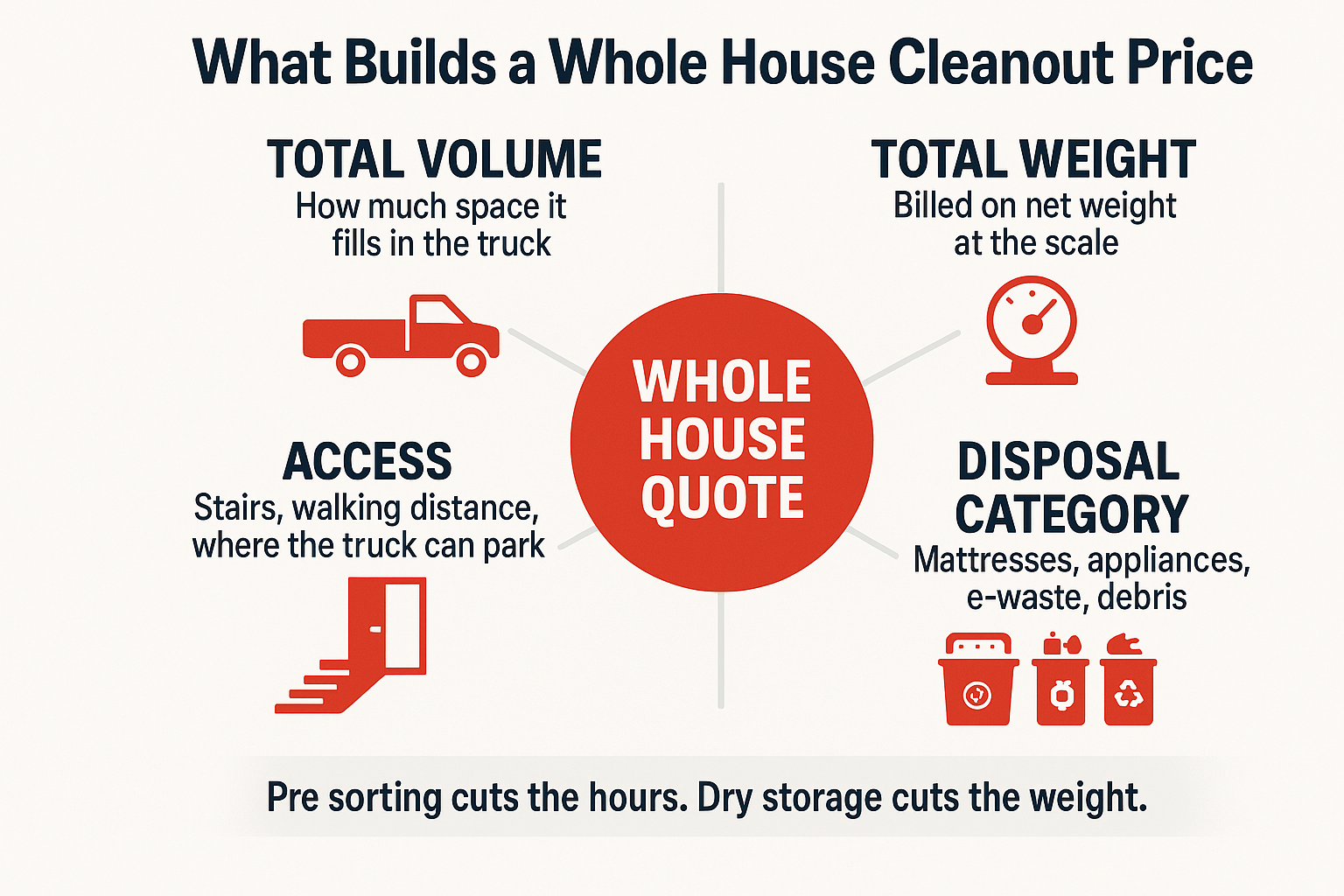
Direct Answer: The cost to clean out a house comes down to four things: total volume, total weight at the scale, access to the truck, and what disposal category each item falls into.
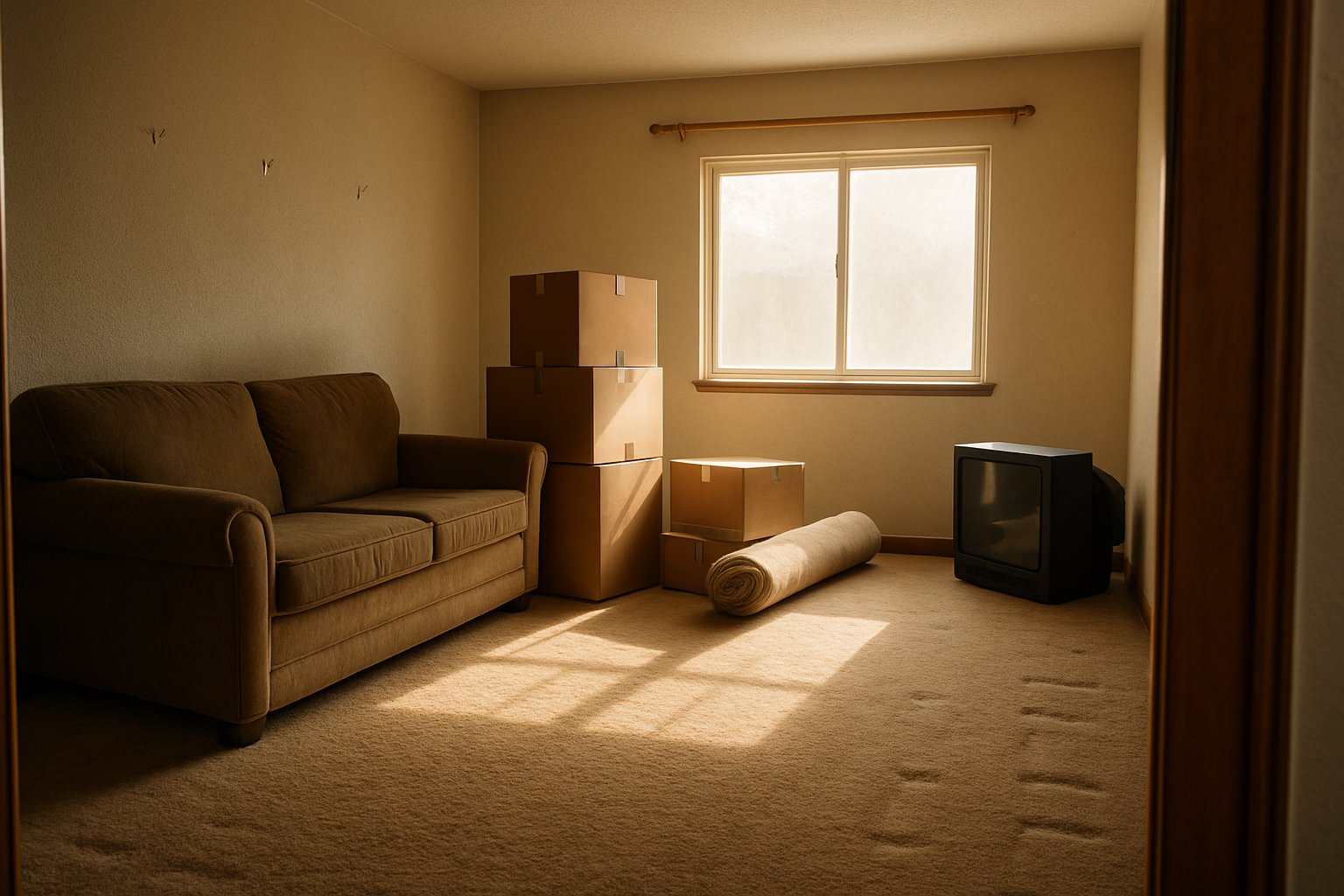
Standing in a house that holds forty years of somebody’s life is a different feeling than cleaning out a garage. There are closets you have not opened, a shed in the back, an attic nobody has checked since the 90s, and a deadline from a buyer, a landlord, or a family member.
The first question almost everybody asks me is some version of what does it cost to clean out a house. The honest answer is that two three bedroom homes on the same street in Hollister can be quoted hundreds of dollars apart, and the reasons are predictable once you know what to look at.
I want to walk you through the four things that move a whole house number, why weight is the one that surprises people, and what you can do before anyone shows up to bring that number down.
The four things that set a whole house number
Every full property quote I give comes out of the same four inputs. Nothing mysterious about them, but most hauling sites skip straight to the word affordable and never explain any of it.
- Total volume. How much space the stuff takes up in a truck or a dumpster. This is the part homeowners estimate pretty well on their own.
- Total weight. What the load weighs on the scale at the transfer station. This is the part homeowners almost never see coming.
- Access. How far the crew walks each item, how many stairs, and where a truck or box can legally sit.
- Disposal category. Where each pile has to go, because a mattress, a fridge with Freon, a pile of tile, and a bag of clothes all have different endings.
A fully furnished house with a packed garage and a side yard full of lumber can easily run double a mostly empty house of the same square footage. Same floor plan, same neighborhood, completely different job.
If you want the general version of how loads get priced around here, I covered it in what junk hauling actually costs in Hollister. This article is about the whole house number specifically, which is built differently.
Weight is the part that blindsides people
Local disposal is billed on net weight at the scale. The truck gets weighed in, gets weighed out, and we pay on the difference. That means the price has very little to do with how full the truck looks.
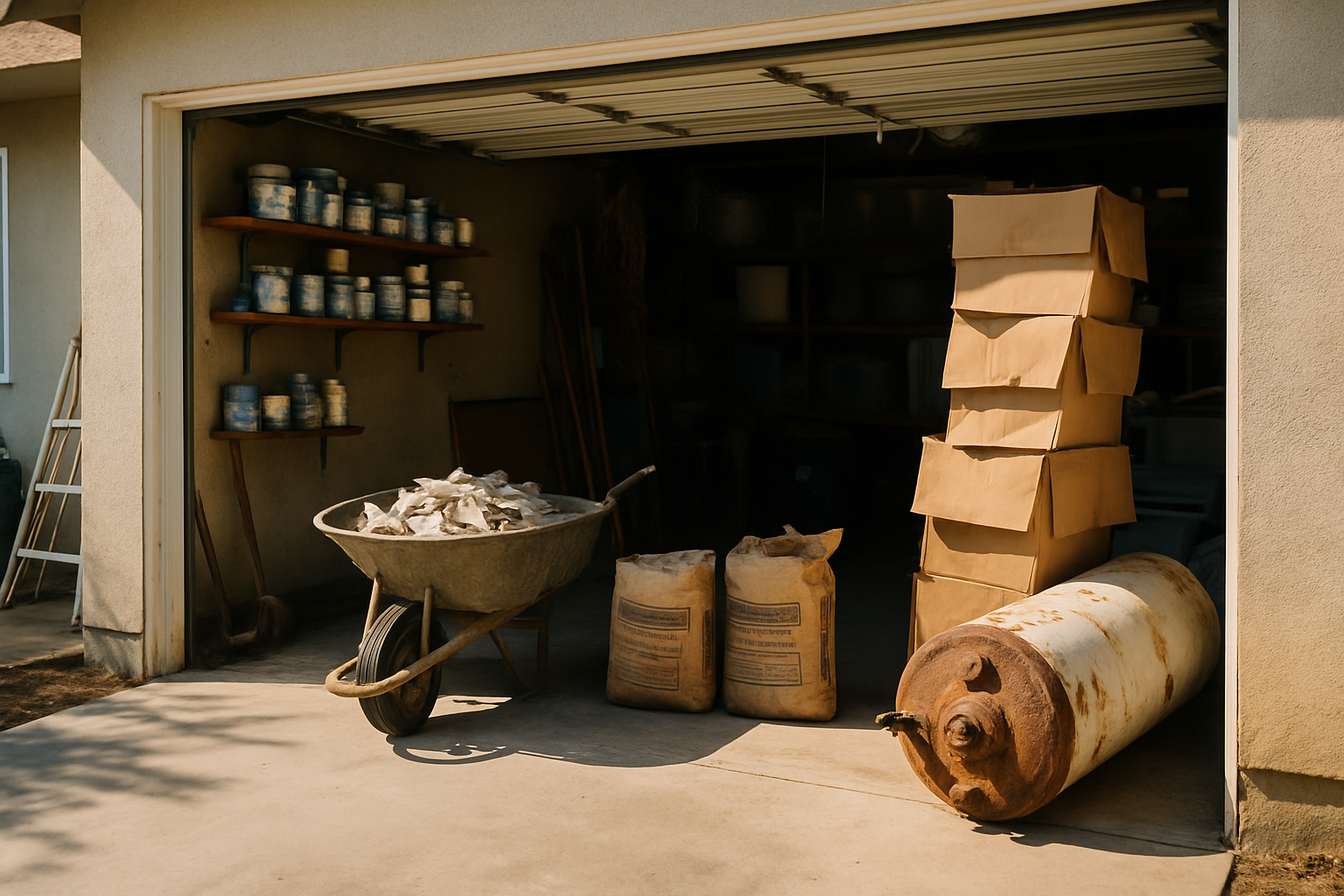
A living room of couches and a mattress can fill a truck and weigh surprisingly little. A garage with broken tile, bagged plaster, a pile of dirt, and cardboard that soaked up two winters of rain can weigh more in half the space.
These are the categories that quietly run up the weight on a whole house job:
- Tile, concrete, brick, and stucco scrap from an old remodel nobody finished
- Dirt, gravel, and bagged mix sitting along the fence line
- Wet cardboard and soaked furniture from a carport or an unsealed shed
- Waterlogged untreated lumber and old fence boards
- Cast iron tubs, water heaters, and old appliances
That is why I price a full house by category and not just by truckloads. A load of loose, dense material can cost more than a bigger load of light furniture, and pretending otherwise is how people end up with a number at the end that does not match the number at the start.
It is also why construction leftovers deserve their own conversation. California tightened the rules on where that material can go, and dumping concrete or drywall in the wrong spot can now cost thousands.
What moves the price, and what you can actually control
Here is how the four drivers show up in a real house, and which parts are in your hands before a crew ever arrives.
| Driver | What it looks like in a real house | What you can control |
|---|---|---|
| Total volume | Furnished bedrooms, packed closets, a full garage, a shed, a side yard | Sell, donate, or gift anything with life left before the job |
| Total weight | Tile, dirt, plaster, soaked cardboard, appliances, old fence boards | Keep outdoor material dry and covered, deal with it before winter |
| Access | Second floor, narrow hallway, detached garage at the back of a deep lot, street only parking | Clear a path, clear the driveway, move cars off the street that morning |
| Disposal category | Mattresses, Freon appliances, e-waste, paint and chemicals, general landfill | Peel the free channel items off the load yourself if you have time |
| Decision time | Someone standing in a hallway deciding if a box stays or goes | Pre sort into keep, donate, and go zones before the crew shows |
The anatomy of a whole house quote
A quick visual on how a full property number gets built, and roughly how much of it each factor tends to drive.
Rain changes the weight math in this valley
Hollister gets roughly 15 inches of rain a year, and almost all of it lands between December and February. Anything sitting in a side yard, a carport, or a shed with a bad roof gains water weight through those months.
The worst offenders are the ones most houses have plenty of:
- Mattresses and box springs
- Upholstered couches and chairs
- Cardboard boxes and paper records
- Untreated lumber and particle board furniture
Once those are soaked, two things happen. They cost more to haul because they weigh more, and they lose any chance of being donated or recycled, so the whole pile heads to the landfill as general waste.
October through mid November is the last dependable dry stretch for the outdoor part of a cleanout around here. That is not a manufactured deadline, it is just how the weight math works. If the inside of the house can wait but the side yard cannot, I would move the outdoor portion first.
I get into the sequencing in more detail in what to clear out before the December rain.
Some of the load does not have to be paid weight at all
I would rather tell you this than have you find out later. A handful of items in a typical house have free or low cost channels, and peeling them off the top shrinks the paid portion of the job.
- County bulky pickups. San Benito County households can schedule up to two free curbside bulky item pickups per year through the residential program. The per pickup limits are small, roughly two cubic yards of reusable material, or up to five e-waste items, or two appliances and bulky items, with Freon appliances counting as two.
- E-waste. Acceptable electronic waste can be taken to the John Smith Road Landfill during regular operating hours with proof of county residency, according to San Benito County’s electronic waste program.
- Household hazardous waste. Paint, solvents, pesticides, and motor oil are only accepted at the county’s third Saturday collection events. We do not handle that material, and no legitimate hauler will put it on a truck.
- Mattresses and box springs. California runs a statewide recycling channel with free drop off sites for these.
- Gilroy households have bulky item options through their residential service as well, worth a call before you assume everything is a paid haul.
Be realistic about what this does. Free channels handle a corner of a house, not a house. Two cubic yards is about one small truck bed. For a three bedroom with a full garage, this trims the edges and nothing more, but trimming the edges on a weight heavy load is worth an afternoon.
The same sorting logic applies to a rented box, which I broke down in what cannot go in the dumpster you just rented.
The hours go into decisions, not lifting
People picture a cleanout as hours of carrying. In my experience the clock mostly runs while somebody stands in a hallway deciding whether a box gets kept.
A family that has already pre sorted into keep, donate, and go zones can turn a two day job into one. That is the single biggest lever a homeowner has, and it costs nothing but time.
The physical side of the property matters too, and these are the things I look at on a walkthrough:
- Power and water. No lights in a windowless garage or back bedroom slows everything down.
- Driveway capacity. Whether it can hold a truck or a dumpster, or whether everything gets carried to the street.
- Stairs and layout. Second floor bedrooms and narrow hallways add real minutes per item.
- A detached garage at the back of a deep lot. Common on older Hollister properties, and it can double the walking distance on half the load.
- Street parking. Near downtown Hollister and in the older Gilroy neighborhoods off Monterey Street, where parking is tight, placement takes planning.
If you want a sorting system that actually holds up over a weekend, I laid one out in how to sort a house full of stuff before a crew arrives.
What a real whole house quote should spell out
The fear behind the search is not the price. It is being surprised at the end.
Before any work starts, a quote on a full house should answer these in plain words:
- What counts as one load, measured in cubic yards or by truck, not by feel
- What happens if the volume comes in over what was estimated, and whether you approve that before it is hauled
- How weight driven items are handled, especially tile, dirt, concrete, and soaked material
- Whether labor is included to take apart beds, shelving, and sheds
- Whether the crew sweeps the space when the last load is out
- What is excluded, so chemicals and similar items do not become a surprise on the last day
Ask for those six things in writing or over the phone, and most of the anxiety about a whole house number disappears. One customer put it this way in a review: “The service provided was excellent! They disclosed all information upfront and there were no hidden fees.” That is the standard to hold anybody to.
For houses, I do not quote off a phone description alone. A walkthrough or a good photo set of every room, the garage, the shed, and the side yard is what turns these drivers into a real number.
Frequently Asked Questions About Whole House Cleanout Costs
What is the average cost to clean out a house around Hollister or Gilroy?
There is no honest flat average, and anybody who gives you one over the phone is guessing. Whole house jobs in this market generally span a wide range depending on volume, weight, access, and disposal category, and a packed three bedroom with a full garage can land several times higher than a mostly empty one. A walkthrough or a full photo set is what gets you a number you can rely on.
What is the cheapest way to get rid of a house full of stuff?
Shrink the paid load before anyone bills you. Sell or donate anything with life left, use your county bulky pickups and free mattress and e-waste channels for what qualifies, and keep outdoor material dry so it does not gain water weight. Then price the remainder, which is usually the bulk of it.
Is a dumpster cheaper than a full service crew for a whole house?
It depends on who is doing the lifting. A dumpster lets a family work at its own pace over several days, and our rentals start at $500 for a two day rental with 10, 15, and 25 yard sizes. If nobody is available to load it, or the house has stairs and a long walk, a crew usually finishes faster for less total cost.
What will a crew not take?
Household hazardous waste, which means paint, solvents, pesticides, pool chemicals, and motor oil. Those only go to the county’s third Saturday collection events. Set that material aside in one spot early so it does not hold up the last load.
Does the house need power and water on during the cleanout?
It is not required, but it helps. Interior rooms, hallways, and garages get dark fast with the power off, and that slows the crew down. If utilities are already shut off, mention it when you get the quote so lighting is planned for.
Thinking through a whole house cleanout?
Full property work is the kind of job our crew is built around, whether that means dropping a dumpster so a family can load at its own pace or sending a crew to clear the house in one push, and switching between the two mid job when a garage turns out worse than it looked. We cover Hollister, Gilroy, San Benito County, South Santa Clara County, and down into Monterey County, CA. If you want a walkthrough and a straight number before anything moves, MG Transportation & Hauling can be reached at (831) 297-1972.
