
Direct Answer: In California you usually can’t clear a tenant’s leftover belongings right away. Send a written Notice of Right to Reclaim, then wait 15 days after hand delivery or 18 days after mailing.
The tenant is gone. The unit still has a couch, a dresser, four bags of clothes, and a stack of boxes in the back bedroom. And you have a lease-up date circled on the calendar.
The instinct is to call a crew that afternoon and have the whole place empty by dinner. I get that call a lot from landlords and property managers in Hollister, Gilroy, and down toward Salinas and Monterey. But in California, the stuff left behind is usually still the former tenant’s property for a set waiting period.
This article is about that clock. Not how a turnover gets scoped or what a load costs, but when you can legally touch what’s in there, and how to line up the hauling so the unit clears the day after you’re clear to move.
The Legal Clock on a Tenant’s Leftover Belongings
California Civil Code sections 1980 through 1991 cover personal property left behind after a tenancy ends. The short version: you have to give written notice and wait before you dispose of anything.
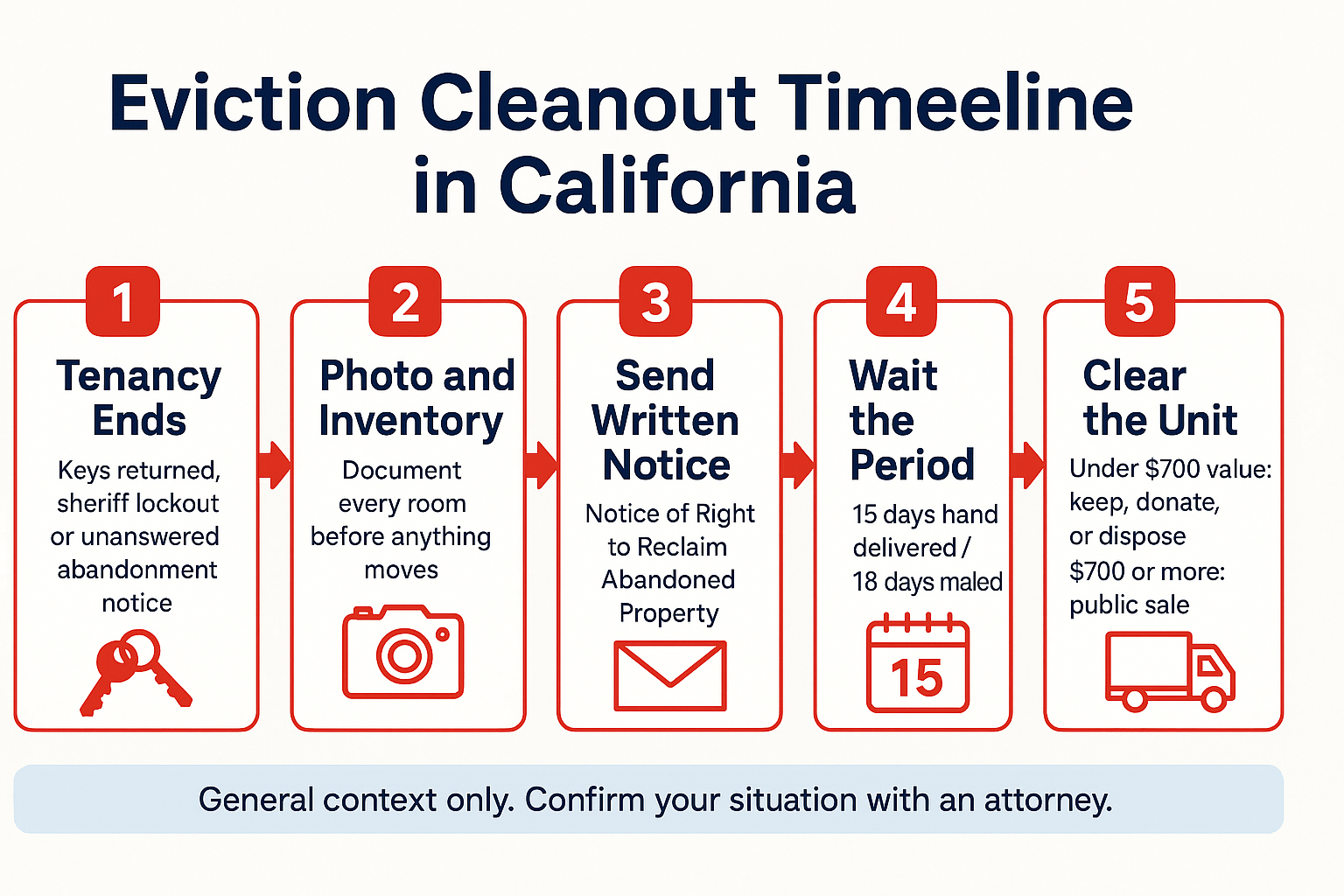
Here’s the sequence in plain language:
- Send a written Notice of Right to Reclaim Abandoned Property to the former tenant at their last known address, and to anyone else you reasonably believe owns the items.
- The notice has to describe the property in enough detail that the owner can identify it, and say where and when it can be picked up.
- The former tenant gets at least 15 days if the notice was hand delivered, or 18 days if it was mailed.
- Under section 1988, if you reasonably believe the total resale value is under $700, you can keep, donate, or dispose of the items once the window closes.
- If the value is $700 or more, it generally has to go to a public sale, with leftover proceeds turned over to the county.
Before anything moves an inch, photograph and inventory everything. Wide shots of each room, then close shots of anything with real value. That record is what protects you if the tenant resurfaces three weeks later asking about a TV.
One plain line: this is general local context, not legal advice. An attorney or your property management company should confirm the specifics for your situation.

The Mistake That Costs Landlords the Most
The costliest error I see is not the disposal step. It’s clearing the unit before the tenancy has clearly ended.
Late rent plus an empty-looking unit is not abandonment. A tenant can be gone for two weeks visiting family and still be legally in possession. If you haul their things out and they were still a tenant, that can look like an illegal eviction, and you can be on the hook for the value of the property.
The safe positions are narrow and worth memorizing:
- Voluntary surrender. The tenant handed back the keys, or gave written notice and moved out.
- Sheriff lockout. The unlawful detainer case finished and the sheriff performed the lockout.
- Notice of Belief of Abandonment under Civil Code 1951.3 that went unanswered within the statutory period.
Until one of those is true, nothing leaves the unit. Not the trash, not the mattress, not the food in the fridge.
I’d rather tell a property manager to wait nine more days than send a crew into a job that turns into a lawsuit. And honestly, once the date is locked, the rest of the turnover gets easier to plan. If you’re mapping out what has to happen after the unit is legally yours again, our breakdown of landlord cleanouts between tenants walks through what you can skip and what you can’t.
Is the Unit Actually Clear to Empty?
This is the check I run through with landlords on the phone before we put a date on the calendar.
| Situation | Tenancy clearly over? | What comes next |
|---|---|---|
| Tenant handed over keys in person or in writing | Yes | Inventory, then send the Notice of Right to Reclaim if belongings remain |
| Sheriff completed the lockout after an eviction | Yes | Inventory, send notice, wait 15 or 18 days before disposing |
| Rent is 30 days late and nobody answers the door | No | Consider a Notice of Belief of Abandonment under 1951.3 or start the eviction process |
| Neighbors say the tenant moved out, unit looks empty | No | Written process only. Do not enter and clear based on appearances |
| Tenant emailed that they are gone but left furniture | Usually yes | Confirm in writing, inventory, then run the notice period |
The Eviction Cleanout Timeline at a Glance
Here’s how the legal steps and the hauling steps line up on the same calendar.
How the Hauling Works Around That Waiting Period
This is the part nobody writes about, and it’s the part that decides whether you start paint on schedule.
Most abandoned units split into two piles:
- Obvious trash. Spoiled food, soiled mattresses, broken furniture, loose garbage, and anything unsanitary. This is generally handled right away once the tenancy is over.
- Personal belongings. Clothing, boxes, electronics, tools, furniture with real value. These get inventoried and staged somewhere secure until the notice window closes.
Because of that split, two visits often beat one. A first pass clears the debris so your painters and flooring crew can get moving. A second pass, booked for a specific day after the deadline, takes out whatever the former tenant never came back for.
That’s a different kind of booking than an emergency same day call. You know the date weeks ahead, so you hold it. We can schedule seven days a week, and same day is possible when you call before noon, but for an eviction cleanout the whole point is landing on the planned date.
On cost, I won’t quote you a number in an article. What actually drives it is:
- Load volume and weight, especially mattresses, appliances, and anything waterlogged
- Stairs and carry distance from the unit to where the truck can park
- How long the crew is on site, which is really a question of how much sorting is involved
- Whether a dumpster makes more sense than a full-service load for a multi-unit or long-running turnover
A free walkthrough estimate is the only honest way to get a real number. If you’re trying to figure out whether your job is a one truck job or something bigger, we break down how large cleanout jobs get scoped.
The Two-Stop Problem: What Can’t Go in the Load
Abandoned units almost always hold things that can’t ride to the landfill in a general load or sit in a rented dumpster. I’ve opened up more than a few garages in Hollister and Gilroy rentals and found:
- Half cans of paint and stain
- Used motor oil and antifreeze
- Car batteries
- Cleaning chemicals and pool supplies
- Old TVs, monitors, and other electronics
Those have to go to a household hazardous waste program, which turns your cleanout into a two stop job. San Benito County runs free household hazardous waste events at the John Smith Road Landfill on the third Saturday of each month, 9am to 12pm, with proof of residency required and limits on what you can bring. You can confirm current details and accepted items on the San Benito County household hazardous waste program page.
Gilroy properties fall under a separate set of programs through Recology South Valley, including bulky item collection, so the answer for a Santa Clara County rental is not the same as the answer for a San Benito County one.
One more thing that trips people up: a vehicle left in the carport is not covered by the abandoned property process for household goods. Vehicles follow Vehicle Code procedures instead. That’s its own conversation, and it’s worth handling separately from the unit cleanout.
If you’re deciding between a full-service crew and dropping a container on site, the rules about where a rented dumpster can legally sit matter more than most landlords expect, especially on narrow downtown streets.
Frequently Asked Questions About Eviction Cleanouts
Can I just throw out a tenant’s stuff if it looks like garbage?
Obvious trash like spoiled food, soiled bedding, and broken junk is generally treated differently from personal belongings. But anything that a reasonable person would call personal property needs the written notice and the waiting period first. When in doubt, photograph it and hold it.
How long do I actually have to wait before clearing the unit?
At least 15 days if you hand delivered the Notice of Right to Reclaim, or 18 days if you mailed it. The clock starts from delivery, not from the day the tenant moved out.
What if the tenant’s belongings are worth more than $700?
Under Civil Code 1988, property you reasonably believe is worth $700 or more generally has to be sold at a public sale, with notice published, and leftover proceeds turned over to the county. Below that threshold, you can keep, donate, or dispose of it once the notice period ends. Have an attorney confirm how the valuation applies to your unit.
Can you come out before the notice period is over?
Yes, for the debris side. A lot of landlords have us clear the unsanitary and clearly discarded material first so paint and flooring can start, then book a second visit for the day after the deadline. It keeps the turnover moving without touching anything you’re still holding.
Do I need to be there when the crew shows up?
Not necessarily, but for an eviction cleanout I recommend it, or at least having your property manager present. Somebody should confirm what’s leaving and what’s being held, and having a second set of eyes on the inventory is worth the hour.
What about a car the tenant abandoned in the parking space?
That one follows Vehicle Code procedures, not the household goods process. Junk car removal is something we handle, but the paperwork path is different, so treat it as a separate item on your list.
Planning a Cleanout Around a Notice Deadline?
When a cleanout has to land on a specific date after a notice period expires, showing up in the window is the whole ballgame. One property owner put it simply in a review: “They delivered and picked up on time, as promised.” – Doris R.
If you’re working through a turnover in Hollister, Gilroy, Salinas, or elsewhere in Monterey County and San Benito County, it’s worth calling ahead once you know your date so a day can be held. MG Transportation & Hauling can be reached at (831) 297-1972 or at mgtransportationhauling.com for a free walkthrough estimate.
