
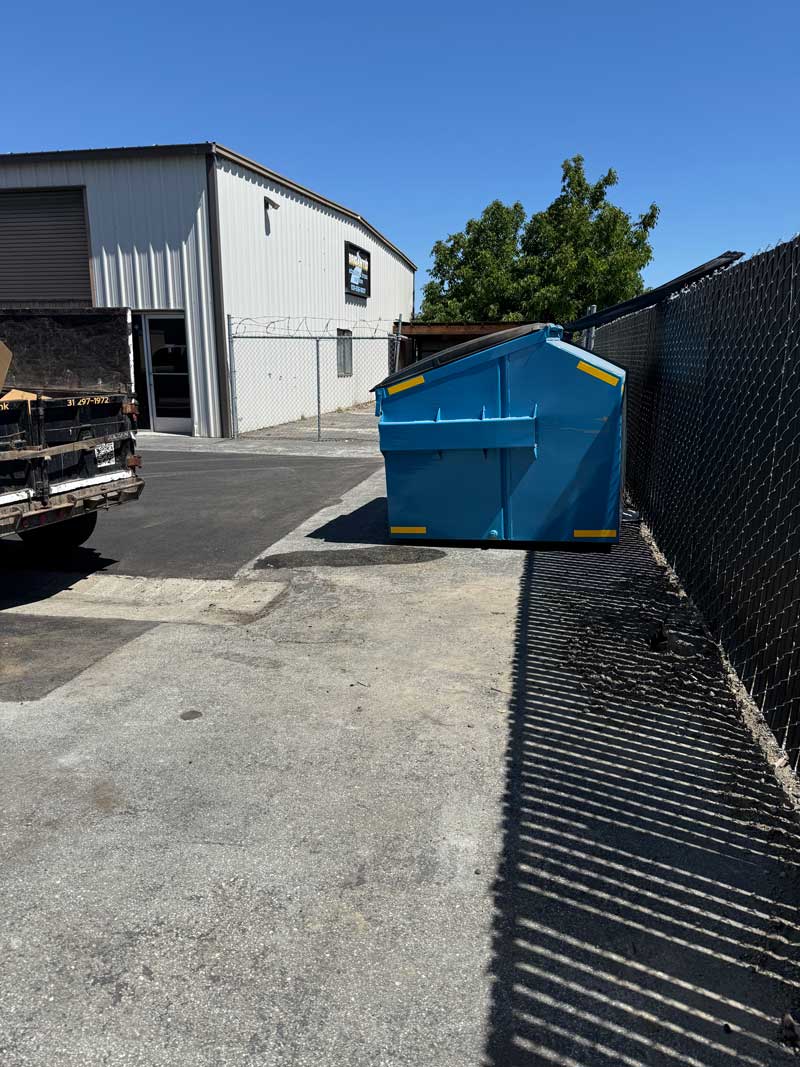
Direct Answer: A rented dumpster on your own driveway, paved side yard, or job site needs no permit. Placing one in a public street usually requires a city encroachment permit applied for days in advance.
You already picked the size. The delivery is set for Thursday morning. And then it hits you that nobody has actually said where the container is going to sit.
Most people assume the driveway is the automatic spot and the street is the easy backup. In practice it works the other way around, because street placement is the option that drags a city permit into your week.
This is a five minute decision that quietly controls three things: whether you need paperwork, whether your concrete gets marked up, and whether the truck can even get the box back out on pickup day. I want to walk you through how I actually think about it on Hollister and Gilroy jobs.
Dumpster placement and street permit rules: private property is the shortcut
Here is the split that matters. A container on your own property (driveway, paved side yard, or an active job site) sits outside the public right of way, so no city permit comes into play. A container in the street, a bike lane, or a public parking strip is a different animal.
In Gilroy, anything that occupies or impedes the public right of way runs through Public Works as an encroachment permit. That is a real application with review time attached to it. It is not something a driver can smooth over at 7 a.m. on delivery morning.
Hollister works on the same principle. The city’s Development Services and Building Division publishes its own encroachment permit application right alongside its other permit forms, so a box in a San Benito County street follows the same basic path.
What that means for you:
- Start asking days early, not the night before, if street placement is your only option
- Expect a permit fee that varies by city and by how long the box stays out
- Know that narrow older streets near downtown may get more scrutiny than a wide suburban block
- Understand that a hauler cannot pull a permit on your behalf at the curb
That is why the large majority of residential jobs I see in both cities end up in the driveway.
What makes a driveway spot work, and what makes it fail
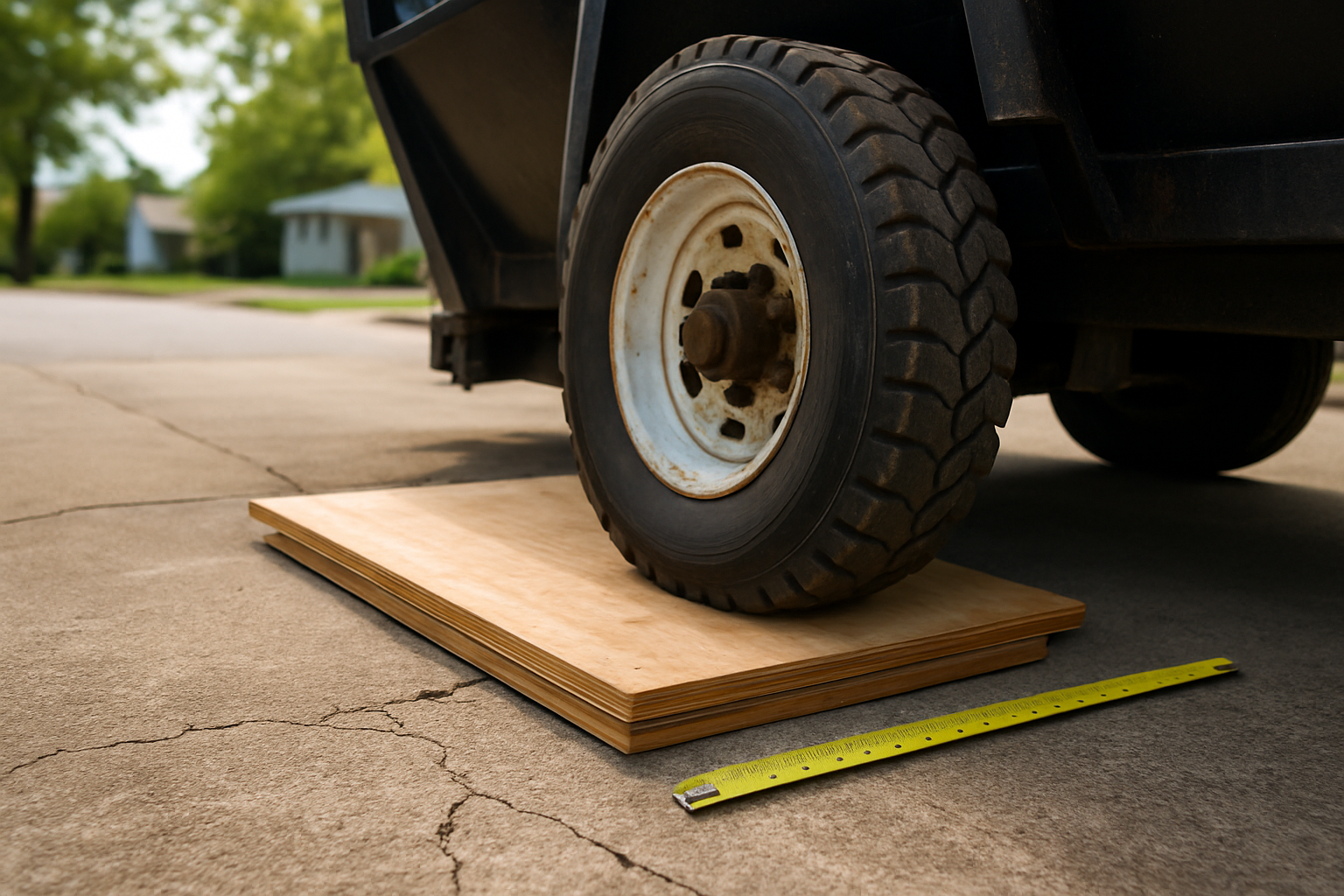
A loaded roll-off box is heavy. Put that weight on older concrete or a driveway with hairline cracks and you can end up with press marks or a spidered corner where the wheels sat.
The fix is cheap and it is standard practice: plywood or planks under the wheels and rails. I would rather spend two minutes laying boards than have a conversation about your driveway later. If your slab is newer and thick, the risk drops, but I still like the boards.
The bigger surprise for homeowners is not the ground. It is the air. The truck has to tilt the box up off the bed to set it down and again to load it back up, which needs real vertical room.
Things that block that tilt more often than people expect:
- Low tree limbs, especially older pepper and oak trees in established Hollister neighborhoods
- Overhead service drops running from the pole to the house
- Carport roofs and patio covers
- Basketball hoops mounted over the driveway apron
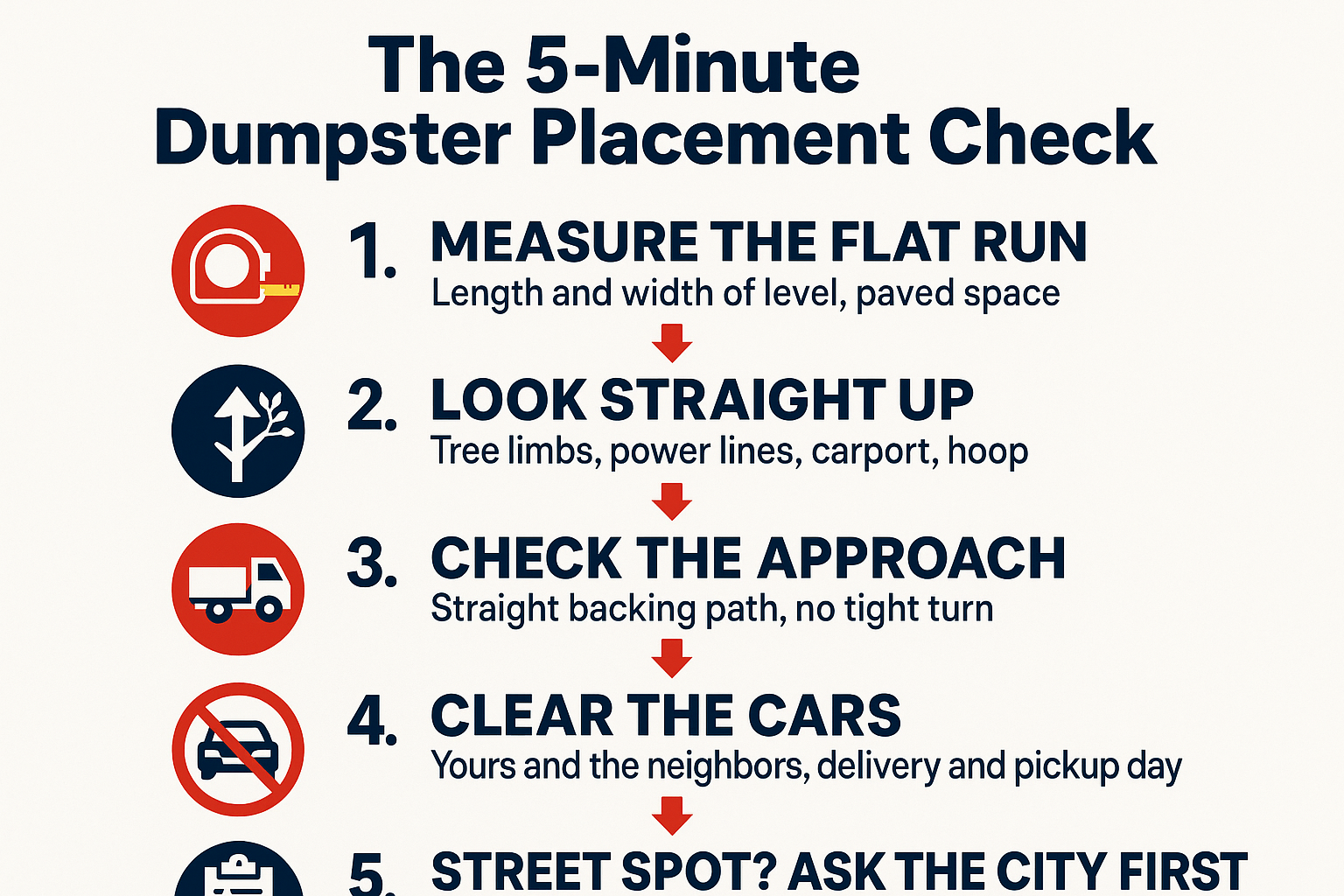
Do this quick self check before you book. Measure the flat run of driveway you actually have available, look straight up at that same spot, and then decide who is moving their car on delivery day. Square footage on the ground is rarely the limiting factor. Height and approach are.
Comparing Your Three Placement Options
Here is how the three common spots stack up on the things that actually cost you time or money.
| Placement | Permit path | Main risk | Best fit |
|---|---|---|---|
| Driveway | None required on private property | Surface marks on older concrete; overhead clearance | Most home cleanouts, garage and estate jobs |
| Public street | City encroachment permit, applied for days ahead | Permit fee, review time, narrow street limits | Homes with no usable driveway or a long approach |
| Paved side yard or job site | None required on private property | Soft ground, gate width, tight swing path | Contractor work, remodels, rear-lot access |
The Five Minute Placement Check
Run through this before your delivery date and you will avoid almost every common placement problem.
The four things that stall a delivery
When a drop gets delayed or moved, it is almost always one of these four:
- A car parked in the drop zone. Yours, a roommate’s, or a neighbor who parks over the apron every morning.
- A gate narrower than the box. Measure the opening, not the fence line.
- Soft or unpaved ground. A side yard that looks fine in July turns into ruts after the first real rain.
- A blocked swing path. The truck needs room to back straight and tilt, not just room for the box itself.
A wasted trip is not free for anyone. When a truck has to leave and come back, that is a slot nobody planned for, and re-delivery or relocation charges are common across this industry.
I would rather tell you that plainly than surprise you with it. Hidden costs are the number one thing customers tell me they are worried about, and the honest answer is that these fees exist, they exist because of fuel and crew time, and the way to avoid them is a ten minute conversation before the truck rolls.
Placement decides how easy pickup is
People pick a spot based on how convenient it is to load. Then the box fills up and the same spot becomes a problem, because a container ringed by project debris or wedged behind a parked car cannot go anywhere.
How you load it matters just as much:
- Nothing above the fill line on the inside wall
- No boards, pipe, or furniture legs sticking out past the rails
- Heavy material like concrete, dirt, and roofing spread flat across the floor instead of piled in one corner
An overloaded or unevenly loaded box cannot be legally or safely hauled, which turns into a second trip. Weight also drives your final cost, which is one reason rental length and load type deserve some thought up front.
Clean placement is what makes the whole rental feel boring in the best way. One local customer summed up the outcome people are really paying for: “They delivered and picked up on time, as promised.” That only happens when the box can leave as easily as it arrived.
If your project is mostly heavy or awkward material with no good staging spot, it may be worth comparing a crew that loads for you against a container you fill yourself.
Where the load actually goes after it leaves your driveway
First-time renters ask me this constantly, and it is a fair question. Loads from Hollister jobs generally head toward the John Smith Road Landfill on the San Benito County side, with recoverable material pulled out where it can be.
Some things never belong in the container at all. Paint, solvents, batteries, and similar household chemicals go to the free household hazardous waste events that San Benito County Integrated Waste Management runs at that same site on the third Saturday of each month, with proof of residency. We do not haul hazardous material, and no reputable operator will.
On the Gilroy side, Recology South Valley handles residential collection and offers curbside bulky item pickups. If you have two chairs and a mattress, that program may be all you need. A container makes sense when the volume is real, not when it is a weekend of light decluttering.
On pricing, I will not throw a number at you here, because permit fees, container size, material weight, and how long you keep it all move it. Remodel debris in particular has its own disposal path and cost profile, and your city or your hauler can give you real figures for your address.
Frequently Asked Questions About Dumpster Placement and Street Permits
Do I need a permit to put a dumpster in my own driveway in Hollister or Gilroy?
No. Your driveway is private property, so it sits outside the public right of way and no city encroachment permit applies. The permit question only comes up when the container occupies a street, sidewalk, alley, or other public space.
How far ahead do I need to apply for a street placement permit?
Start days ahead, not the night before. Gilroy runs right-of-way activity through Public Works and Hollister handles it through Development Services, and both involve staff review. If your delivery is Thursday and you call the city Wednesday afternoon, you are probably not getting a street spot.
Will the container crack my driveway?
It can leave marks on older or already-cracked concrete, which is why plywood or planks under the wheels and rails is standard. I will always ask about the age and condition of your slab before we set a box down, and on questionable concrete I would rather find another spot than risk it.
What happens if the truck shows up and the spot is blocked?
Usually we can work it out on the spot by moving a car or shifting the placement a few feet. If the drop truly cannot happen, the truck has to leave and come back, and re-delivery charges are common in this industry because of the fuel and crew time involved. Clearing the zone the night before avoids the whole thing.
Can I put the container on grass or dirt in the side yard?
Sometimes, but I am cautious about it. Dry, compacted ground in summer can hold a box fine, while the same spot after a Central Coast rain turns into ruts that a loaded truck cannot pull out of. Paved surfaces are always the safer call.
Thinking through where your container should go?
We keep 10, 15, and 25 yard containers running across Hollister, Gilroy, and the surrounding Monterey County, CA area, and we scout the spot before the box arrives rather than dropping it wherever it fits. Knowing which driveways, side yards, and older streets a roll-off truck can actually work in is the part that comes from being local. If you want to talk placement before you book, MG Transportation & Hauling can be reached at (831) 297-1972.
