

Direct Answer: Property managers need a hauling crew that shows up on time, documents the work, and fits their schedule, not the other way around. Most haulers don’t deliver all three.
If you manage rental properties in Hollister or Gilroy, you already know what a bad hauling crew costs you. It’s not just the cleanup bill. It’s the extra days the unit sits vacant, the contractor who shows up and can’t work because the debris is still there, and the late-night phone call trying to track down someone who never arrived.
Property managers operate on a different set of expectations than homeowners. When a homeowner needs junk removed, they mostly want it gone. When a property manager needs it gone, there’s usually a lease deadline, a paint crew scheduled for the following morning, and a prospective tenant touring at the end of the week. The margin for error is close to zero.
This article focuses on the two or three things that actually separate a capable commercial hauling crew from one who’s fine for a one-time homeowner job but not built for the demands of property management. If you’ve been burned by unreliable crews before, these are the questions you need to be asking upfront.
The Real Cost of a No-Show on a Unit Turn
Between-tenant cleanouts are, by volume, the most common job we do for property managers in the Hollister and Gilroy area. And they’re almost always time-sensitive in a way that a standard junk call is not.
A typical unit turn might involve:
- A couch, mattress, or bed frame left in the living room or bedroom
- Bags of trash or personal items abandoned in a garage or storage unit
- A broken appliance, usually a microwave or mini-fridge, that the tenant didn’t take
- Random debris in a parking stall or shared outdoor area
- Occasionally, a full room’s worth of furniture if the tenant left in a hurry
None of that is especially complicated to remove. What makes it complicated is the scheduling chain attached to it. The hauler has to come before the cleaning crew, who has to finish before the painter, who needs to be done before the property inspection. One no-show at the start collapses everything that follows.
We’ve had property managers reach out to us after exactly this scenario. One Hollister property manager described calling a hauler who confirmed a morning appointment, then simply never appeared and stopped responding. By the time she found a replacement, she’d lost two days and had to reschedule everything downstream. That’s not a minor inconvenience. In a rental market where a two-bedroom in San Benito County can run $1,800 to $2,200 per month, two lost days of vacancy is real money.
For a deeper look at what a unit-turn cleanout actually involves, our landlord cleanout guide breaks down what’s worth prioritizing and what can wait.

What to Ask Before You Hire Any Hauler for a Commercial Job
Most homeowners don’t think to ask a hauler for documentation. Property managers should always ask, and the answers will tell you a lot about who you’re actually dealing with.
Before committing to any crew for a commercial hauling job, these are the questions worth asking:
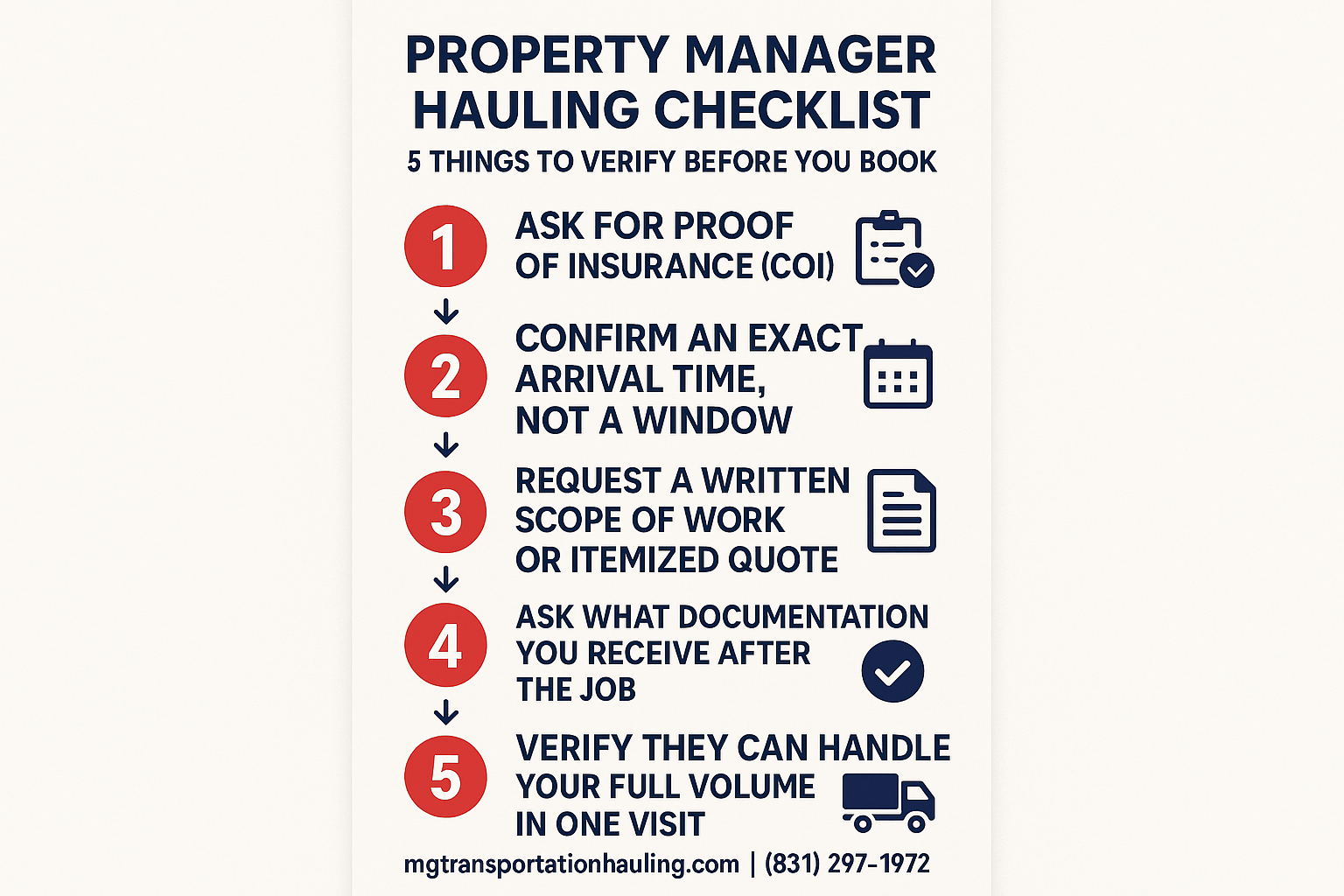
- Are you licensed and insured? Any legitimate operator should carry general liability insurance. On a commercial property, this matters. If something gets damaged during removal, you want to know there’s coverage.
- Can you provide a certificate of insurance? Asking for the COI is the actual verification step. A crew that hesitates here is a crew worth walking away from.
- What documentation do I receive after the job? A professional hauler should be able to tell you what was removed and where it went. This is especially relevant if you’re managing a property for an owner or HOA and need to account for disposal.
- How do you handle items that can’t go to a standard landfill? Not everything a tenant leaves behind goes to the same place. Knowing that your hauler understands this distinction matters.
- What’s your scheduling window? A hauler who gives you a four-hour window is harder to work with than one who can commit to a specific time. Ask directly.
These aren’t aggressive questions. They’re standard for any commercial service, and a crew that’s done this work before will answer them without blinking. According to the California Contractors State License Board, verifying a contractor’s license and insurance before work begins is one of the most basic consumer protections available, and it applies equally to hauling and debris removal work.
For a broader look at what separates reliable hauling crews from ones that cut corners, this breakdown of what makes a crew worth trusting is worth a few minutes of your time.
What Property Managers Should Verify Before Hiring a Hauler
This checklist covers the five verification steps that protect property managers from unreliable or underprepared hauling crews.
Why Fall Is Actually the Better Window for Commercial Cleanouts
May through August is peak demand for hauling and cleanout work around Hollister and Gilroy. Families are moving, leases are turning over, and everyone needs something removed at the same time. Scheduling during that window is harder, lead times stretch, and the best crews book out faster.
Property managers who plan cleanouts in September through November tend to get a smoother experience on almost every dimension. Scheduling is more flexible. Crews have more availability. And the work itself often moves faster because you’re not competing for the same timeslots as a dozen other landlords doing turnover work in the same week.
Fall also tends to be when property managers do their year-end property preparation: clearing units that sat vacant over the summer, reducing liability exposure before winter, and getting properties ready for annual inspections. Treating that work as a planned project rather than an emergency response usually produces better results and fewer surprises on the bill.
If you’re managing multiple units in San Benito County or the Gilroy area and you know you have two or three cleanouts coming up before December, reaching out in September gives you real scheduling flexibility. Waiting until the week before you need the work done makes everything harder.
For a practical look at how scope affects cost, what junk hauling actually costs in Hollister walks through the factors that drive the number up or down, useful reading before you request quotes.
Summer vs. Fall Cleanout Scheduling, What Changes
For property managers coordinating multiple unit turns or end-of-lease cleanouts, the timing of the job affects more than just the calendar.
| Factor | Summer (May – August) | Fall (September – November) |
|---|---|---|
| Scheduling availability | High demand, tighter lead times | More flexible, easier to book |
| Coordination with contractors | Painters, cleaners also busy | Trades generally more available |
| Typical trigger | Lease expirations, move-outs | Year-end prep, liability reduction |
| Best approach | Call early, book as soon as possible | Plan ahead, batch jobs if possible |
| Urgency level | Often reactive, short timeline | Usually proactive, more predictable |
The Scheduling and Communication Gap Most Haulers Don’t Fill
One thing I hear consistently from property managers who’ve used us more than once is that what kept them coming back wasn’t the price. It was knowing that when we say we’ll be there at 10 a.m., we’re there at 10 a.m.
Amber Caradonna, one of our reviewers, described reaching out last minute and being told the crew would arrive at 10 a.m. Her words: “he showed up right on time.” That sounds like a low bar, but if you’ve managed properties long enough, you know it isn’t.
For property managers coordinating multiple trades on a unit turn, communication isn’t a soft benefit. It’s the whole decision. A hauler who goes quiet after booking, shows up in a vague two-hour window, or texts to say they’re running late while your painter is standing in the parking lot is a hauler who is costing you money.
What actually works for commercial jobs is:
- A confirmed arrival time, not a window
- A response time measured in minutes, not hours, when you call or text with a question
- A crew that can assess scope on arrival and tell you honestly if the job is bigger than quoted
- Cleanup included so the unit is actually ready for the next trade when the crew leaves
If you’re comparing options, understanding what drives junk removal quotes versus final bills is worth reading before you commit to anyone. Scope surprises on a commercial job are avoidable when you know the right questions to ask upfront.
For jobs where the volume is large enough that you’re weighing a dumpster against a full-service crew, this comparison of dumpster rental versus full-service junk removal lays out how to decide which approach actually fits the job.
Frequently Asked Questions About Commercial Junk Hauling for Property Managers
Do you provide a certificate of insurance for commercial property jobs?
Yes. Any legitimate hauling company doing work on a commercial property should be able to provide proof of insurance before the job starts. If a crew you’re considering hesitates to provide a COI, that’s a clear signal to keep looking.
Can you work around our contractor schedule instead of giving us a wide arrival window?
We commit to specific arrival times, not windows. Property managers coordinating with painters, cleaners, or inspectors can’t plan around a crew that might show up anytime between 8 a.m. and noon. When we book a job, we book a time.
What happens if the tenant left more than expected when your crew arrives?
We assess what’s actually there when we arrive and give you an honest picture of scope before we start loading. If the job is larger than what was described on the call, we’ll walk through the additional cost with you before we begin, not after. No surprises on the back end.
How much does a between-tenant cleanout typically cost in Hollister or Gilroy?
Cost varies based on volume, the types of items involved, and whether you need same-day scheduling. In general, smaller single-unit turnover jobs tend to run less than a full property cleanout, while units with furniture, appliances, and garage debris can get into a higher range. The best way to get an accurate number is to describe the unit and what was left behind when you call.
Can you handle commercial cleanout jobs across multiple units at the same property?
Yes. Multi-unit jobs are something we’re set up for. If you’re managing an apartment complex or a commercial building with several spaces to clear, we can talk through the best way to schedule that work so it doesn’t drag out over multiple separate visits.
Is fall really a better time to schedule than summer?
In practical terms, yes. Summer is our busiest season and scheduling compresses. If you have cleanouts planned for before the end of the year and you’re not operating on an emergency timeline, September through November gives you more flexibility to get exactly the date and time you need. It’s the difference between planning and reacting.
Ready to Find a Hauler Who Actually Works on Your Schedule?
If you’re managing properties in Hollister, Gilroy, or anywhere in San Benito County and you’ve spent too much time chasing down unreliable crews, we’d be glad to talk through what your cleanout actually involves. MG Transportation & Hauling works with property managers, landlords, and real estate professionals throughout the area, and we’re built for jobs where the schedule matters as much as the work itself. Call us at (831) 297-1972 or visit mgtransportationhauling.com to describe your job and get a straightforward quote.
