

Direct Answer: A hoarder house cleanout starts with a walk-through assessment, moves zone by zone through the property, and involves careful sorting before anything gets hauled. It takes longer than a standard cleanout and requires a crew that handles the process with discretion.
Most people who call us about a hoarder house cleanout aren’t the person who lives there. They’re the adult child who drove up from Gilroy after a parent passed away. They’re the sibling who’s been putting off the conversation for two years. They’re the landlord who inherited a situation they didn’t expect. Whatever brought you here, you’re not just asking someone to move stuff — you’re asking someone to enter a space that carries a lot of emotional weight for somebody you care about.
That context matters. A crew that treats a hoarder cleanout the same as a garage haul is going to create problems — things lost, decisions made too fast, and a process that feels chaotic instead of controlled. I’ve seen what the right approach looks like and what the wrong one costs people, and the difference comes down to a few specific things.
This article walks through the full process, from the first visit to the last load. If you’re trying to figure out how to get something like this done in the Hollister or Gilroy area — without making an already hard situation worse — this is what you need to know.
Why the Walk-Through Matters Before Anything Gets Touched
The single biggest mistake in a hoarder cleanout is starting before you understand what you’re dealing with. A proper first-visit assessment isn’t a formality — it’s where the job actually begins.
Here’s what we’re looking at during that walk-through:
- Pathway conditions — Are hallways and doorways blocked? Can we move a loaded cart through safely, or does the access change the plan?
- Weight and structural concerns — Years of accumulation can put real load on floors. Rooms stacked floor to ceiling aren’t just a volume problem; they’re a safety one.
- Buried valuables — Documents, medications, cash, and keepsakes are routinely found under layers of items in these situations. A crew that starts loading without looking first will throw away things that can’t be replaced.
- Volume estimate — This determines how many loads, what equipment makes sense, and whether a dumpster rental or full crew removal is the better call. You can read more about when a junk removal crew makes more sense than a dumpster if you’re weighing that decision.
The walk-through also gives the family or property owner a chance to flag things before the work starts — items to keep, areas that need special handling, or anything the crew should know going in. That conversation up front saves a lot of grief later.

Working Zone by Zone — and Why That Approach Works
You can’t just start pulling things out of a hoarder home and hope it goes well. The volume is too large, the decisions are too many, and the person overseeing the job will burn out fast if everything happens at once.
What works better is a zone-by-zone approach — one room or section at a time, cleared completely before moving to the next. Here’s why this matters:
- Family members or the property owner can review each area and weigh in on what stays, what gets donated, and what gets hauled — before the next room opens up
- It keeps the work contained and visible, so nothing goes missing in a chaotic single-day blitz
- It reduces decision fatigue, which is real and serious in these situations — especially when there’s grief involved
- It lets us catch buried items (documents, prescriptions, valuables) in a methodical way rather than missing them under a pile
For a large home, this might mean breaking the job into multiple visits. For a smaller property in Hollister or Gilroy, we might get through the full house in one day — but still zone by zone, not all at once. The pace is driven by what the situation actually needs, not by what’s fastest for the crew.
If you’ve wondered how long it takes to clear out a house, the honest answer is that a hoarder situation almost always runs longer than a standard cleanout — plan accordingly.
The Hoarder Cleanout Process: What Happens at Each Stage
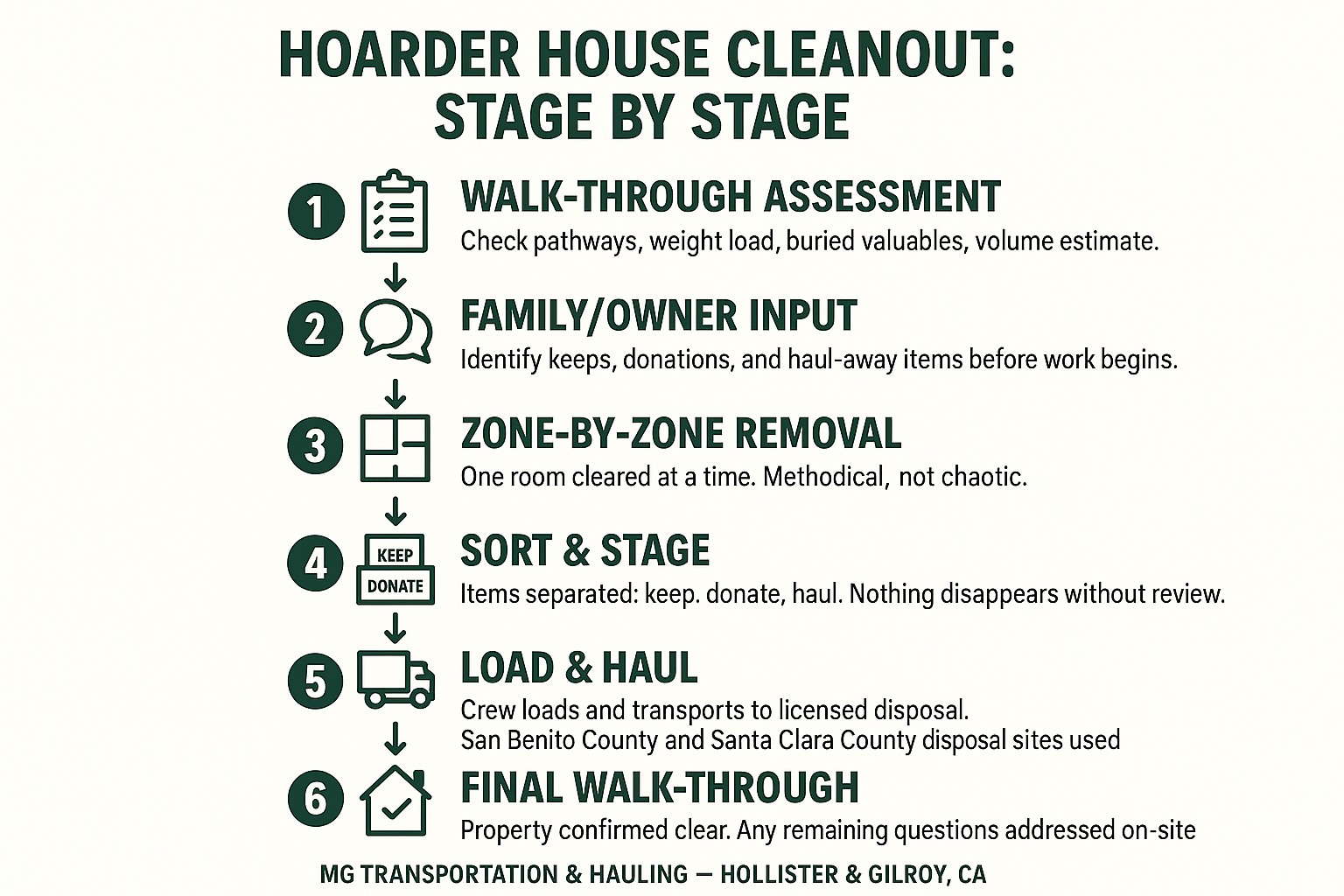
This breakdown shows the six stages of a hoarder house cleanout, from initial assessment through final haul-away — so you know what to expect and when.
Discretion Is Part of the Job — Not a Nice-to-Have
People in hoarder situations are often acutely aware of who can see what’s happening. Neighbors. Other family members. Passersby on the street. The last thing someone already dealing with grief or embarrassment needs is a crew that turns the cleanout into a spectacle.
Discretion in this work is practical, not just polite. Here’s what that looks like on the ground:
- Working efficiently — a crew that moves with purpose doesn’t linger on the driveway or leave things staged in the front yard longer than necessary
- Keeping the process contained — items go from inside the home to the truck, not spread across the property where everyone walking by can see
- No commentary — a professional crew doesn’t remark on the condition of the home, the volume of items, or anything that would add to the stress of the family or owner nearby
This is something I take seriously. When someone is watching their parent’s belongings being loaded into a truck, or standing in a home they haven’t entered in years, the crew’s behavior is part of the service. It either makes the day bearable or it makes it worse.
For anyone wondering what separates a reliable hauling crew from a bad one, this is near the top of the list.
Hoarder Cleanout vs. Standard Cleanout: What’s Actually Different
If you’ve hired someone for a garage haul before, a hoarder cleanout will feel different in several important ways. Here’s a side-by-side look at what changes.
| Factor | Standard Cleanout | Hoarder House Cleanout |
|---|---|---|
| Walk-Through Required | Usually brief or skipped | Always required — access, safety, and volume assessment |
| Timeline | Often same-day or one visit | Frequently multi-visit; depends on home size and volume |
| Sorting Process | Basic keep/haul decision | Zone-by-zone sorting with owner input at each stage |
| Hidden Items | Rarely an issue | Documents, medications, valuables often buried — requires careful handling |
| Crew Approach | Load and go | Methodical, contained, with active communication throughout |
| Emotional Dimension | Usually neutral | Often involves grief, family dynamics, or sensitive history |
| Pricing Factors | Volume and access | Volume, access, number of visits, sorting complexity, disposal mix |
What Disposal Actually Looks Like — and What It Costs
One of the most common questions I get is what happens to everything after it leaves the property. For hoarder cleanouts, the disposal mix is almost always more complicated than a standard haul.
Most loads include a combination of:
- General household debris routed to a licensed landfill — in this area, that often means the John Smith Road Landfill or transfer stations serving San Benito and South Santa Clara Counties
- Donatable items that can go to local organizations if they’re in usable condition — furniture, clothing, kitchenware, that sort of thing
- Items requiring separate handling — electronics, appliances, mattresses, and certain materials may need to go to different facilities. You can learn more about how disposal decisions get made after a large cleanout if you want the full picture.
On pricing: hoarder cleanouts vary more than almost any other job we do, because the volume, number of visits, and disposal complexity all affect the final cost. Many factors drive the range — volume per load, the number of truck runs, whether a dumpster rental makes more sense for part of the job, and what’s in the load. We always provide upfront pricing before work begins, and we’re straightforward about what drives the number. There are no hidden fees — one customer who hired us for an estate situation noted we disclosed all information upfront with no surprises on the bill.
For a broader look at how quotes and final costs can differ on large jobs, this article on why your quote and final bill don’t always match is worth reading before you call anyone.
Frequently Asked Questions About Hoarder House Cleanouts
Do I need to be present for the entire cleanout?
It depends on your situation and comfort level. For hoarder cleanouts, I’d recommend that someone who knows the property is present for at least the first walk-through and the start of each zone. That person doesn’t have to be there every minute, but having a point of contact available means decisions about borderline items don’t get made without input. If no family member is able to be present, a designated property manager or real estate agent can fill that role.
What items can’t be hauled away during a hoarder cleanout?
We handle general household items, furniture, appliances, debris, and most of what you’d find in a residential property. We do not handle hazardous materials, chemicals, asbestos, or biohazardous waste — those require licensed specialty crews. If we encounter something during the walk-through that falls outside our scope, we’ll tell you upfront so you can arrange the right handling before we start.
How do you handle items that might have sentimental or monetary value?
This is exactly why the zone-by-zone approach and the owner walk-through matter. We don’t make those calls — the family or property owner does. Our job is to slow down enough to give people the chance to review before anything gets hauled. If someone wants to go through a specific box or pile before it leaves the property, we work around that. We’ve pulled cash, documents, and keepsakes out of what looked like junk piles. Moving fast isn’t worth the cost of losing something irreplaceable.
How long does a full hoarder cleanout take in Hollister or Gilroy?
A single-bedroom situation might be done in a day. A full multi-bedroom home with years of accumulation can take two to four visits or more, depending on volume and how much sorting is involved. I give a realistic timeline estimate after the walk-through — not before, because the volume and access conditions are what drive the answer.
Is it more cost-effective to rent a dumpster or hire a full crew for a hoarder cleanout?
For most hoarder situations, full-crew removal makes more sense than a dumpster alone. The sorting complexity, the need to move items through narrow pathways, and the sheer volume of decision-making involved means having experienced hands on-site is worth it. That said, some large cleanouts use both — a crew for the removal and a dumpster staged outside for overflow. We’ll tell you what makes sense after the walk-through.
Ready to Talk Through What This Job Actually Involves?
If you’re dealing with a hoarder cleanout situation in Hollister, Gilroy, or anywhere in San Benito or South Santa Clara County, we’re used to getting calls from people who aren’t quite sure where to start. One customer who came to us after losing her mother put it simply: the owner was ‘compassionate and understanding of our situation’ — Shulena B. That’s the job. You can reach MG Transportation & Hauling at (831) 297-1972 or visit mgtransportationhauling.com/ to tell us what you’re working with — no pressure, just a straight conversation about what it takes to get it done.
