
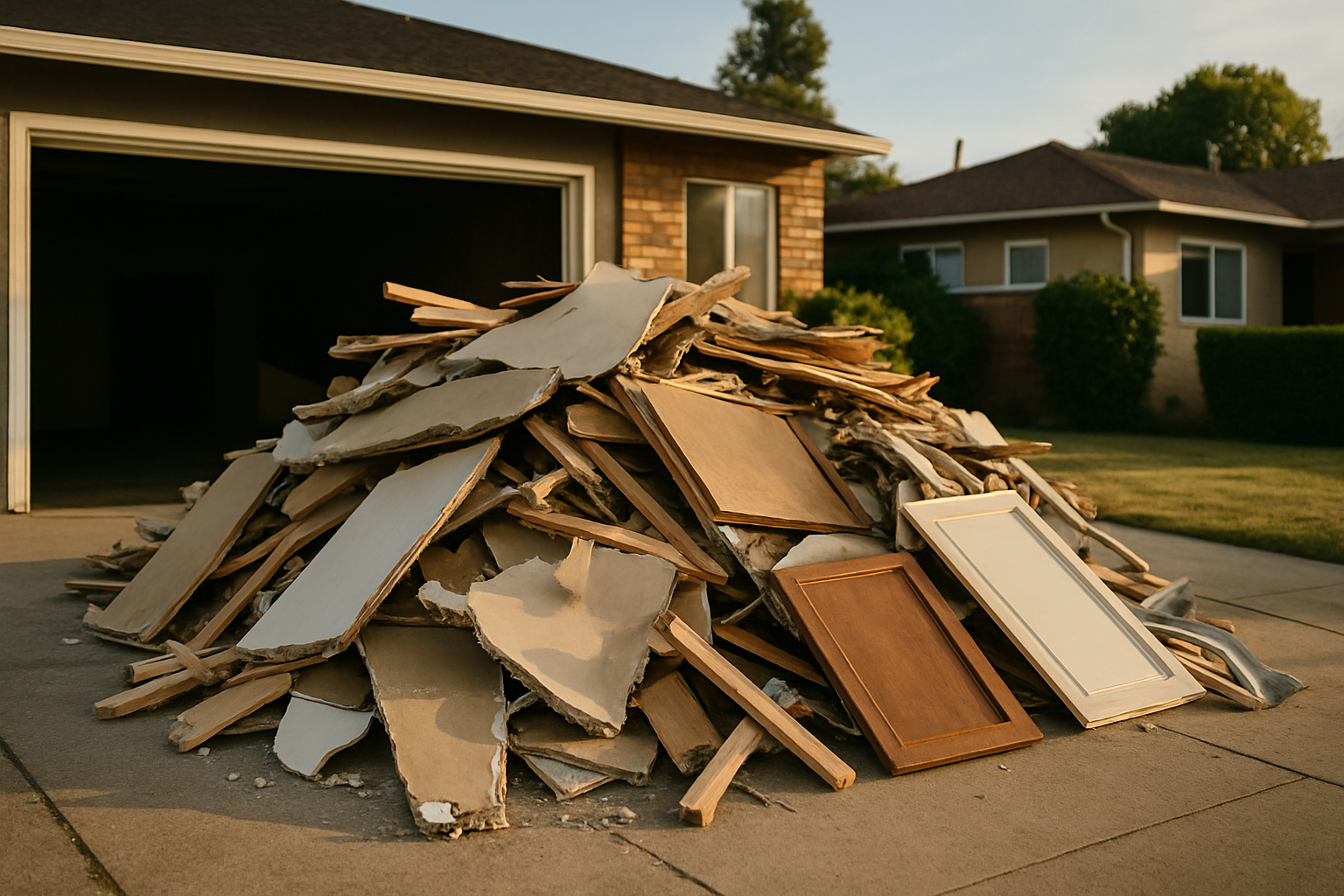
Direct Answer: Renovation junk that sits too long attracts pests, creates safety hazards, and can trigger code complaints. The longer it stays, the harder and more expensive it gets to remove.
You finished the demo. Maybe it was a bathroom gut, a kitchen remodel, or a garage conversion. The old cabinets came out, the drywall came down, and now there’s a pile of broken tile, wood scraps, and busted fixtures sitting in your driveway or stacked in a corner of the yard. You tell yourself you’ll deal with it next weekend.
That’s where it starts. In Hollister and Gilroy, we see this constantly — renovation debris that was supposed to be a temporary situation turning into a weeks-long or months-long problem. And what starts as an inconvenience has a way of becoming something that costs real money to fix.
This article covers two things that actually matter: what specifically goes wrong when construction junk sits, and what your realistic options are for getting rid of it before the situation gets worse.
What Actually Happens When Renovation Debris Sits
Most people think of leftover renovation material as just an eyesore. But there’s a practical chain of events that kicks in once debris sits for more than a week or two — and most of it costs you money.
Moisture gets in fast. In San Benito County, morning fog and coastal air push inland enough that drywall, OSB, and insulation left outside can absorb moisture within days. Once that happens, you’ve got material that’s significantly heavier than when it came out — which affects disposal cost because most haulers charge by weight and volume. What actually determines the price of junk removal explains how weight plays into final pricing, and waterlogged drywall is one of the main reasons a job ends up costing more than the homeowner expected.
Pests move in. Stacked wood framing, old cabinet boxes, and piles of insulation are exactly what rodents and termites are looking for. In warmer months around Hollister and Gilroy, that process can start in under two weeks.
There are also a few less obvious problems:
- City code complaints — Gilroy’s Building Division does respond to neighbor complaints about debris piles, and a notice can come with a deadline and potential fines
- Contractor delays — if your next trade can’t access the work area, your project timeline slips
- Material weight increase — wet drywall and soaked insulation can weigh 30–50% more than dry material, which directly raises hauling cost
- Injury risk — broken tile, exposed nail heads, and unstable stacks are a liability, especially with kids or tenants on the property
The Weight Problem Nobody Warns You About
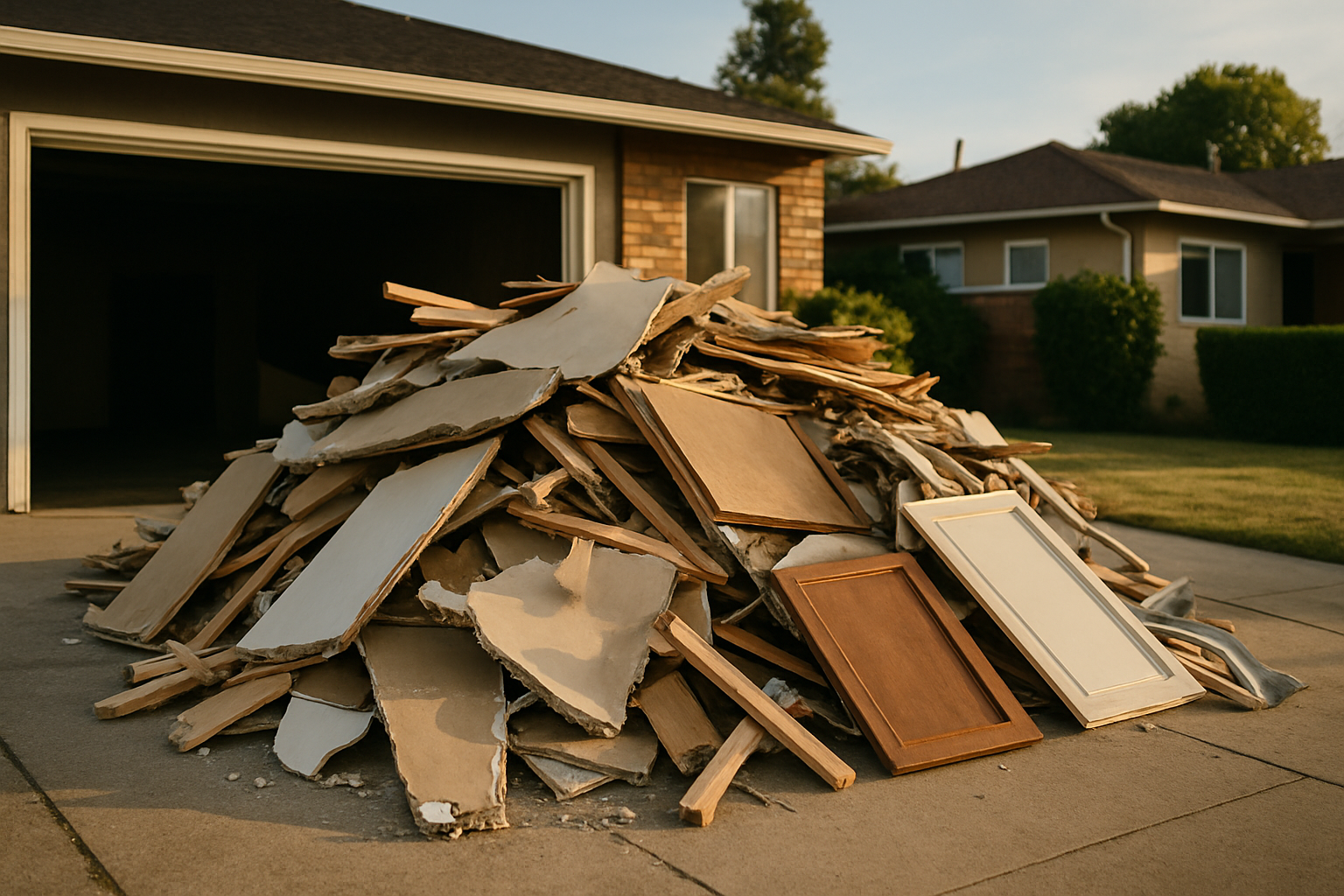
This is the one that catches people off guard the most. When you pulled that drywall out during demo, it was manageable. After a week outside in the Central Coast air, it’s a different story.
Drywall is gypsum — it absorbs water readily and becomes dense and brittle when it does. A standard 4×8 sheet of half-inch drywall weighs about 54 pounds dry. After moisture exposure, that same sheet can push 70–80 pounds. Multiply that across a full bathroom or kitchen demo, and you’re looking at a significantly heavier load than what you started with.
Why does that matter? Because hauling costs are directly tied to the weight and volume of what’s being moved. What might have been a $250–$350 haul the day after demo could become a $400–$500 job a month later — same material, just heavier and harder to handle. That’s before accounting for any additional labor to break up or sort debris that’s settled and compacted.
The same principle applies to old insulation batts, particle board cabinets, and any wood left out in the rain. Moving fast after a renovation isn’t just about convenience — it’s about keeping your disposal cost where it should be.
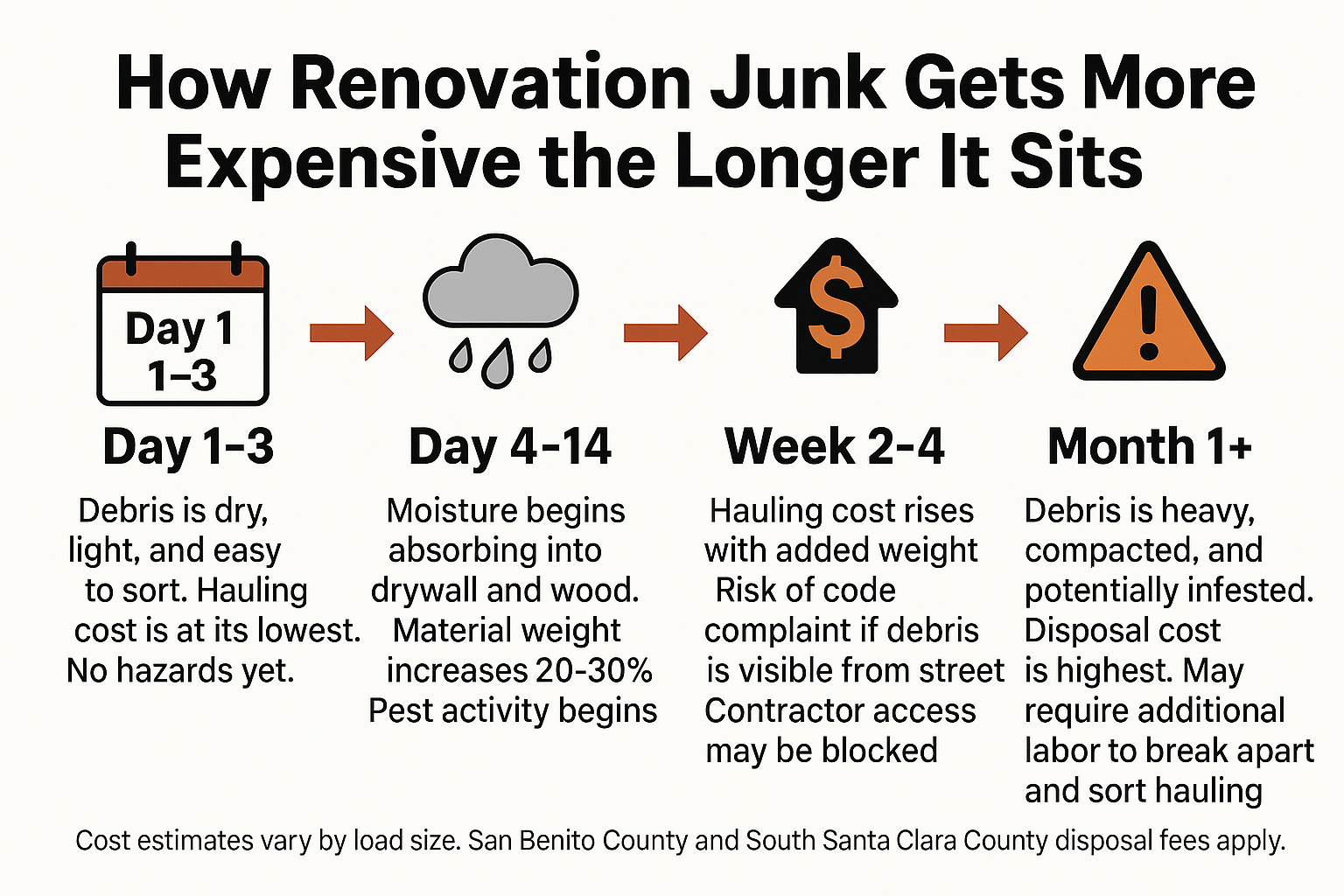
How Renovation Junk Gets More Expensive the Longer It Sits
This timeline shows what actually changes — practically and financially — as renovation debris sits from day one to month two.
Your Two Real Options — and When Each One Makes Sense
Once you’ve got renovation debris piling up, you’re choosing between two approaches: renting a dumpster or hiring a crew to haul it out. Both work. They’re not the right fit for the same situation.
A dumpster rental makes sense if:
- Your project is still ongoing and you’re generating debris over multiple days or weeks
- You want to sort and load material on your own schedule
- The debris is already broken down into manageable pieces
- You have a flat, accessible spot on your property for a roll-off container
A junk removal crew makes more sense if:
- The renovation is done and the debris is a single load you want gone in one visit
- Material has gotten heavy, mixed, or hard to sort on your own
- You don’t have a clear spot for a dumpster, or you’re worried about driveway damage
- You’re a landlord or property manager who needs the space cleared before a tenant walkthrough
For mixed loads after a remodel — old appliances, cabinet boxes, tile debris, and framing scraps all in one pile — a crew is usually the faster and cleaner option. You don’t pay for rental days you don’t use, and the job is done in a few hours rather than stretched across a week. When a junk removal crew makes more sense than a dumpster breaks this down in more detail if you’re still weighing it.
For larger projects — full gut remodels, multi-room renovations, or contractor jobs in Gilroy or Hollister where debris is ongoing — a dumpster keeps things cleaner throughout the project. What is a roll-off dumpster and how it works is a good starting point if you haven’t rented one before.
Dumpster Rental vs. Junk Removal Crew: Quick Comparison
Neither option is universally better — it depends on your timeline, your load, and your access. Here’s how they stack up for typical renovation cleanouts in the Hollister and Gilroy area.
| Factor | Dumpster Rental | Junk Removal Crew |
|---|---|---|
| Best for | Ongoing projects, multi-day debris | Single-session post-reno cleanout |
| Typical cost (local) | $350–$550 for 10-15 yard | $250–$600 depending on volume |
| Labor required | You load it yourself | Crew handles everything |
| Timeline | You set the pace | Done in hours, same or next day |
| Heavy/wet debris | Harder to load yourself | Crew handles weight and sorting |
| Driveway access needed | Yes — flat, clear drop zone | No — crew works around obstacles |
| Disposal handled | Hauler picks up when called | Included in service |
Where Does Renovation Debris Actually Go?
This is a question more people should ask before they hire anyone. Not all debris from a remodel ends up in the same place, and where it goes matters — both for environmental reasons and because it affects your cost.
In San Benito County, most non-recyclable construction debris is routed to the John Smith Road Landfill in Hollister. Recyclable materials — clean concrete, metal, cardboard — can often be diverted to recycling facilities, which reduces the overall landfill cost.
Some materials from a renovation are worth separating before hauling:
- Metal (old pipes, steel framing, aluminum window frames) — often accepted at scrap yards or recycled separately
- Clean concrete and masonry — can sometimes be diverted, which lowers disposal fees
- Wood framing — if unpainted and untreated, may be accepted at green waste or wood recycling facilities
- Appliances — need to be handled differently from general debris; many have refrigerant or other components that require separate processing
A good hauler will sort what can be diverted from what has to go to landfill. That separation isn’t just responsible — it can save you money on your final bill. Where construction debris actually goes after a remodel covers this process in detail if you want to understand exactly how disposal is handled.
Frequently Asked Questions About Renovation Debris Removal
How long can I legally leave renovation debris on my driveway or yard?
There’s no single statewide rule, but both Hollister and Gilroy have municipal codes that address visible debris and blight. The City of Gilroy Building Division can respond to neighbor complaints, and if debris is considered a nuisance or creates a safety hazard, you may receive a notice with a correction deadline. Two to four weeks is about the outer edge before complaints start becoming likely in residential neighborhoods. Don’t wait to find out where your city draws the line.
Does wet drywall cost more to haul away?
Yes, because weight directly affects hauling cost. Drywall absorbs moisture quickly when left outside, and a soaked load can weigh significantly more than the same material removed dry. If your debris has been sitting through any rain or fog — which is common in the Hollister and Gilroy area — expect the job to cost more than it would have the week after demo.
Can a hauler take everything from a renovation in one trip?
Usually, yes — for a standard single-room or small multi-room remodel. A full kitchen or bathroom gut, including old cabinets, tile, drywall, and fixtures, typically fits in one truck load. Larger whole-home renovations or multi-unit projects may require more than one haul. The easiest way to know is to describe your load when you call for a quote — a good hauler will give you a straight answer about what it takes.
What if some of my debris might have lead paint or asbestos?
This is important: standard junk removal and hauling services do not cover hazardous material abatement. If your home was built before 1978 and you’re demoing walls or disturbing old flooring, you need a licensed abatement contractor to assess and handle those materials before a hauler can take the rest. Don’t assume a hauler will sort that out on arrival — it’s a separate process with separate licensing requirements.
Is it cheaper to rent a dumpster than hire a crew for post-renovation cleanup?
It depends on your situation. For a single cleanout where the renovation is already done, a crew is often comparable in price — and you don’t pay for days you don’t use. Dumpsters make more financial sense when you need the container on-site for multiple days across an active project. Hidden fees in hauling is worth reading before you commit to either option.
How do I prepare for a hauling crew to come out?
You don’t need to sort or bag anything. But it does help to identify any items you want to keep before the crew arrives — once the truck is loaded, things don’t come back. If you have hazardous material mixed in (old paint cans, propane tanks, chemicals), set those aside and let the crew know upfront. Clear a path to the debris if possible. That’s it.
Ready to Get That Debris Off Your Property?
If renovation junk has been sitting longer than it should, MG Transportation & Hauling serves Hollister, Gilroy, and throughout San Benito County with straightforward hauling and no hidden fees. Call (831) 297-1972 or visit mgtransportationhauling.com/ to describe your load and get a quote — no pressure, just a straight answer on what it takes to get it done.
