

Direct Answer: A full property cleanout means a crew removes everything you want gone — furniture, appliances, debris, and junk — hauls it away, and leaves the space empty and broom-clean.
Most people asking this question are staring down a property that’s been sitting too long — a garage packed floor to ceiling, a rental unit a tenant left behind, or a family home that needs to be cleared before it hits the market. The situation is real, the timeline is usually tight, and the question “how does this actually work?” is completely fair.
A full property cleanout is not the same as a curbside junk pickup. We’re talking about a coordinated job that involves a crew, the right equipment, proper disposal routing, and a clear plan for what goes where. In the Hollister and Gilroy area, these jobs can range from a single-car garage to an entire estate — and they’re not all built the same.
This article walks through what actually happens during a cleanout, phase by phase. If you’ve never done this before, or if a past experience left you with more questions than answers, this is the breakdown worth reading.
The Assessment: What Gets Looked At Before a Single Item Moves
Before anything is loaded onto a truck, someone needs to understand the full scope of what they’re walking into. A real cleanout company — not a guy with a pickup — will do a walkthrough before pricing the job or booking a crew.
During that walkthrough, the goal is to answer a few specific questions:
- How much volume is there, measured in cubic yards or truck loads?
- What types of materials are present — furniture, appliances, construction debris, hazardous materials that can’t be taken?
- Is there anything with value — items worth donating, selling, or separating before disposal?
- Are there access issues — narrow hallways, stairs, locked rooms, or items too large to move without additional equipment?
In Hollister properties especially, older homes often have basements, detached outbuildings, or sheds that aren’t obvious until you’re standing in the backyard. Those spaces get factored into the estimate.
This walkthrough is also where pricing gets established. If you want to understand what drives the final number, what actually determines the price of junk removal comes down to volume, weight, labor time, and disposal fees — all of which get assessed at this stage.
Skip this step with any company, and you’re setting yourself up for a surprise bill at the end.

The Day of Service: What the Crew Actually Does
Once the job is scoped and scheduled, this is what a typical cleanout day looks like on the ground.
The crew arrives with a truck — sometimes multiple, depending on volume — and does a quick final walkthrough with whoever is on site. This confirms what’s going, what stays, and whether anything changed since the estimate.
Then the work starts. On a full cleanout, that means:
- Carrying items out room by room, starting with the largest and heaviest pieces first
- Breaking down or disassembling furniture that can’t fit through doorways whole
- Loading and sorting as they go — some materials get separated for donation or recycling, the rest get loaded for the landfill
- Sweeping or brooming out the space after all items are removed
For larger jobs in Hollister or Gilroy — a full hoarder house, a commercial property, an estate — this can take a full day or span across two days with a return trip. Anyone telling you a 3,000-square-foot hoarder house can be cleared in four hours is either underestimating the job or planning to cut corners.
If you’re weighing whether a crew makes more sense than a dumpster for your specific situation, when a junk removal crew makes more sense than a dumpster lays out exactly when each approach fits — and when it doesn’t.
Large, awkward items deserve a specific mention. Hot tubs, safes, pianos, riding mowers — these are the pieces that slow a job down if the crew isn’t prepared for them. Some items are genuinely harder to move than they look, and the right crew knows that going in.
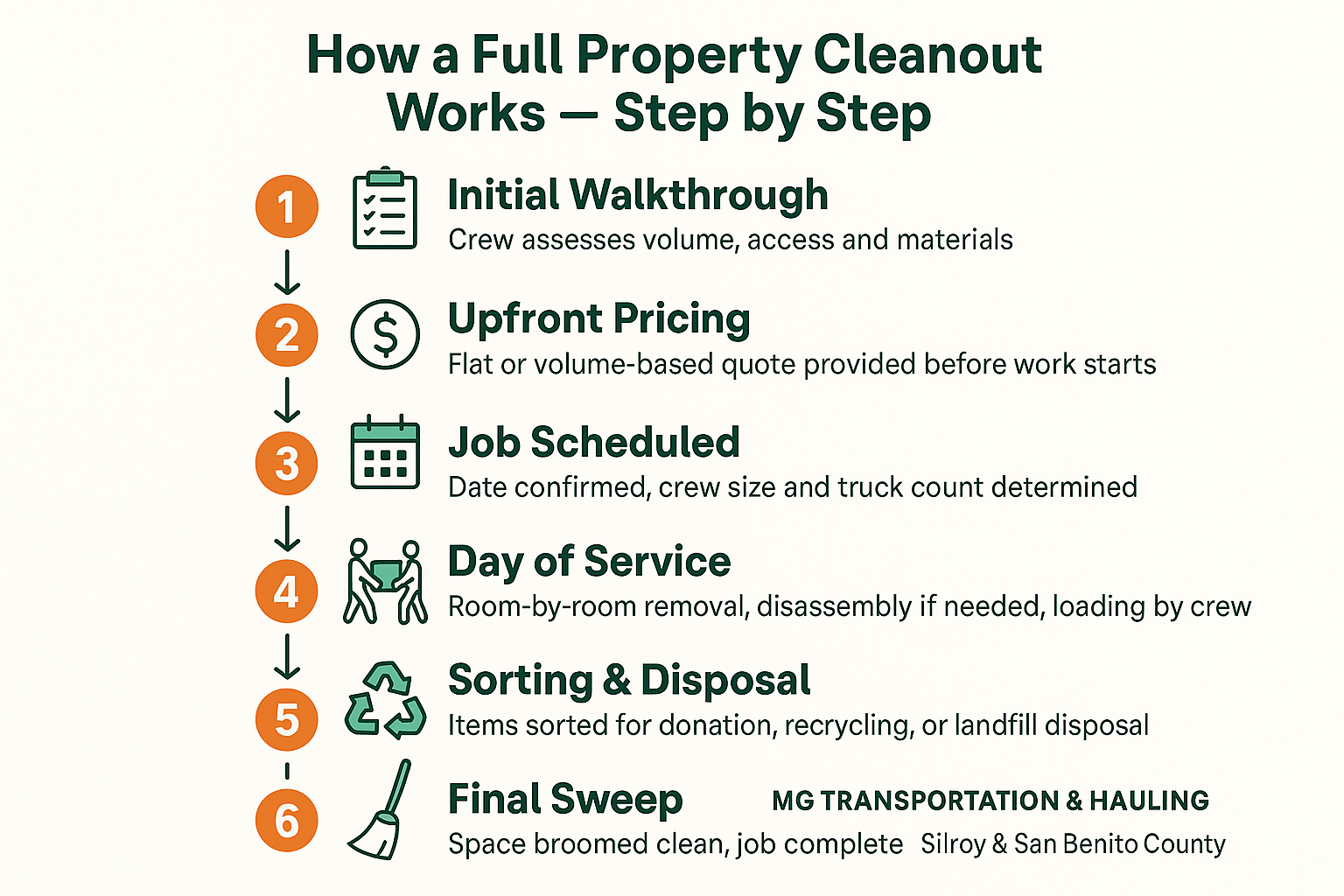
A Property Cleanout From Start to Finish
Here’s the full sequence of a property cleanout, from first call to empty space.
Where Everything Goes After It Leaves the Property
This is the question most people don’t think to ask — and it’s one of the most important ones.
Not all disposal is the same. A hauler who charges $200 less than everyone else is often cutting costs on the back end, which means your stuff ends up dumped illegally or in ways that could create liability for you if the load is traced back to the property address.
Here’s how responsible disposal actually breaks down:
- Landfill loads — General junk, broken furniture, and debris goes to a licensed facility. In this area, that typically means routing through San Benito County Integrated Waste Management’s transfer station or the John Smith Road Landfill for loads originating in Hollister. Gilroy loads often route through Recology South Valley.
- Donation runs — Usable furniture, clothing, and household goods get dropped at local organizations when items are still in acceptable condition. This requires a separate trip and adds time, but it keeps good items out of the landfill.
- Appliance and metal recycling — Washers, dryers, refrigerators, and metal scrap have recycling value. A crew that separates these is doing the job right.
- Electronics — TVs, monitors, and similar items require separate e-waste handling and can’t go into a standard landfill load.
It’s also worth knowing that landfill fees in California have gone up meaningfully in 2025 and 2026, which affects what cleanouts cost. What higher landfill fees mean for hauling in 2026 gives a clear breakdown of why prices have moved and what to expect.
If a company can’t tell you where your load is going, that’s a problem worth taking seriously.
Property Cleanout Types: What Each One Typically Involves
Cleanout jobs vary a lot depending on the property type and situation. Here’s a quick breakdown of what each typically looks like in terms of crew, time, and disposal complexity.
| Cleanout Type | Typical Crew Size | Avg. Time on Site | Disposal Complexity |
|---|---|---|---|
| Single garage | 1–2 people | 2–4 hours | Low — mostly landfill load |
| Full residential (empty home) | 2–3 people | 4–8 hours | Medium — appliances, furniture sorting |
| Estate cleanout | 3–4 people | 1–2 days | High — donation sorting, possible multiple loads |
| Hoarder house cleanout | 3–5 people | 1–3 days | High — volume, potential biohazard screening needed |
| Rental unit turnover | 2 people | 2–5 hours | Low to medium — depends on tenant left-behinds |
| Commercial property | 3–5 people | 1–2 days | High — debris, fixtures, possible demolition materials |
What You Should Do Before the Crew Shows Up
You don’t need to sort through everything or move a single item before we arrive — that’s literally the job. But a few things on your end will make the day run smoother and protect you from misunderstandings.
Walk the property yourself first. Identify anything you want to keep, and either move it to a separate room or mark it clearly. Once loading starts, the pace picks up fast. Pointing something out in the moment can get missed.
Know where documents and valuables are. Old filing cabinets, dresser drawers, and boxes in the back of closets can hold financial documents, photos, and jewelry. A good crew will flag anything that looks personal, but you shouldn’t rely on that as your safety net.
Be available or have someone on site. For any job larger than a single pickup, have a decision-maker present or reachable by phone. Questions come up — especially on estate cleanouts or hoarder situations — and having to wait for approval slows the whole job down.
If you’re dealing with an estate and wondering whether to try a sale before the cleanout, how to do an estate sale is a practical guide to that question. Sometimes a sale first makes sense. Sometimes it doesn’t. Worth understanding the tradeoffs before committing to either direction.
Frequently Asked Questions About Full Property Cleanouts
Do I need to be home during the cleanout?
You don’t have to be physically present the entire time, but someone needs to be reachable by phone and ideally on site at the start to confirm what goes and what stays. For larger jobs like estate cleanouts or hoarder houses, having someone present throughout is strongly recommended — decisions come up that can’t wait.
What can’t be removed during a cleanout?
Hazardous materials — including paint cans with liquid paint still in them, propane tanks, motor oil, pesticides, and asbestos-containing materials — can’t go into a standard cleanout load. These require separate handling through programs like the San Benito County Household Hazardous Waste program. A responsible hauler will flag these items during the walkthrough rather than quietly leave them behind.
How is a full cleanout priced?
Most cleanouts are priced by volume (how much truck space the load takes up) combined with estimated labor time. Some companies charge a flat rate for the full job after a walkthrough. What you want to avoid is hourly-only pricing with no cap — that’s where surprise bills come from. Hidden fees in hauling covers the specific things to ask before you book.
How long does a full property cleanout take?
A single-car garage takes 2–4 hours. A full house with furniture takes a full day. A hoarder situation or large estate can run 2–3 days depending on volume and access. The walkthrough estimate will give you a realistic timeline before the job starts.
Will the crew take everything, or are there things they’ll leave behind?
A full-service cleanout crew takes everything you flag as going — furniture, appliances, mattresses, boxes, yard equipment, debris. The exceptions are hazardous materials as noted above. If you have items like a hot tub or a non-running vehicle on the property, those can typically be handled but may be quoted separately since they require different equipment or towing.
What’s the difference between a cleanout and regular junk removal?
Regular junk removal is usually a few items — a couch, a pile of boxes, an old appliance. A property cleanout means clearing an entire space, often room by room, with a larger crew and multiple loads. The logistics, crew size, and time involved are meaningfully different. Full-service junk removal for large cleanouts goes deeper on what separates a small pickup job from a full property operation.
Ready to Get a Clear Picture of What Your Cleanout Involves?
If you’re dealing with a property in Hollister, Gilroy, or anywhere in San Benito County, MG Transportation & Hauling handles full property cleanouts from the walkthrough through the final sweep — no hidden fees, no vague estimates. Call (831) 297-1972 or visit mgtransportationhauling.com/ to tell us what you’re working with and get a straightforward quote.
