
Quick Answer
To dispose of old bed pieces the right way, start by stripping the bedding, checking the mattress and frame for damage or bugs, and taking the frame apart if you can. After that, your main options are donation if it’s clean and usable, mattress recycling, local bulk pickup, self-hauling to a disposal site, or hiring a junk removal crew to handle the lifting and drop-off.
That Old Bed Has to Go Now What
You’ve got a mattress leaning against the wall, a frame taking up half the room, and no easy way to move any of it. If you’re trying to figure out how to dispose of old bed pieces without making a bigger mess of your day, the key is to separate what might be reusable from what needs to be hauled off.
Start with an honest condition check. If the mattress is clean, structurally sound, and still fairly recent, it may be worth looking over some poor sleep mattress indicators before you decide whether to keep it, donate it, or replace it. In Hollister, Gilroy, and nearby areas, the right disposal option usually comes down to three things: condition, local rules, and whether you have the vehicle and help to move it safely.
A bed is easy to ignore until move-out day, cleanup day, or the new mattress delivery window is suddenly tomorrow.
First Steps Preparing Your Bed for Disposal
Before you call anybody or load anything, prep the bed properly. That saves time, prevents damage to walls and floors, and gives you a realistic idea of whether the bed can be donated, recycled, or only disposed of.
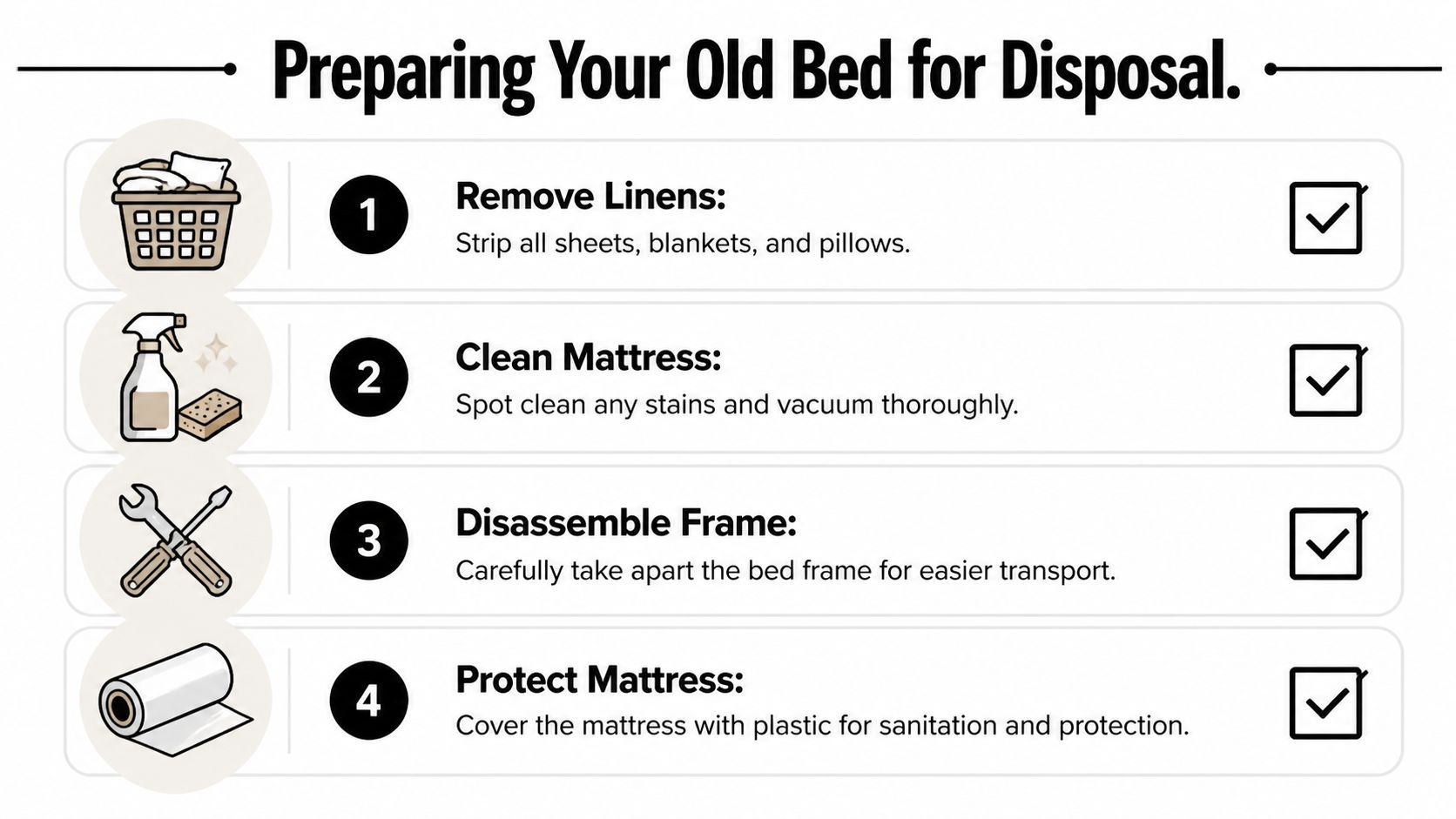
Strip it down before you move it
Remove sheets, pillows, toppers, and anything stored underneath the bed. Vacuum off dust and loose debris so you’re not carrying dirt through the house.
If the mattress has an odor issue, deal with that before you try to donate it or transport it indoors anywhere else. Basic cleaning helps, but if there’s a deeper smell problem, these solutions for mattress urine odor are useful for deciding whether cleanup is realistic or whether disposal makes more sense.
Check for stains, pests, and damage
This part matters more than people think. A stained or torn mattress usually won’t qualify for donation, and visible pest issues can shut down donation, recycling, or pickup options fast.
Look closely at seams, corners, handles, and the underside. Check the frame too, especially wood joints, slats, and fabric headboards where bugs or mildew can hide.
Practical rule: If you wouldn’t feel right handing the mattress to a family member, don’t list it as “good condition.”
Take the frame apart the smart way
Most frames are much easier to remove in pieces. Start by removing slats and support beams, then unscrew bolts and joints with the right hand tools. Keep hardware in a zip bag even if you think you’re done with the frame. Loose bolts rolling around in a truck bed or driveway are a pain.
If you need a closer walkthrough, this guide on how to take apart a metal bed frame is worth following step by step.
The one prep step that gets skipped most is bundling the frame parts once they’re apart. According to Junk King’s bed disposal guidance, using ratchet straps to bundle parts can reduce volume by 70%, increase municipal bulk pickup acceptance from 50% to 95%, and non-disassembled frames are rejected over 65% of the time.
- Bag the hardware: Tape the bag to the headboard or keep it in a toolbox.
- Bundle rails and slats: Ratchet straps work better than loose rope.
- Wrap sharp corners if needed: Old towels or cardboard help protect walls.
- Cover the mattress if required: Some pickup programs and disposal sites want it bagged or wrapped.
Can Someone Else Use It Donation and Resale Options
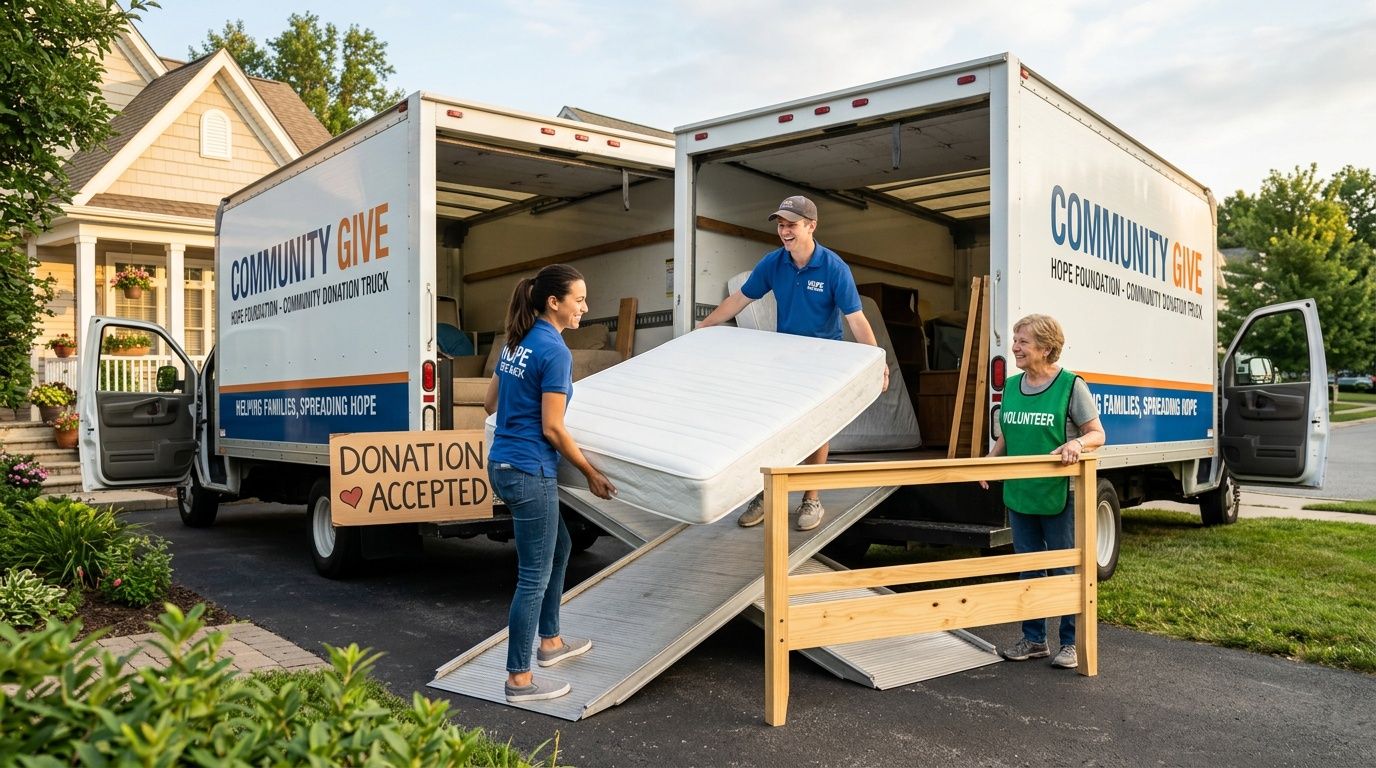
Donation sounds simple until you start calling around. In practice, bed frames are far easier to donate than mattresses.
What usually qualifies
A solid wood or metal frame with all its parts still present has a decent chance. Headboards, footboards, slats, and side rails need to be intact, not split, bent, or missing connectors.
Mattresses are a different story. A lot of organizations either won’t accept them at all or will only take them if they’re very clean, newer, and free of stains, smells, tears, and pest concerns.
Resale works better for some beds than donation
If the bed set is modern, clean, and complete, local marketplace listings can move it faster than waiting on donation approval. Good photos, exact dimensions, and honest condition notes matter. “Used guest room bed, no stains, includes all hardware” gets better responses than a vague listing.
For estate situations, donation and resale often overlap with larger property decisions. If you’re sorting furniture during a family cleanout, this article on how to do an estate sale can help you decide what should be sold, donated, or hauled away.
Quick reality check before you offer it to someone
Use this checklist:
| Item | Usually worth donating or selling | Usually headed for disposal |
|---|---|---|
| Mattress | Clean, no tears, no odor, no bug signs | Stained, sagging, torn, or unsanitary |
| Box spring | Structurally sound, clean cover | Broken frame, ripped fabric |
| Metal frame | Straight rails, all bolts present | Bent sections, missing hardware |
| Wood bed | Tight joints, no cracks | Split wood, loose joints, water damage |
If you’re already apologizing for the condition when you describe it, disposal is probably the honest route.
Responsible Disposal Mattress Recycling and Landfill Rules
When a bed can’t be reused, the next question is whether it can be recycled. For mattresses, that matters a lot because they take up a huge amount of space once they hit the waste stream.
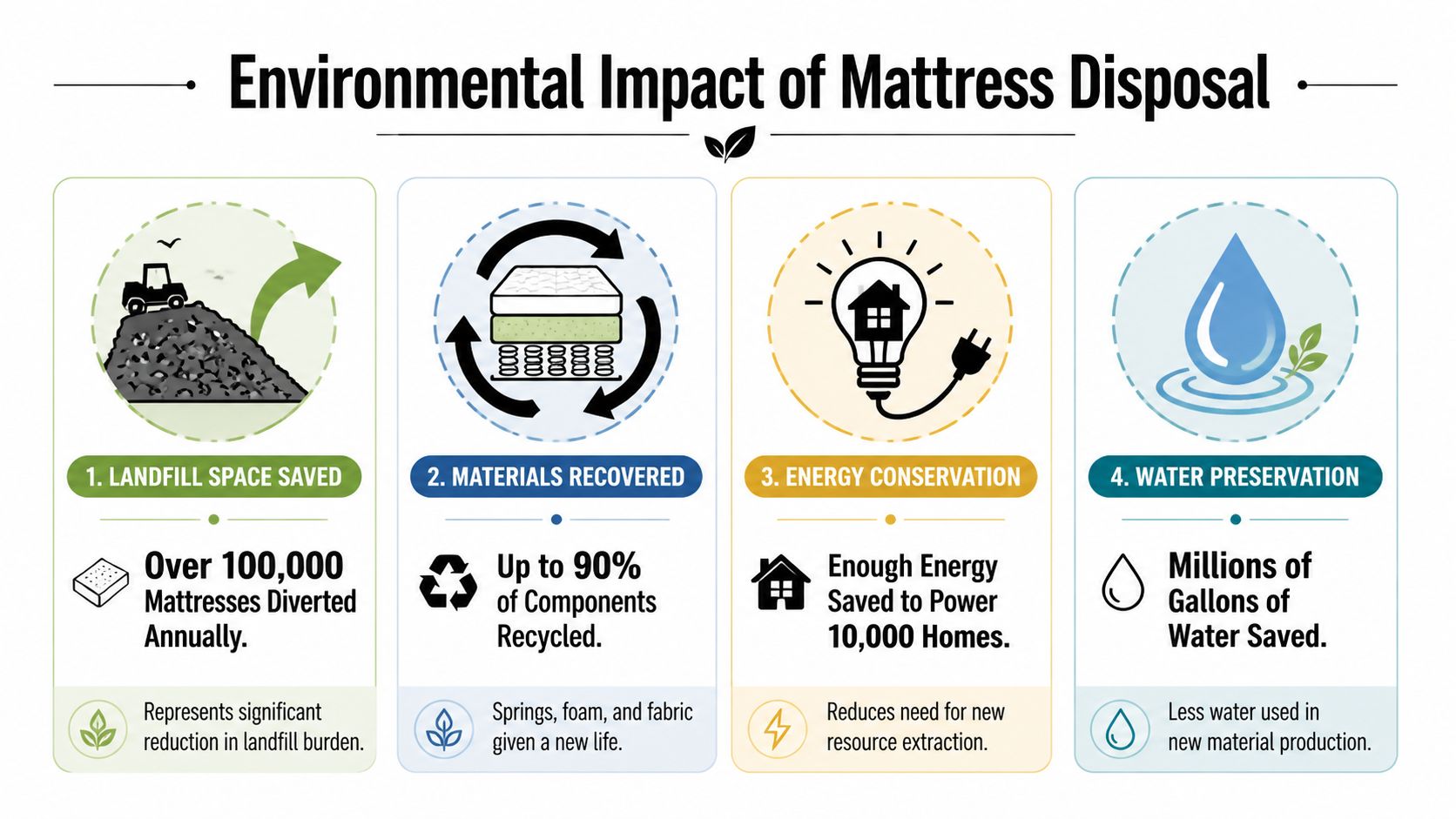
In the United States, about 18 to 20 million mattresses are discarded each year, roughly 50,000 per day, and 75 to 80% end up in landfills, taking up an estimated 750 to 800 million cubic feet of landfill space annually, according to Sharetown’s mattress waste overview. The same source notes that only 5 to 10% are recycled nationwide, even though recycling can recover a large share of the materials.
Why recycling is worth checking first
A mattress isn’t just trash. Steel, foam, wood, and fabric all have reuse potential when they go to the right facility.
The strongest example is California’s mattress recycling system. The Mattress Recycling Council reports that since the first state programs began in 2015, it has recycled over 15 million mattresses. In program states like California, up to 75% of an innerspring mattress’s contents can be recovered and reused.
If you’re also dealing with the foundation, this page on box spring recycling is useful because box springs often get handled a little differently than mattresses at drop-off and recycling sites.
What works and what doesn’t at disposal sites
A whole mattress is awkward to load, awkward to unload, and sometimes awkward to get accepted if it’s filthy or not wrapped as required. A bed frame that hasn’t been broken down can be even more annoying because it chews up space in a truck and may not fit cleanly through a scale line or unloading area.
Landfill disposal is still sometimes the fallback, especially for contaminated mattresses or broken mixed-material furniture. But it’s usually the least efficient option. You’re paying in time, effort, and vehicle space, and you may still need to meet local prep rules before they’ll take it.
- Recycling works best for: Innerspring mattresses, box springs, and cleaner loads.
- Landfill is often the fallback for: Wet, heavily stained, infested, or badly damaged items.
- Frames do better when separated by material: Metal with metal, wood with wood, upholstered parts apart if possible.
A mattress that’s clean and handled early has more options. One that sits outside in the weather for a week usually doesn’t.
Getting It Gone Comparing Local Disposal Methods
You’ve got the mattress halfway down the hall, the frame is still bolted together, and now the core question hits. Who is going to take this thing?
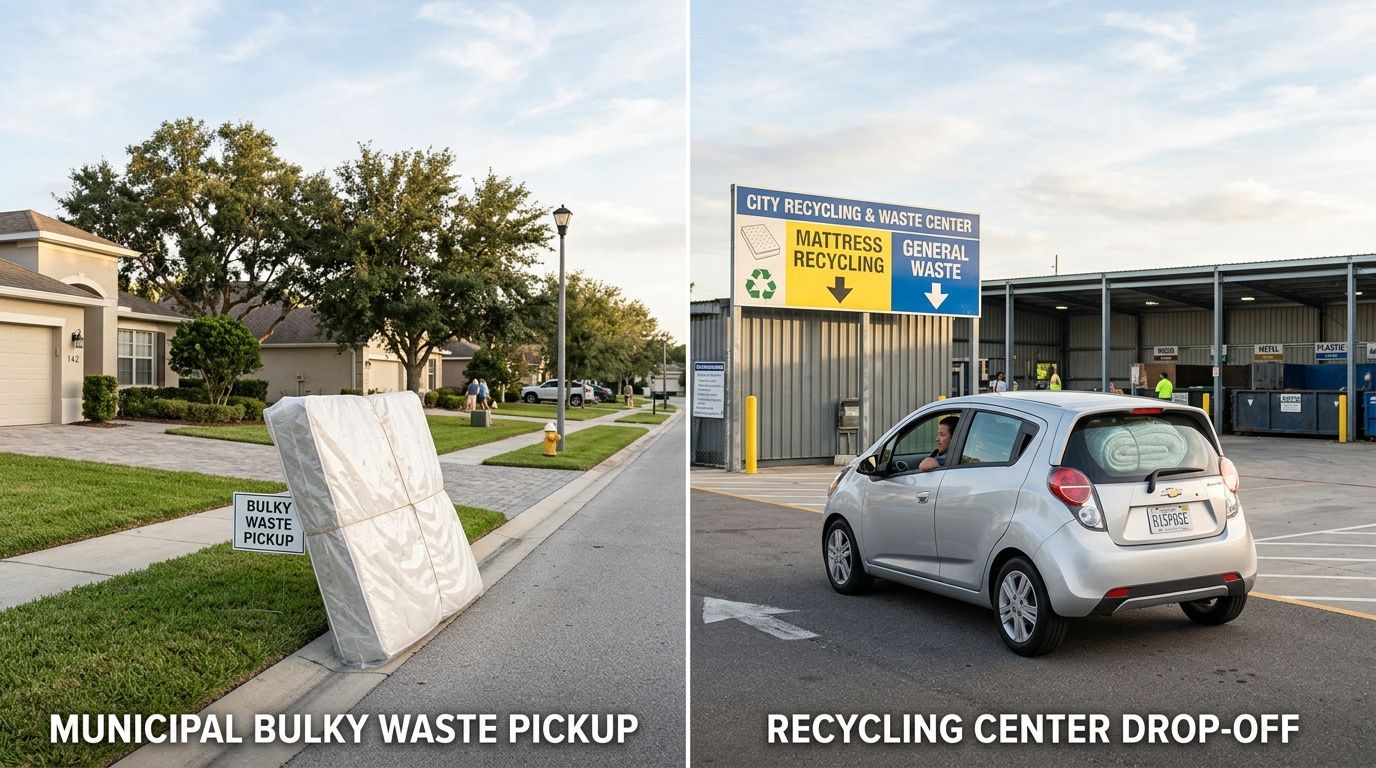
Around Hollister, Gilroy, San Benito County, and South Santa Clara County, the usual choices are curbside bulky pickup, self-hauling, or paying a crew to remove it from the house. Each one works. Each one also has a catch.
Curbside bulk pickup
Curbside pickup is the cheapest path if your local service allows it and you can work on their schedule. It usually makes sense for a straightforward mattress set that you can move out yourself without tearing up walls, dragging dirt through the house, or blocking the driveway for days.
The problem is access and timing. In older Hollister and Gilroy neighborhoods, I see plenty of narrow side yards, tight porch steps, and second-floor bedrooms that make “just put it at the curb” a bigger job than people expect. If pickup is a week out, that bed has to sit somewhere in the meantime.
This option fits best when:
- the bed is already broken down
- you have help getting it outside
- the pickup rules are clear
- you can wait for the scheduled date
Self-hauling to a recycling or disposal site
Self-hauling gives you control. If you want it gone today, that matters.
It also gives you all the hard parts. You need a vehicle that can carry a mattress without it folding, catching wind, or hanging out unsafely. You need straps, gloves, and enough room to load the frame pieces without damaging the truck bed or interior. Then you still have to unload it at the site.
For one clean mattress and a simple metal frame, self-haul can be a reasonable Saturday job. For a king mattress, a box spring, and a wood headboard from an upstairs room, it turns into a lot of lifting for one disposal run.
Full-service junk removal
Full-service removal costs more than doing it yourself, but it solves the part that causes the most trouble. Getting a bulky bed out of the home without injuring yourself or scraping up the property.
That is usually the practical choice for upstairs removals, heavier adjustable bases, damaged bed sets, or situations where the mattress is only one item in a bigger cleanout. MG Transportation & Hauling LLC is one local example of a crew that handles lifting, loading, and haul-away in one stop.
I usually tell neighbors to look at the whole job, not just the disposal fee. If you have to borrow a truck, buy straps, make a dump run, and ask a friend to help wrestle a floppy queen mattress down a stairwell, the cheap option stops feeling cheap pretty fast.
If the bed is part of a larger cleanup
Sometimes the bed is just one piece of the mess. Garage cleanouts, move-outs, remodel debris, and rental turnovers are different jobs than single-item removal.
In those cases, a truck crew may still be the right call, but sometimes a container on-site makes more sense if you’re clearing things over a few days. This guide on what a roll-off dumpster is used for helps explain when that setup fits better than a one-time pickup.
- Choose curbside pickup if: you can meet the local rules and get everything out to the street yourself.
- Choose self-haul if: you have the right vehicle, enough help, and want full control over timing.
- Choose full-service removal if: the bed is awkward, heavy, upstairs, dirty, or tied to a larger property cleanup.
Frequently Asked Questions About Bed Disposal
Can I put an old mattress on the curb?
Only if your local waste service allows it. Some areas require a scheduled bulky-item pickup, and some require the mattress to be wrapped before it goes out. If you skip the rules, it may sit there untouched.
Will anyone take just the bed frame?
Yes, that’s often easier than dealing with a mattress. Metal and wood frames in decent shape may be donated, sold, or hauled away with far fewer restrictions than upholstered sleep surfaces.
What if the mattress has stains or smells?
That usually rules out donation. Recycling or disposal may still be possible, but condition matters, especially if there are signs of contamination, mold, or pests.
Do I need to take the frame apart first?
Not always, but it helps a lot. A disassembled frame is easier to carry through the house, easier to stack in a truck, and more likely to be accepted for pickup or disposal.
What should I do with the box spring?
Treat it as its own item. Don’t assume it will be accepted under the same rules as the mattress, and check whether the disposal site or pickup service wants it wrapped, separated, or broken down first.
How long does bed removal usually take?
For a simple pickup, the actual lifting part is often quick once access is clear. The slow part is usually the prep, moving other furniture out of the way, and making sure the path out of the home is safe.
Let Us Handle the Heavy Lifting
If you’ve read through the options, you’ve probably noticed that how to dispose of old bed the easy way depends on how much lifting, disassembly, and driving you want to do yourself. If you’d rather skip that part, a local hauling crew can remove the bed from the room, load it, and take it where it needs to go. For bigger cleanouts, this overview of full-service junk removal for large cleanouts gives a clear picture of what that process looks like.
If you need help removing an old bed in Hollister, Gilroy, San Benito County, or South Santa Clara County, contact MG Transportation & Hauling LLC for a straightforward estimate or to schedule a pickup. Call (831) 297-1972, or visit 1550 South St, Suite 102, Hollister, CA 95023.
